%22%3E%0A%3Cpath%20d%3D%22M-0.00012207%2027.4428L4.82746%2021.6883C7.76264%2023.9283%2011.1226%2024.8552%2014.2702%2024.8552C15.8923%2024.8552%2016.5875%2024.4303%2016.5875%2023.6965V23.6193C16.5875%2022.8469%2015.7378%2022.4221%2012.8413%2021.8428C6.77781%2020.6069%201.46746%2018.869%201.46746%2013.1724V13.0952C1.46746%207.95862%205.48401%204%2012.9185%204C18.1323%204%2021.975%205.23586%2025.1033%207.70759L20.7006%2013.8097C18.1516%2011.9559%2015.1006%2011.1448%2012.6095%2011.1448C11.2578%2011.1448%2010.6399%2011.6083%2010.6399%2012.2648V12.3421C10.6399%2013.0759%2011.3737%2013.5393%2014.2316%2014.08C21.1447%2015.3545%2025.7599%2017.3628%2025.7599%2022.789V22.8662C25.7599%2028.5434%2021.0868%2032%2013.8454%2032C8.36126%2032%203.43712%2030.4552%20-0.00012207%2027.4428Z%22%20fill%3D%22white%22%2F%3E%0A%3Cpath%20d%3D%22M26.9569%2021.0702V20.9929C26.9569%2014.6978%2031.4755%209.9281%2037.79%209.9281C45.2824%209.9281%2048.739%2015.1419%2048.739%2021.5336C48.739%2021.9971%2048.739%2022.5378%2048.7004%2023.0012H35.1638C35.7817%2024.855%2037.2493%2025.8205%2039.1417%2025.8205C40.7252%2025.8205%2042.0383%2025.0867%2043.4286%2023.6578L48.1404%2027.404C46.0548%2030.1074%2043.081%2031.9998%2038.5431%2031.9998C31.63%2031.9998%2026.9762%2027.6357%2026.9762%2021.0895L26.9569%2021.0702ZM40.7638%2019.1391C40.5707%2017.1309%2039.3735%2015.9722%2037.8286%2015.9722C36.2838%2015.9722%2035.3183%2017.2081%2035.0479%2019.1391H40.7638Z%22%20fill%3D%22white%22%2F%3E%0A%3Cpath%20d%3D%22M50.6707%2010.4298H59.4182V14.678C60.6155%2011.8201%2062.5465%209.9663%2066.0224%2010.1208V19.4091H65.0955C61.3879%2019.4091%2059.4182%2021.456%2059.4182%2026.1291V31.4973H50.6707V10.4298Z%22%20fill%3D%22white%22%2F%3E%0A%3Cpath%20d%3D%22M66.2151%2010.4296H75.3875L78.7861%2020.9923L82.2234%2010.4296H91.2799L82.7447%2031.6516H74.7309L66.2151%2010.4296Z%22%20fill%3D%22white%22%2F%3E%0A%3Cpath%20d%3D%22M90.5847%2021.0702V20.9929C90.5847%2014.6978%2095.1033%209.9281%20101.418%209.9281C108.91%209.9281%20112.367%2015.1419%20112.367%2021.5336C112.367%2021.9971%20112.367%2022.5378%20112.328%2023.0012H98.7916C99.4095%2024.855%20100.877%2025.8205%20102.77%2025.8205C104.353%2025.8205%20105.666%2025.0867%20107.056%2023.6578L111.768%2027.404C109.683%2030.1074%20106.709%2031.9998%20102.171%2031.9998C95.2578%2031.9998%2090.604%2027.6357%2090.604%2021.0895L90.5847%2021.0702ZM104.392%2019.1391C104.199%2017.1309%20103.001%2015.9722%20101.456%2015.9722C99.9116%2015.9722%2098.9461%2017.2081%2098.6757%2019.1391H104.392Z%22%20fill%3D%22white%22%2F%3E%0A%3Cpath%20fill-rule%3D%22evenodd%22%20clip-rule%3D%22evenodd%22%20d%3D%22M122.368%204.36764C128.191%20-1.45588%20137.632%20-1.45588%20143.456%204.36764C149.279%2010.1912%20149.279%2019.6324%20143.456%2025.4559L132.912%2036L122.368%2025.4559C116.544%2019.6324%20116.544%2010.1912%20122.368%204.36764ZM125.009%207.55761C124.948%207.86849%20124.916%208.39718%20124.916%209.14566V10.4189C124.916%2011.1832%20124.948%2011.7198%20125.013%2012.0267C125.078%2012.3317%20125.278%2012.6168%20125.617%2012.8762C125.956%2013.1376%20126.403%2013.3316%20126.958%2013.4623C127.512%2013.593%20128.1%2013.6584%20128.837%2013.6584C129.573%2013.6584%20130.217%2013.591%20130.769%2013.4524C131.322%2013.3158%20131.761%2013.1178%20132.086%2012.8604C132.411%2012.6029%20132.605%2012.3178%20132.666%2012.0069C132.728%2011.6961%20132.759%2011.1674%20132.759%2010.4189V9.14566C132.759%208.38134%20132.728%207.84473%20132.662%207.53781C132.597%207.23287%20132.397%206.94971%20132.058%206.68834C131.72%206.42696%20131.272%206.23291%20130.718%206.10223C130.163%205.97154%20129.536%205.90619%20128.839%205.90619C128.102%205.90619%20127.459%205.97352%20126.906%206.11213C126.352%206.24875%20125.914%206.44677%20125.589%206.70418C125.265%206.9616%20125.071%207.24673%20125.009%207.55761ZM130.276%2024.8638C133.876%2024.8638%20135.557%2024.2064%20135.557%2021.862V21.858V21.3155C135.557%2019.6581%20134.516%2018.971%20131.252%2018.3136C130.278%2018.1136%20129.908%2017.9136%20129.908%2017.3136V16.9414C129.908%2016.6543%20130.177%2016.5117%20130.413%2016.5117C130.749%2016.5117%20130.918%2016.7137%20130.918%2016.9414V18.1136H135.391V17.3988C135.391%2015.4563%20134.347%2014.4266%20130.177%2014.4266C127.15%2014.4266%20124.896%2015.3414%20124.896%2017.3711V17.7433C124.896%2019.5155%20125.805%2020.3155%20129.201%2021.0303C129.28%2021.0472%20129.355%2021.063%20129.427%2021.0781C130.329%2021.2674%20130.647%2021.3341%20130.647%2021.9174V22.2897C130.647%2022.6619%20130.546%2022.8045%20130.142%2022.8045C129.67%2022.8045%20129.637%2022.5471%20129.637%2022.262V21.2897H124.894V21.7471C124.894%2024.149%20126.476%2024.8638%20130.276%2024.8638ZM136.424%2024.5569H140.925V14.7355H136.424V24.5569ZM137.955%2013.5019H140.925V6.06064H138.092V9.411L136.193%206.06064H133.359V13.5019H136.193V10.1199L137.955%2013.5019ZM129.269%2012.152C129.204%2012.2688%20129.055%2012.3262%20128.825%2012.3262L128.827%2012.3282C128.604%2012.3282%20128.459%2012.2767%20128.398%2012.1758C128.336%2012.0748%20128.305%2011.8074%20128.305%2011.3758V7.90068C128.305%207.51852%20128.352%207.28684%20128.445%207.20962C128.538%207.13239%20128.675%207.09279%20128.851%207.09279C129.059%207.09279%20129.198%207.14031%20129.265%207.23734C129.332%207.33239%20129.366%207.55416%20129.366%207.90068V11.3203C129.366%2011.7579%20129.334%2012.0352%20129.269%2012.152Z%22%20fill%3D%22white%22%2F%3E%0A%3C%2Fg%3E%0A%3Cdefs%3E%0A%3CclipPath%20id%3D%22clip0_15160_920%22%3E%0A%3Crect%20width%3D%22148%22%20height%3D%2236%22%20fill%3D%22white%22%2F%3E%0A%3C%2FclipPath%3E%0A%3C%2Fdefs%3E%0A%3C%2Fsvg%3E%0A)
Fonseca and Sinner at Indian Wells Offers Glimpse of the Future
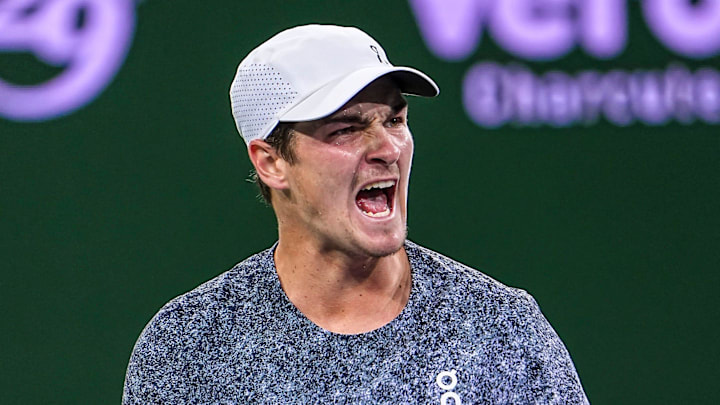
Since his breathtaking arrival as an ATP Tour match winner in February 2024, Joao Fonseca has carried the heavy mantle of being the young player most likely to challenge the current duopoly at the top of men's tennis.
Perhaps it was the manner in which he dismantled fellow rising young talent Arthur Fils to claim his debut ATP Tour match win on home soil at the Rio Open two years ago, or the fact that the then 17-year-old backed up this milestone by dispatching experienced Chilean clay-courter Cristian Garin in the very next round.
Regardless of the exact alchemy at play here, the effect was striking. Namely, to draw an utterly unanimous verdict across players, analysts, and followers of the sport. One that declared loudly, with little doubt, that Joao Fonseca was a future tennis great.
Fonseca's Arrival Brings Brazilian Exuberance
Across the course of the past two-and-a-bit seasons since then, Jannik Sinner and Carlos Alcaraz's stranglehold at the top of the game has only tightened further, with the pair now having claimed the past nine Grand Slam titles between them.
Of course, similar excitement to Fonseca's arrival accompanied Sinner and Alcaraz as they made their first waves on tour. Yet the young Brazilian's nascent emergence as a potential rising superpower feels different for two distinct reasons.
Firstly, the clamour that surrounded first Alcaraz and then Sinner's ascents was one defined by relief as much as anything else. An anxious, underlying sense of uncertainty defined 2022 - the year Roger Federer retired and Rafael Nadal's timeless exploits at the Australian Open and Roland-Garros quickly proved to be his final, glorious swansong - while Novak Djokovic was absent from two of the four majors.
Alcaraz's stunning surge in the spring of that year, culminating in his maiden Grand Slam title in New York several months later, was the gratefully received reassurance that life in the sport after the Big Three era would not just survive, but could flourish. In short, Sinner and Alcaraz were filling a vacuum. Fonseca, on the other hand, is providing a much-needed challenge to the new reigning superpowers.
Secondly, Fonseca is South American. As well as this providing a welcome injection of variety into a global sport whose biggest stars in recent years have largely been European, it also showcases a new and vibrant demographic of tennis fan - one that is more akin to a football crowd than the genteel deference of, say, the Wimbledon faithful.
The South Americans are truly wonderful sports fans - uniquely flamboyant, utterly passionate and unapologetically partisan. Brazilians, evidently, are no exception to the rule. In most places he plays, Fonseca draws disproportionately large crowds of exuberant, vocal support. This has added an extra layer of fervent, feverish delirium to the steady rise of a young man hailing from Rio de Janeiro. One that even the stratospheric fandom of Sinner and Alcaraz never quite equalled.
Fonseca Faces Seismic Test in Sinner Meeting
Fonseca is not the lone challenger to the new standing order, however.
While the former young pretenders of years gone by - such as Alexander Zverev and Stefanos Tsitsipas - appear to have missed their slim window in the overlapping crossover between the Big Three era and the present day 'Sincaraz' dominance, and Djokovic's extraordinary continued excellence is on an inevitable downward trajectory, the eyes of the tennis world have turned to those players following in the wake of the leading pair's ascent.
There are several contenders jostling for the leading position here. They include - among others - the talismanic American Ben Shelton, Great Britain's Jack Draper and the immensely gifted Czech, Jakub Mensik. Each is worthy of an article of their own, assessing their credentials and potential pitfalls.
Yet none of them, as yet, are set to take on either of the world's top two at this week's Masters 1000 tournament in Indian Wells. Fonseca, meanwhile, is due to meet Sinner for the very first time in an ATP Tour match when he takes on the Italian in the last 16 in the Californian desert on Tuesday.
Now 19 years old, the Brazilian has two ATP titles to his name as well as a Next Gen ATP Finals trophy to add to his early collection. Sinner, at the same age, had the exact same haul. Indeed, it was during his 20th year, back in 2021, that the Italian accelerated his success, claiming four titles in a season to transition from promising young talent into an established ATP threat.
Fonseca will be hoping for a similar trajectory across 2026. And there is no better place to start stamping some genuine authority on the elite than against the four-time Grand Slam champion at Indian Wells.
"I'm playing really well. I think I have the level," was the Brazilian's own assertion of his ability to disrupt the established order at the very top of the sport. "I'm playing really good. So, I mean, I think I can get there. It needs time, it needs to work mentally, physically and needs to work with the technique as well. There is a lot to improve, but I'm thinking I'm on the right path."
At such a tender age, Fonseca already appears to possess the diplomatic skills that are now a prerequisite for tennis players when facing the press. This was evident in his measured response when asked about the pressure of many deeming him to be the man to challenge Sinner and Alcaraz.
"I don't think I like or dislike," he explained in his most recent press conference at Indian Wells. "I just try to act like, try to do my things. If people say that the people think that I can be good stuff, that I can play some good tennis, that I can be there playing with Alcaraz and Sinner, and then I try to bring in a positive way, not as a pressure but as a privilege. I mean, people are saying this. So I have the game, I have the level."
Unique Indian Wells Conditions Could Prove Key
As much as a player of Sinner's calibre can ever look vulnerable, the opening two months of 2026 may be the most weakness the irrepressible Italian has shown over the past two years. His loss to Djokovic in the semi-finals in Melbourne will have bruised him, as was perhaps evident in his unexpected defeat to Mensik in Doha a couple of weeks later.
The Czech also showed that the rising stars pose a threat. It is now down to Fonseca to see if he can replicate that to deliver the biggest win of his own young career to date.
The other factor here is the capricious nature of the Californian desert. The conditions at Indian Wells can be notoriously treacherous, with firm-gripping courts often producing rally speeds closer to clay-court tennis than to hard. That will benefit Fonseca, who grew up honing his craft on the South American clay.
On the other hand, the thin, moisture-free air of the desert also rewards clean, big-hitters, which can complement Sinner's already devastating groundstrokes - as long as the wind does not become a complicating factor, as it so often can at this unique tournament.
In short, this should be a truly fascinating encounter. There will be many variables at play, and it will be intriguing to see just how close Fonseca can push Sinner, if at all, or if he can, in fact, best him.
Regardless of the outcome, however, one thing is already close to certain. That is, the tennis world is about to catch its seminal first glimpse of a future rivalry likely to define the sport for many years to come.
 Add us as a preferred source on Google
Jamie Malachy is a freelance tennis journalist, aiming to provide a unique, nuanced and informative analysis of the sport he loves. He has been documenting tennis since 2019, and writing professionally since 2023. Working in collaboration with Tennis Majors and numerous other sports news outlets, personal highlights include covering six Grand Slam singles finals and the 2024 Paris Olympic Games. You can reach him at: jamiemalachy@gmail.com
Follow JamieMalachy