%22%3E%0A%3Cpath%20d%3D%22M-0.00012207%2027.4428L4.82746%2021.6883C7.76264%2023.9283%2011.1226%2024.8552%2014.2702%2024.8552C15.8923%2024.8552%2016.5875%2024.4303%2016.5875%2023.6965V23.6193C16.5875%2022.8469%2015.7378%2022.4221%2012.8413%2021.8428C6.77781%2020.6069%201.46746%2018.869%201.46746%2013.1724V13.0952C1.46746%207.95862%205.48401%204%2012.9185%204C18.1323%204%2021.975%205.23586%2025.1033%207.70759L20.7006%2013.8097C18.1516%2011.9559%2015.1006%2011.1448%2012.6095%2011.1448C11.2578%2011.1448%2010.6399%2011.6083%2010.6399%2012.2648V12.3421C10.6399%2013.0759%2011.3737%2013.5393%2014.2316%2014.08C21.1447%2015.3545%2025.7599%2017.3628%2025.7599%2022.789V22.8662C25.7599%2028.5434%2021.0868%2032%2013.8454%2032C8.36126%2032%203.43712%2030.4552%20-0.00012207%2027.4428Z%22%20fill%3D%22white%22%2F%3E%0A%3Cpath%20d%3D%22M26.9569%2021.0702V20.9929C26.9569%2014.6978%2031.4755%209.9281%2037.79%209.9281C45.2824%209.9281%2048.739%2015.1419%2048.739%2021.5336C48.739%2021.9971%2048.739%2022.5378%2048.7004%2023.0012H35.1638C35.7817%2024.855%2037.2493%2025.8205%2039.1417%2025.8205C40.7252%2025.8205%2042.0383%2025.0867%2043.4286%2023.6578L48.1404%2027.404C46.0548%2030.1074%2043.081%2031.9998%2038.5431%2031.9998C31.63%2031.9998%2026.9762%2027.6357%2026.9762%2021.0895L26.9569%2021.0702ZM40.7638%2019.1391C40.5707%2017.1309%2039.3735%2015.9722%2037.8286%2015.9722C36.2838%2015.9722%2035.3183%2017.2081%2035.0479%2019.1391H40.7638Z%22%20fill%3D%22white%22%2F%3E%0A%3Cpath%20d%3D%22M50.6707%2010.4298H59.4182V14.678C60.6155%2011.8201%2062.5465%209.9663%2066.0224%2010.1208V19.4091H65.0955C61.3879%2019.4091%2059.4182%2021.456%2059.4182%2026.1291V31.4973H50.6707V10.4298Z%22%20fill%3D%22white%22%2F%3E%0A%3Cpath%20d%3D%22M66.2151%2010.4296H75.3875L78.7861%2020.9923L82.2234%2010.4296H91.2799L82.7447%2031.6516H74.7309L66.2151%2010.4296Z%22%20fill%3D%22white%22%2F%3E%0A%3Cpath%20d%3D%22M90.5847%2021.0702V20.9929C90.5847%2014.6978%2095.1033%209.9281%20101.418%209.9281C108.91%209.9281%20112.367%2015.1419%20112.367%2021.5336C112.367%2021.9971%20112.367%2022.5378%20112.328%2023.0012H98.7916C99.4095%2024.855%20100.877%2025.8205%20102.77%2025.8205C104.353%2025.8205%20105.666%2025.0867%20107.056%2023.6578L111.768%2027.404C109.683%2030.1074%20106.709%2031.9998%20102.171%2031.9998C95.2578%2031.9998%2090.604%2027.6357%2090.604%2021.0895L90.5847%2021.0702ZM104.392%2019.1391C104.199%2017.1309%20103.001%2015.9722%20101.456%2015.9722C99.9116%2015.9722%2098.9461%2017.2081%2098.6757%2019.1391H104.392Z%22%20fill%3D%22white%22%2F%3E%0A%3Cpath%20fill-rule%3D%22evenodd%22%20clip-rule%3D%22evenodd%22%20d%3D%22M122.368%204.36764C128.191%20-1.45588%20137.632%20-1.45588%20143.456%204.36764C149.279%2010.1912%20149.279%2019.6324%20143.456%2025.4559L132.912%2036L122.368%2025.4559C116.544%2019.6324%20116.544%2010.1912%20122.368%204.36764ZM125.009%207.55761C124.948%207.86849%20124.916%208.39718%20124.916%209.14566V10.4189C124.916%2011.1832%20124.948%2011.7198%20125.013%2012.0267C125.078%2012.3317%20125.278%2012.6168%20125.617%2012.8762C125.956%2013.1376%20126.403%2013.3316%20126.958%2013.4623C127.512%2013.593%20128.1%2013.6584%20128.837%2013.6584C129.573%2013.6584%20130.217%2013.591%20130.769%2013.4524C131.322%2013.3158%20131.761%2013.1178%20132.086%2012.8604C132.411%2012.6029%20132.605%2012.3178%20132.666%2012.0069C132.728%2011.6961%20132.759%2011.1674%20132.759%2010.4189V9.14566C132.759%208.38134%20132.728%207.84473%20132.662%207.53781C132.597%207.23287%20132.397%206.94971%20132.058%206.68834C131.72%206.42696%20131.272%206.23291%20130.718%206.10223C130.163%205.97154%20129.536%205.90619%20128.839%205.90619C128.102%205.90619%20127.459%205.97352%20126.906%206.11213C126.352%206.24875%20125.914%206.44677%20125.589%206.70418C125.265%206.9616%20125.071%207.24673%20125.009%207.55761ZM130.276%2024.8638C133.876%2024.8638%20135.557%2024.2064%20135.557%2021.862V21.858V21.3155C135.557%2019.6581%20134.516%2018.971%20131.252%2018.3136C130.278%2018.1136%20129.908%2017.9136%20129.908%2017.3136V16.9414C129.908%2016.6543%20130.177%2016.5117%20130.413%2016.5117C130.749%2016.5117%20130.918%2016.7137%20130.918%2016.9414V18.1136H135.391V17.3988C135.391%2015.4563%20134.347%2014.4266%20130.177%2014.4266C127.15%2014.4266%20124.896%2015.3414%20124.896%2017.3711V17.7433C124.896%2019.5155%20125.805%2020.3155%20129.201%2021.0303C129.28%2021.0472%20129.355%2021.063%20129.427%2021.0781C130.329%2021.2674%20130.647%2021.3341%20130.647%2021.9174V22.2897C130.647%2022.6619%20130.546%2022.8045%20130.142%2022.8045C129.67%2022.8045%20129.637%2022.5471%20129.637%2022.262V21.2897H124.894V21.7471C124.894%2024.149%20126.476%2024.8638%20130.276%2024.8638ZM136.424%2024.5569H140.925V14.7355H136.424V24.5569ZM137.955%2013.5019H140.925V6.06064H138.092V9.411L136.193%206.06064H133.359V13.5019H136.193V10.1199L137.955%2013.5019ZM129.269%2012.152C129.204%2012.2688%20129.055%2012.3262%20128.825%2012.3262L128.827%2012.3282C128.604%2012.3282%20128.459%2012.2767%20128.398%2012.1758C128.336%2012.0748%20128.305%2011.8074%20128.305%2011.3758V7.90068C128.305%207.51852%20128.352%207.28684%20128.445%207.20962C128.538%207.13239%20128.675%207.09279%20128.851%207.09279C129.059%207.09279%20129.198%207.14031%20129.265%207.23734C129.332%207.33239%20129.366%207.55416%20129.366%207.90068V11.3203C129.366%2011.7579%20129.334%2012.0352%20129.269%2012.152Z%22%20fill%3D%22white%22%2F%3E%0A%3C%2Fg%3E%0A%3Cdefs%3E%0A%3CclipPath%20id%3D%22clip0_15160_920%22%3E%0A%3Crect%20width%3D%22148%22%20height%3D%2236%22%20fill%3D%22white%22%2F%3E%0A%3C%2FclipPath%3E%0A%3C%2Fdefs%3E%0A%3C%2Fsvg%3E%0A)
Inside the 11-Year Design Process of HEAD's New Tennis Racket
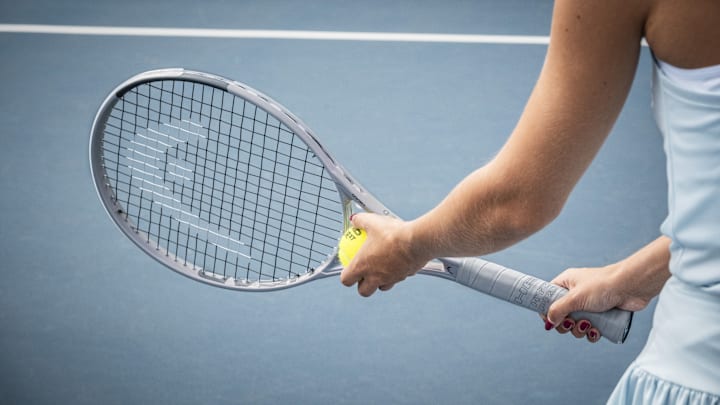
HEAD unveiled its latest innovative technology in the form of SQUARED, an innovative tennis racket using dual-tube architecture to separate power from comfort in a single frame.
The outer tube in the racket uses Torayca T800S carbon fiber for optimal stability, while a second, foam-filled Comfort Tube runs from the grip to the main string bed to absorb vibration and reduce arm strain. The technology combines the best aspects of comfort and power, limiting the need for athletes to choose between the two.
HEAD's technology aims to reduce the physical impact of a racket's swing on an athlete's arm, therefore reducing the risk of common tennis injuries such as arm soreness and wrist inflammation.
Sports Illustrated's Serve On SI sat down with Felix Schumann, Director of Product for HEAD USA and Canada, to discuss the 11-year process of developing SQUARED.

What is dual-tube technology, and how does it work?
We did reverse engineering where we figured out the problem with a lot of consumers is that they get arm issues and uncomfortable sensations from playing, especially beginner and intermediate players. Usually, when a tennis racket is created, there's one bigger tube that goes from the throat all the way to the top of the racket that gets molded in a heated compression system.
Here, we have still the outer tube going all the way, but then we also have a separate portion that goes all the way down to the handle, which is something pretty unique. That's the sensation for the player that's connecting to the yoke piece and therefore has less vibration in the end.
This racket has been 11 years in the making. What does the development process look like during that time?
One is understanding what is actually happening within the market because we have seen a shift, definitely from the early 2000s. People were really looking for control rackets. I would say between 2010 to 2020 was really more of a focus towards power rackets. Now, we see a shift more towards maneuverable rackets. So, [we need] something in between powerful and controllable.
Two, we work with tons of different vendors and come up with new ideas. We do have our own factory in China that we constantly work with on a daily basis, where we exchange new ideas, new materials, new stories.
Three is our R&D team. There's constantly ideas that are being played around just to get new ideas going and also try new things. A lot of things in tennis currently are repetitive, especially on the racket side. So, we really wanted to come up with something that is very unique to the market.

When you are in the development process, do you consult with doctors on how to use the technology to prevent injury?
Our team in Austria, the product team, and the R&D team work really closely with a few universities. When we were testing with all these beginners and intermediate players, people were having bad technique and, therefore, making bad contact.
The impact on your joints and your body was actually exponentially higher because there was not the right contact point. So, we came up with the balance idea because that helps people be more maneuverable and get the racket quicker around, so they can make contact in front of their body.
Who is SQUARED built for?
Since 2020, the participation numbers in tennis really have skyrocketed within the US. There's really three groups that we're targeting with Squared. One is the beginner player, either younger or also adult players that are getting into the sport.
Then, we also see a lot of returners, a lot of people that have played tennis 10-15 years ago. They were more playing with heavier rackets that were control-focused. Now, the innovation and the materials have gotten so good that lighter-weight rackets can be stable. That's a lot easier on the arms and the joints of the players.
Third category we really look at with this racket is coaches. Coaches spend 8-10 hours a day on the court, and they're feeding a ton. SQUARED is really amazing for that long hours on the court because, again, it really relieves your arm. It's easy to feed. It has a super light pickup feel, so it feels really comfortable in the hand of the coach.
How did you test the racket's durability and speed?
We did tests all around the U.S. on different surfaces within different weather climates. Usually there's two phases within the testing process. One is the on-court portion where we have completely blacked out rackets and people go through certain drills and test the rackets.
Then there's the interview process after, where we write down what the consumers are saying and just dig deep into a bunch of questions and really have consumers give us their honest feedback. And one portion that always came out there is what would you like to improve within the tennis industry or within your tennis game? And that was injury prevention.
You mentioned that this racket is heavily targeted towards the U.S. tennis community. Why does SQUARED fit in the U.S. more so than Europe?
We have seen such skyrocketing numbers within beginner and intermediate players within the U.S., and it's a little bit different in the U.S. versus Europe. For example, in Europe, you start playing within a tennis club. You take lessons immediately, whereas here in the U.S., we obviously have tons of public courts where people just go on to the court.
The technique is not as developed for a lot of beginners. Hence, the reason, again, we want to make it easier for that consumer to make better contact immediately with that racket, whereas maybe in Europe, they would be more versatile and have a racket that could be a little bit heavier on their end.
 Add us as a preferred source on Google
Megha Gupta is a multimedia journalist studying at Columbia University. She has a passion for exploring the intersections of fashion, culture, and sports, and previously covered the 2024 Paris Olympics at NBC Sports.
Follow 20meghaggupta