
How the NCAA’s New Eligibility Rule Proposal Could Impact College Softball
The NCAA is considering a major eligibility rule change, according to a report from Ross Dellenger of Yahoo.
An NCAA committee is set to meet in a few days to discuss new eligibility rules for student-athletes, which reportedly includes an age-based standard that would allow athletes five years of eligibility from the time of their 19th birthday or high school graduation, whichever comes first.
Another detail that Dellenger reported is that there would be no waivers, redshirts, or exceptions to the new rules except for a very small handful of circumstances (such as maternity leave, military service, or religious missions).
If approved, the rule could be implemented as soon as this fall.
The NCAA is exploring a significant change to its eligibility rule, per Yahoo Sports’ @RossDellenger.
— Yahoo Sports (@YahooSports) April 8, 2026
Next week, an NCAA committee will discuss a new age-based standard for athlete eligibility that would grant athletes five full years of eligibility from the time of their 19th… pic.twitter.com/PuxgKQnaEh
The news comes just days after President Donald Trump's executive order highlighted a five-year participation window for student-athletes to help bring more structure and stability to college sports.
Currently, student-athletes have four years of eligibility over a five-year calendar with the option to regain another year of play through a redshirt or waiver request.
The new proposal means student-athletes won't be able to regain a year through a redshirt or waiver. It also means fewer court cases, where student-athletes are suing the NCAA for extra eligibility.
How Would This Affect Softball?
The proposal is very black-and-white. Softball players could play up to five years in that window. As of now, they only have five years to play four seasons.
If the proposal passes, softball could see more players sticking around for an extra season. As of now, softball players can transfer without consequence. The executive order prevents that by limiting it to a one-time transfer before graduation and then they could transfer again after receiving their undergrad degree.
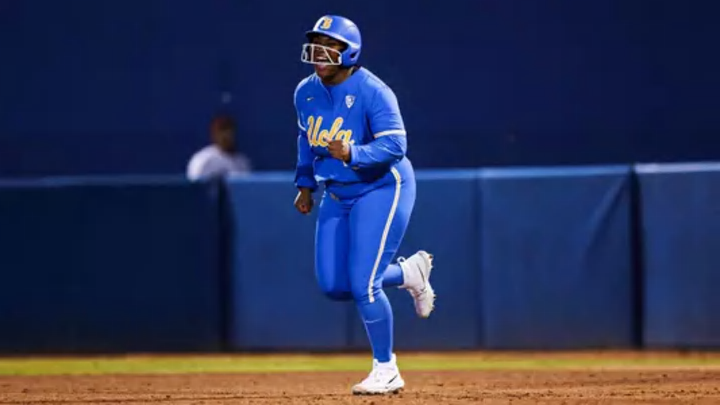
Think of it this way: former UCLA standout Aaliyah Jordan spent seven years on the Bruins' roster. She took a medical redshirt in 2017, her freshman year, for a knee injury and then earned another year of eligibility because of the COVID-19 pandemic in 2020. During what could have been her final season in 2022, she suffered an ACL tear after just eight starts, which earned her another medical redshirt and extra year of eligibility.
Jordan was 24 years old during her final season of college softball.
Updated numbers on the NCAA’s eligibility legal battles:
— Ross Dellenger (@RossDellenger) April 9, 2026
- 74 cases filed
- 34 NCAA injunction wins (does not include 14 voluntarily dismissed)
- 12 athlete injunction wins
- 14 still pending in lower courts https://t.co/E9eTmKrvXN
The new rule would put an end to careers like Jordan's after year five. In her case, she would just sit out her first year and then have four years to play four seasons.
The NCAA is fighting dozens of cases each year over eligibility, softball's Bre Warren just filed one to play at Virginia Tech this season.
Having a five-in-five window might be the most feasible path forward, and it would save the NCAA millions of dollars in legal fees. It would do away with post-grad student-athletes and completely get rid of sixth and seventh years of eligibility.
 Add us as a preferred source on Google
-1d7db99dccc9abef7b9378f016b22b68.webp "Maren Angus")
Maren Angus was born in Los Angeles and raised in Nashville, Tenn. She is a graduate of Middle Tennessee State University and has been a sports writer since 2008. She has been covering college softball since 2016 for various outlets including Softball America, ESPNW and Hurrdat Sports. She is currently the managing editor of Softball On SI and also serves as an analyst for Nebraska softball games on Nebraska Public Media and B1G+.