
Why WNBA Players Have a Point in CBA Standoff With League
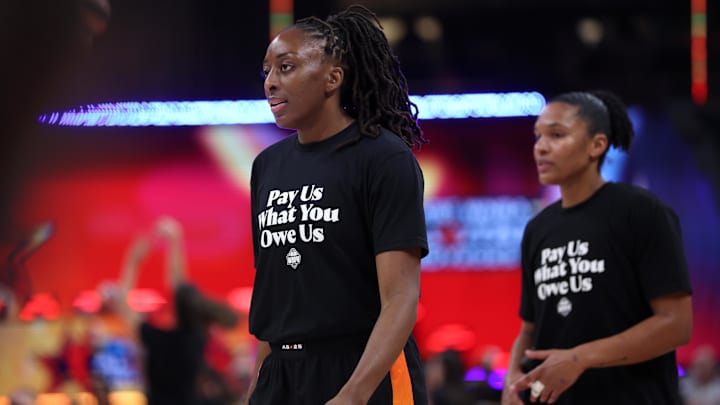
It’s crunch time for collective bargaining between the WNBA and the Players' Association as the two sides met Monday in hopes of getting closer to an agreement that would allow the season to transpire without delay.
The situation is complex with a number of issues on the table, but the biggest sticking point is the revenue share model, so let’s get into it.
The union has proposed the players receive a 30% share of the league’s gross revenue with an average player salary over $800,000.
The WNBA has proposed a share of 70% of net revenue, on average, over the course of the deal. But that equates to about 15% of total league revenue, so an average salary of about $530,000. Significant difference.
What does the league mean by net revenue? Unlike in accounting terms, which defines net revenue as “gross revenue minus returns, allowances and discounts” (as pointed out by economist David Berri), the league’s definition is essentially “revenue after subtracting expenses.”
Outlining the Argument for WNBA Players

There are a few reasons why it’s fair for players to ask for a share of gross revenue.
A typical business playbook pays wages out of gross revenue because employee compensation is considered a necessary operating expense.
Therefore a reasonable first question is: why should players be paid from a pie of net revenue when they have no say in how that pie is made, in other words, how the league budgets and spends its money, arriving at whatever’s left to pay players? This is what WNBPA Executive Director Terri Jackson was referring to last October when she said the league owners wanted to pay themselves back first.
Secondly - and this is key - this is not how it’s done with the WNBA players’ counterparts in the NBA. NBA players receive roughly a 50/50 split of Basketball Related Income or about 40 or so percent of gross revenue.
That brings up another question: why should WNBA players accept 15% when they know their male counterparts get 40?
And if you’re thinking, “Well the NBA makes more money,” here's why it's not that simple.
The NBA Set a Precedent for the Argument

In 1983, the NBA announced the salary cap system as we know it, which would take effect in the ‘84-'85 season, with NBA players receiving 53% of gross revenue consisting primarily of gate receipts and TV contracts. The projected revenue for that season was $175 million.
That’s less than the WNBA was projected to generate back in 2023 when they reportedly brought in $180-200 million. While this was just about double what they had made in 2019, showing the growth that was already happening, it was prior to the boom of the last two seasons in which the league saw massive increases in attendance and TV ratings, leading to soaring team valuations and a lucrative new media rights deal. (Shoutout to the Good Game with Sarah Spain podcast for sharing the connection between the two eras.)
By the way, David Stern became NBA commissioner in 1984 and was instrumental in enacting this system. So 30-plus years after Stern fought for the creation of the WNBA, his 43-year-old blueprint is providing an argument for why WNBA players deserve more today.
The WNBA's Gripe With the Union's Proposal

Of course, it’s not the job of the WNBA, its commissioner or its lawyers to help fix pay equity and the gender wage gap, it’s to get the league owners the best financial deal possible. However, it is their job to actively participate in these negotiations. Yet as of Monday, they had not formally responded to the players’ latest proposal submitted over a month ago, telling ESPN it wasn’t that different from the union’s past proposals and they were waiting for something more realistic. Also per Sports Business Journal, league sources believe they’ve acquiesced way more than the union. This elicits more thoughts and yes, more questions.
Perhaps the league’s proposals have evolved considerably more than the union side because the league started with an offer that was similar to the now-relic of 2020: revenue sharing that would only be triggered if certain targets were exceeded (why should it not be guaranteed as with NBA players?), base max salary around $850k (why should the best women’s basketball players in the world, given how mainstream they’ve become, not warrant seven figures?), and share of league office revenue only as opposed to league AND team revenue (again, when NBA players get a share of everything basketball related, why shouldn’t WNBA players)? These questions no longer apply as the WNBA has since made their proposed terms more attractive, including a base max salary over $1 million.
But this brings us back to the stalemate over gross versus net revenue. The WNBA is claiming it would lose $700 million over the course of the six year offer if it accepted the proposal where players get 30% of gross revenue, per multiple reports. That doesn't quite tell the whole story, as the league is not counting the $750 million in expansion fees it already received for franchises that are slated to start up in Cleveland, Detroit and Philadelphia through 2030.
Like the NBA, the WNBA does not factor expansion fees into the revenue to be shared with players, but here’s the next question: why is the W operating as though that money doesn’t contribute to the owners’ bottom lines? The answer to that one could be linked to the ownership structure in the WNBA.
But first, a quick note about NBA expansion fees. They are meant to provide immediate cash for existing owners, offsetting concerns about sharing future revenue. In regard to potential upcoming NBA expansion, Sportico outlined just last year: “Expansion fees are shared directly among owners – to offset the dilution of NBA-wide revenue.”
Now, back to the WNBA ownership structure. It was already unique in that 50% was owned by NBA owners and the other half by WNBA owners. Those percentages turned into 42% apiece when a $75 million capital raise sold 16% of the league to a large group of investors in 2022. This came on the heels of a 2020 season that had no fans and a 2021 season that had limited attendance following the COVID-19 pandemic, contributing to the league being valued around $470 million. Just three years later, a single WNBA franchise was valued at a higher amount.
Thus it’s not surprising that Front Office Sports reported the WNBA is exploring buying back that 16% stake, and that many still don’t believe the league can support the union’s proposed gross revenue model due to its ownership structure. But that doesn’t change the current state of affairs.
How Does the CBA Stalemate Get Resolved?

So the biggest question of all: how do the two sides in this negotiation come to an agreement?
And follow-ups: Does the league blink and propose a lower percentage of gross revenue? Would a higher percentage of net revenue be feasible with expenses already accounted for? Are there other perks the players would accept without sharing gross revenue? The hope, for everyone in the women’s basketball ecosystem, is those answers will reveal themselves very soon. And the answers may only suffice until the next CBA rolls around.
But just because the league has proposed substantially higher salaries than what WNBA players were paid previously, does not necessarily mean those salaries alone are reflective of the players’ worth in this moment and the near future. What would truly show they are valued, is graduating to a system their NBA counterparts have enjoyed for over four decades.
Recommended Reading:
 Add us as a preferred source on Google
Maria Marino is a sports commentator who can be seen sharing her passion for women's hoops on ESPN platforms. Previously she hosted the podcast "Buckets WNBA" for two seasons, in addition to hosting other programs on Action Network. She was also a full-time talent on SNY for nearly five years, hosting studio shows and reporting in the field, including for UConn women's basketball.
Follow mariacmarino