
What We Saw From Jaron-Keawe Sagapolutele in Return to Starting Lineup
In this story:
In his first starting assignment since returning from a concussion, Cal quarterback Jaron-Keawe Sagapolutele got straight-forward advice from new play-caller Pat McCann.
“Coach Pat, he came with a great game plan,” said Sagapolutele of his first meaningful snaps with McCann calling plays. “The one thing I really loved was just him telling me, trust myself. Be me.
“He believes that I can make plays, he had full faith in me. I really love Coach Pat. We came out with an aggressive mindset. We came attacking.”
For a half, anyway.

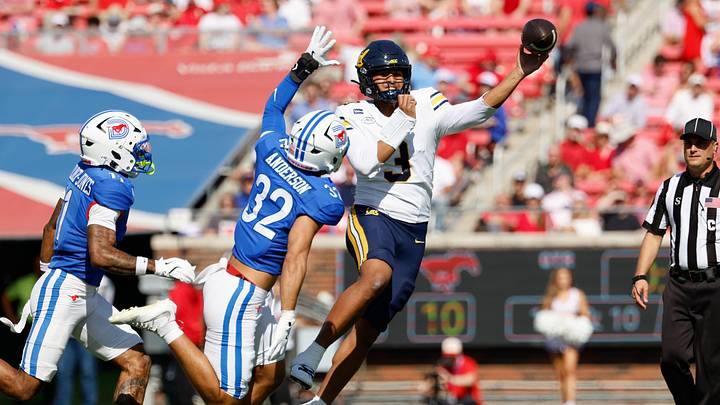
JKS was consistently on target in the first half at No. 23 SMU on Saturday. He completed 19 of 23 attempts for 214 yards, including a 10-yard touchdown pass to Chase Hendricks, as the Bears forged a 20-17 lead.
In the first half alone, he had completions of 28 yards to Chase Hendricks, 36 yards to Ian Strong and 26 yards to Taimane Purcell.
Given everything — the quality of opponent, the 9 a.m. PT kickoff on the road, the M*A*S*H status of the team’s offensive roster — it was the Bears’ best first-half performance of the season.
The second half was a different story. SMU outscored the Bears 42-0 the rest of the way — dominating on both sides of the line of scrimmage — to pocket a 59-20 victory.,
For Sagapolutele, who was knocked out action late in the first half of the Oct. 3 game at UNLV, it was an encouraging return. He came off the bench to play parts of the second half the week before in a 41-7 loss to Wake Forest and looked sharp, albeit against backups.
McCann kept SMU off balance for a half and coach Tosh Lupoi drafted reinforcements from the defense, giving safety Kingston Lopa snaps at wide receiver (1 catch, 11 yards) and cornerback Niles Davis at running back (4 rushes, 11 yards). Cal executed a fake field goal for a first down and tight end Mason Mini scored on a 1-yard sneak while lined up as a shotgun quarterback.
After all of that, none of it worked in the second half, when the Mustangs outgained Cal 306 yards to 50, out-rushed the Bears 182 yards to minus-1, and forged a 20-2 edge in first downs.
If nothing else, the game demonstrated that Sagapolutele can still be elite. Even without two starting offensive linemen, no run game and no depth at receiver, he was his old self.
Asked about coming back from the concussion, he said, “It was a long process, just going through a lot of procedures to get back. Thankful that Coach Tosh believed in me to come back and I was able to be back on the field.”
He lamented the Bears losing all momentum in the second half, although he gave SMU credit for defensive changes that made it more difficult to find targets downfield.
“We were rolling first half and just coming back out with the same mentality that we’re going to do the same thing. Continue that aggressiveness that we had,” he said of how things might have been different.
He passed for just 51 yards in the second half, finishing 27 for 37 for 265 yards with no turnovers. He was sacked twice in the second half, taking the blame for both.
In concussion protocol JKS sat out the Oct. 10 game against Virginia Tech — the week after UNLV — but said he benefitted from watching backup Jackson Brousseau play well in the Bears’ 25-20 victory.
“Jackson’s one heck of a player. He knows how to operate the offense, he can make throws,’ Sagapolutele said of the Colorado State transfer. “That was one thing that was great for me to just sit back and take my mental notes and see how the commands the offense, see how he moves the ball down the field.
"Especially that V-Tech game when he went out there and absolutely balled out. It was just a blessing to see.”
But this is Sagapolutele’s team, and he knows the Bears must play better than they did in the second half on Saturday.
Noting that the Bears, at 3-5 overall and 2-3 in the ACC, are in “a bit of a storm” right now, he acknowledged, “A lot of things to clean up, for sure.”
Follow Jeff Faraudo on Twitter, Facebook and Bluesky
 Add us as a preferred source on Google

Jeff Faraudo was a sports writer for Bay Area daily newspapers since he was 17 years old, and was the Oakland Tribune's Cal beat writer for 24 years. He covered eight Final Fours, four NBA Finals and four Summer Olympics.