%22%3E%0A%3Cpath%20d%3D%22M0%209.69043H5.34889V25.7008H0V9.69043Z%22%20fill%3D%22white%22%2F%3E%0A%3Cpath%20d%3D%22M7.18359%2013.2135H12.3781V14.948C13.1773%2013.9218%2014.4396%2012.9138%2016.2013%2012.9138C18.8349%2012.9138%2020.4786%2014.6483%2020.4786%2017.4636V25.7003H15.2841V19.1345C15.2841%2018.0629%2014.6393%2017.4454%2013.8674%2017.4454C13.0955%2017.4454%2012.3781%2018.0629%2012.3781%2019.1345V25.7003H7.18359V13.2135Z%22%20fill%3D%22white%22%2F%3E%0A%3Cpath%20d%3D%22M21.6587%2019.5434V19.498C21.6587%2015.5385%2024.038%2012.914%2026.9894%2012.914C28.8874%2012.914%2029.9408%2013.7404%2030.74%2014.6304V9H35.9345V25.7005H30.74V24.1658C29.8954%2025.083%2028.9328%2025.9911%2027.0348%2025.9911C24.0108%2025.9911%2021.6587%2023.3576%2021.6587%2019.5434ZM30.8581%2019.4798V19.4344C30.8581%2018.1994%2029.9681%2017.1913%2028.7784%2017.1913C27.5888%2017.1913%2026.6988%2018.1721%2026.6988%2019.4344V19.4798C26.6988%2020.7421%2027.5888%2021.7229%2028.7784%2021.7229C29.9681%2021.7229%2030.8581%2020.7421%2030.8581%2019.4798Z%22%20fill%3D%22white%22%2F%3E%0A%3Cpath%20d%3D%22M37.5337%209H42.9098V12.3147H37.5337V9ZM37.6245%2013.2137H42.819V25.7005H37.6245V13.2137Z%22%20fill%3D%22white%22%2F%3E%0A%3Cpath%20d%3D%22M44.0259%2022.1496V22.1042C44.0259%2019.6159%2045.8785%2018.2174%2048.7845%2018.2174C49.8379%2018.2174%2051.182%2018.4444%2051.7359%2018.6714V18.4626C51.7359%2017.3183%2051.0276%2016.6554%2049.4293%2016.6554C48.1488%2016.6554%2047.0772%2016.9278%2045.9784%2017.3637L45.0611%2013.9128C46.5051%2013.3679%2048.1488%2012.9956%2050.3192%2012.9956C52.862%2012.9956%2054.5057%2013.5223%2055.6046%2014.6212C56.5399%2015.5565%2056.9123%2016.7734%2056.9123%2018.5806V25.6913H51.7178V24.429C50.8459%2025.3644%2049.6835%2025.9819%2048.1306%2025.9819C45.7332%2025.9819%2044.035%2024.6106%2044.035%2022.1405L44.0259%2022.1496ZM51.7813%2021.078V20.5513C51.4816%2020.4332%2051.0276%2020.3424%2050.5917%2020.3424C49.5655%2020.3424%2048.9934%2020.9599%2048.9934%2021.7409V21.7863C48.9934%2022.5219%2049.5201%2023.0032%2050.183%2023.0032C51.1002%2023.0032%2051.7813%2022.2676%2051.7813%2021.078Z%22%20fill%3D%22white%22%2F%3E%0A%3Cpath%20d%3D%22M58.4653%2013.2135H63.6598V14.948C64.459%2013.9218%2065.7213%2012.9138%2067.4831%2012.9138C70.1167%2012.9138%2071.7604%2014.6483%2071.7604%2017.4636V25.7003H66.5659V19.1345C66.5659%2018.0629%2065.9211%2017.4454%2065.1492%2017.4454C64.3773%2017.4454%2063.6598%2018.0629%2063.6598%2019.1345V25.7003H58.4653V13.2135Z%22%20fill%3D%22white%22%2F%3E%0A%3Cpath%20d%3D%22M72.832%2022.1496V22.1042C72.832%2019.6159%2074.6846%2018.2174%2077.5906%2018.2174C78.6441%2018.2174%2079.9881%2018.4444%2080.5421%2018.6714V18.4626C80.5421%2017.3183%2079.8337%2016.6554%2078.2354%2016.6554C76.9549%2016.6554%2075.8834%2016.9278%2074.7845%2017.3637L73.8673%2013.9128C75.3112%2013.3679%2076.9549%2012.9956%2079.1254%2012.9956C81.6681%2012.9956%2083.3119%2013.5223%2084.4107%2014.6212C85.3461%2015.5565%2085.7184%2016.7734%2085.7184%2018.5806V25.6913H80.5239V24.429C79.6521%2025.3644%2078.4897%2025.9819%2076.9368%2025.9819C74.5393%2025.9819%2072.8411%2024.6106%2072.8411%2022.1405L72.832%2022.1496ZM80.5784%2021.078V20.5513C80.2787%2020.4332%2079.8246%2020.3424%2079.3887%2020.3424C78.3626%2020.3424%2077.7904%2020.9599%2077.7904%2021.7409V21.7863C77.7904%2022.5219%2078.3171%2023.0032%2078.9801%2023.0032C79.8973%2023.0032%2080.5784%2022.2676%2080.5784%2021.078Z%22%20fill%3D%22white%22%2F%3E%0A%3Cpath%20d%3D%22M93.3018%209.69043H98.6506V15.339H103.545V9.69043H108.894V25.7008H103.545V19.9614H98.6506V25.7008H93.3018V9.69043Z%22%20fill%3D%22white%22%2F%3E%0A%3Cpath%20d%3D%22M110.292%2019.4978V19.4524C110.292%2015.9288%20113.217%2012.9138%20117.34%2012.9138C121.462%2012.9138%20124.341%2015.8834%20124.341%2019.407V19.4524C124.341%2022.9759%20121.417%2025.9909%20117.294%2025.9909C113.171%2025.9909%20110.292%2023.0213%20110.292%2019.4978ZM119.356%2019.4978V19.4524C119.356%2018.2173%20118.438%2017.2365%20117.294%2017.2365C116.15%2017.2365%20115.278%2018.2173%20115.278%2019.407V19.4524C115.278%2020.6874%20116.195%2021.6682%20117.34%2021.6682C118.484%2021.6682%20119.356%2020.6874%20119.356%2019.4978Z%22%20fill%3D%22white%22%2F%3E%0A%3Cpath%20d%3D%22M125.204%2019.4978V19.4524C125.204%2015.9288%20128.128%2012.9138%20132.251%2012.9138C136.374%2012.9138%20139.252%2015.8834%20139.252%2019.407V19.4524C139.252%2022.9759%20136.328%2025.9909%20132.205%2025.9909C128.082%2025.9909%20125.204%2023.0213%20125.204%2019.4978ZM134.267%2019.4978V19.4524C134.267%2018.2173%20133.35%2017.2365%20132.205%2017.2365C131.061%2017.2365%20130.189%2018.2173%20130.189%2019.407V19.4524C130.189%2020.6874%20131.106%2021.6682%20132.251%2021.6682C133.395%2021.6682%20134.267%2020.6874%20134.267%2019.4978Z%22%20fill%3D%22white%22%2F%3E%0A%3Cpath%20d%3D%22M139.507%2024.1837L141.269%2021.2323C142.776%2022.1677%20144.474%2022.6308%20145.891%2022.6308C146.39%2022.6308%20146.645%2022.5128%20146.645%2022.2222V22.1768C146.645%2021.9225%20146.418%2021.7681%20145.155%2021.4412C141.995%2020.6602%20140.052%2019.8156%20140.052%2017.2365V17.1911C140.052%2014.4486%20142.249%2012.9138%20145.491%2012.9138C147.553%2012.9138%20149.587%2013.4405%20151.095%2014.3577L149.451%2017.4454C148.125%2016.7098%20146.527%2016.283%20145.473%2016.283C144.974%2016.283%20144.738%2016.4192%20144.738%2016.6735V16.7189C144.738%2016.9732%20145.01%2017.1275%20146.272%2017.4545C149.433%2018.2355%20151.331%2019.0982%20151.331%2021.6591V21.7045C151.331%2024.4289%20149.296%2026%20145.909%2026C143.484%2026%20141.287%2025.3825%20139.507%2024.1928V24.1837Z%22%20fill%3D%22white%22%2F%3E%0A%3Cpath%20d%3D%22M152.448%209H157.824V12.3147H152.448V9ZM152.539%2013.2137H157.733V25.7005H152.539V13.2137Z%22%20fill%3D%22white%22%2F%3E%0A%3Cpath%20d%3D%22M159.041%2019.525V19.4796C159.041%2015.7563%20161.72%2012.9138%20165.471%2012.9138C169.902%2012.9138%20171.964%2016.0015%20171.964%2019.7975C171.964%2020.0699%20171.964%2020.3968%20171.946%2020.6693H163.918C164.281%2021.7681%20165.153%2022.3402%20166.27%2022.3402C167.205%2022.3402%20167.986%2021.9043%20168.813%2021.0598L171.6%2023.2756C170.365%2024.8739%20168.604%2026%20165.906%2026C161.811%2026%20159.041%2023.4118%20159.041%2019.525ZM167.223%2018.3808C167.105%2017.1911%20166.397%2016.5009%20165.489%2016.5009C164.581%2016.5009%20163.999%2017.2365%20163.845%2018.3808H167.232H167.223Z%22%20fill%3D%22white%22%2F%3E%0A%3Cpath%20d%3D%22M173.198%2013.2137H178.393V15.7292C179.101%2014.0401%20180.245%2012.9413%20182.307%2013.0321V18.5444H181.762C179.564%2018.5444%20178.402%2019.7523%20178.402%2022.5221V25.7005H173.207V13.2137H173.198Z%22%20fill%3D%22white%22%2F%3E%0A%3Cpath%20d%3D%22M182.389%2024.1837L184.151%2021.2323C185.658%2022.1677%20187.357%2022.6308%20188.773%2022.6308C189.273%2022.6308%20189.527%2022.5128%20189.527%2022.2222V22.1768C189.527%2021.9225%20189.3%2021.7681%20188.038%2021.4412C184.877%2020.6602%20182.934%2019.8156%20182.934%2017.2365V17.1911C182.934%2014.4486%20185.132%2012.9138%20188.374%2012.9138C190.435%2012.9138%20192.469%2013.4405%20193.977%2014.3577L192.333%2017.4454C191.007%2016.7098%20189.409%2016.283%20188.356%2016.283C187.856%2016.283%20187.62%2016.4192%20187.62%2016.6735V16.7189C187.62%2016.9732%20187.892%2017.1275%20189.155%2017.4545C192.315%2018.2355%20194.213%2019.0982%20194.213%2021.6591V21.7045C194.213%2024.4289%20192.179%2026%20188.791%2026C186.367%2026%20184.169%2025.3825%20182.389%2024.1928V24.1837Z%22%20fill%3D%22white%22%2F%3E%0A%3Cpath%20fill-rule%3D%22evenodd%22%20clip-rule%3D%22evenodd%22%20d%3D%22M203.99%204.36764C209.813%20-1.45588%20219.254%20-1.45588%20225.078%204.36764C230.901%2010.1912%20230.901%2019.6324%20225.078%2025.4559L214.534%2036L203.99%2025.4559C198.166%2019.6324%20198.166%2010.1912%20203.99%204.36764ZM206.631%207.55761C206.57%207.86849%20206.538%208.39718%20206.538%209.14566V10.4189C206.538%2011.1832%20206.57%2011.7198%20206.635%2012.0267C206.7%2012.3317%20206.9%2012.6168%20207.239%2012.8762C207.578%2013.1376%20208.025%2013.3316%20208.58%2013.4623C209.134%2013.593%20209.722%2013.6584%20210.459%2013.6584C211.195%2013.6584%20211.839%2013.591%20212.391%2013.4524C212.944%2013.3158%20213.383%2013.1178%20213.708%2012.8604C214.033%2012.6029%20214.227%2012.3178%20214.288%2012.0069C214.35%2011.6961%20214.381%2011.1674%20214.381%2010.4189V9.14566C214.381%208.38134%20214.35%207.84473%20214.284%207.53781C214.219%207.23287%20214.019%206.94971%20213.68%206.68834C213.342%206.42696%20212.894%206.23291%20212.34%206.10223C211.785%205.97154%20211.158%205.90619%20210.461%205.90619C209.724%205.90619%20209.081%205.97352%20208.528%206.11213C207.974%206.24875%20207.536%206.44677%20207.211%206.70418C206.887%206.9616%20206.693%207.24673%20206.631%207.55761ZM211.898%2024.8638C215.498%2024.8638%20217.179%2024.2064%20217.179%2021.862V21.858V21.3155C217.179%2019.6581%20216.138%2018.971%20212.874%2018.3136C211.9%2018.1136%20211.53%2017.9136%20211.53%2017.3136V16.9414C211.53%2016.6543%20211.799%2016.5117%20212.035%2016.5117C212.372%2016.5117%20212.54%2016.7137%20212.54%2016.9414V18.1136H217.013V17.3988C217.013%2015.4563%20215.969%2014.4266%20211.799%2014.4266C208.772%2014.4266%20206.518%2015.3414%20206.518%2017.3711V17.7433C206.518%2019.5155%20207.427%2020.3155%20210.823%2021.0303C210.902%2021.0472%20210.978%2021.063%20211.049%2021.0781C211.951%2021.2674%20212.269%2021.3341%20212.269%2021.9174V22.2897C212.269%2022.6619%20212.168%2022.8045%20211.764%2022.8045C211.292%2022.8045%20211.259%2022.5471%20211.259%2022.262V21.2897H206.516V21.7471C206.516%2024.149%20208.098%2024.8638%20211.898%2024.8638ZM218.047%2024.5569H222.547V14.7355H218.047V24.5569ZM219.577%2013.5019H222.547V6.06064H219.714V9.411L217.815%206.06064H214.981V13.5019H217.815V10.1199L219.577%2013.5019ZM210.891%2012.152C210.826%2012.2688%20210.677%2012.3262%20210.447%2012.3262L210.449%2012.3282C210.226%2012.3282%20210.081%2012.2767%20210.02%2012.1758C209.958%2012.0748%20209.927%2011.8074%20209.927%2011.3758V7.90068C209.927%207.51852%20209.974%207.28684%20210.067%207.20962C210.16%207.13239%20210.297%207.09279%20210.473%207.09279C210.681%207.09279%20210.82%207.14031%20210.887%207.23734C210.954%207.33239%20210.988%207.55416%20210.988%207.90068V11.3203C210.988%2011.7579%20210.956%2012.0352%20210.891%2012.152Z%22%20fill%3D%22white%22%2F%3E%0A%3C%2Fg%3E%0A%3Cdefs%3E%0A%3CclipPath%20id%3D%22clip0_15185_22842%22%3E%0A%3Crect%20width%3D%22230%22%20height%3D%2236%22%20fill%3D%22white%22%2F%3E%0A%3C%2FclipPath%3E%0A%3C%2Fdefs%3E%0A%3C%2Fsvg%3E%0A)
Lamar Wilkerson Walked Through Flames. The Trail Led Him to Indiana Basketball.
In this story:
BLOOMINGTON, Ind. — His eyes glance above, staring at the blank $2 million video board levitating over Branch McCracken Court. His head pivots right, where five crimson-colored national championship banners hang.
Lamar Wilkerson, smile wide and face lit, basks in the glory of Simon Skjodt Assembly Hall.
“This is absurd, man,” Lamar said, his face still glowing brighter than the fluorescent lights illuminating the court. “Like, bro, this just don’t even seem real.”
An hour after a 24-point performance against Milwaukee energized thousands of fans inside one of college basketball’s most famous cathedrals, Lamar still struggled to grasp his new reality.
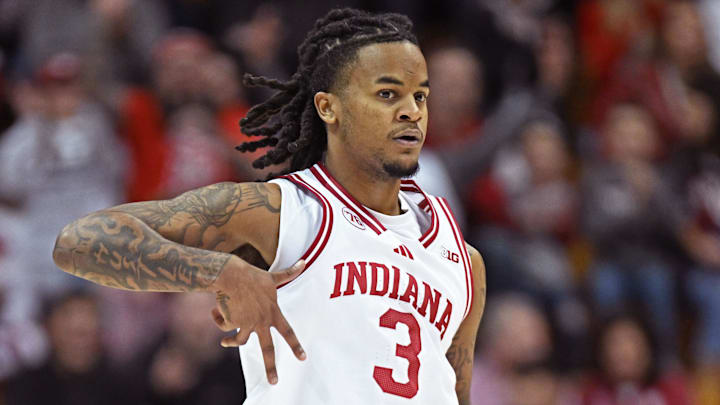
The candy striped pants tailored to his size. The No. 3 jersey folded under his nameplate in the Hoosiers’ lavish locker room. The spotlight that follows him as he rises from the bench and high-fives teammates while his name echoes through Assembly Hall to finish introductions.
It’s all more glamorous than his upbringing.
Lamar lived in a trailer in Ashdown, Ark., from age 7 through 13. His basketball career started on a dirt road outside the trailer, and the backboard on his first hoop only lasted one year.
Now, Lamar has his own brand, 3World — a creative nod to Ashdown, a rural country town in the southwest corner of Arkansas.
“It's kind of like you made it out of the mud,” said Chris Threadgill, Lamar’s mentor and long-time trainer. “He’s like, ‘I'm from Ashdown. It's like a third-world country.’”
Ashdown has a population of 4,088, and Lamar’s high school graduation class had approximately 70 people. The city is largely driven by Domtar, a Canada-headquartered paper mill.
There’s little flash, little shine.
“They call us more blue-collar people here,” Threadgill said. “Just a blue-collar community. Everybody gets up, puts on their boots and hard hat, lunch pail and goes to work.”
Lamar tried that life.
During the COVID-19 pandemic, he worked five-to-six days a week with 12-hour shifts for Husqvarna, a Swedish manufacturing company that built outdoor power products and offered a student line when options were scarce.
Husqvarna gave Lamar money in his pocket for the first time while facing an uncertain playing future near the end of high school after decommitting from an NCAA Division II school.
He liked the money. That was about it. One month later, he was out.
“I hated every minute of it, bro,” Lamar said. “It was draining. By the third week, I was like, ‘It's old. I can't do this, man.’ I respect people that get up and do that every day. I'm not one of them. I cannot do that. I cannot.”
But he soon tried again, picking up a job at Brookshire’s, a nearby supermarket where he bagged groceries, brought them to customers’ cars and stacked shelves. He’d often get in trouble, he admits, for not bringing items forward from the back of the shelf.
The gig spanned three weeks.
“I'm like, ‘Why am I in trouble for that? I can see it. Why can't they see it?’” 6-foot-6 Lamar said, smiling. “I ain't last in that job for long.”
It was there, after leaving two typical teenage jobs in less than two months, where Lamar realized his fate: Basketball was Plan A. There was no Plan B.
***
Lamar has seen friends and family members put into prison. He’s seen his mom work three jobs to support her family. He’s lost close friends to death far too early.
Lamar still battles demons. He’s endured one too many broken hearts to ever toy with love again. But loyalty? He’ll never lose that.
“Life’s precious, bro,” Lamar said. “I’ve seen love get people killed, get people stabbed in the back. Seen that firsthand. So, I'd rather have loyalty over love any day. Like, be loyal to me. Be considerate to how I’m feeling. Because I know I'm going to be the same way.
“So, I don't need love. I don't need nobody’s heart, bro. Just be loyal to me. That's all that matters to me.”
Before 7-year-old Lamar entered the Ashdown trailer, he’d already lived in Houston, Fayetteville and Texarkana. His father, Mark, still resides in Houston. When Mark and Lamar’s mom, Kizzy, divorced, Kizzy took Lamar and his older sister, Lark, during the school year, which meant stops across Arkansas for family and work purposes.

Sports were one of Lamar’s constants. He ran track and played outfield in baseball, but basketball was always his passion. Kizzy played college basketball, and Lamar first touched a ball when he was 3 or 4 years old.
“He forever carried that basketball around with him,” Mark said. “I don't care if we were going out to eat, he had that basketball with him.”
Mark always stored an extra basketball in his car. If he drove past a park with a basketball court, Lamar wanted to stop. Some kids dream of being an astronaut or firefighter. Lamar only told Mark of his aspirations to play in the NBA.
Lamar’s first step came on a Saturday morning in 2011.
Threadgill served as a volunteer referee when he discovered Lamar, an advanced-minded 9-year-old who committed several turnovers because his court vision and basketball IQ were so far ahead of his teammates.
After the game, Threadgill introduced himself to Lamar and Kizzy. They exchanged numbers, and as fate had it, Kizzy worked with Chris’s wife, Allie. On Monday, Allie approached Kizzy at the office and relayed that Chris wanted to train Lamar.
They haven’t looked back.
Within a week, Chris and Lamar began working out together on a 20-by-20 concrete slab in Threadgill's backyard, no bigger than, in Lamar’s retrospective eyes, the paint on the court in Assembly Hall. It was still a more luxurious option than his backboard-less hoop on the dirt road — Lamar and his brother, Neil Jr., broke the glass with BB guns.
During their first workout, Chris asked Lamar several baseline questions about basketball. Their conversation — and relationship — suddenly grew much deeper.
“I would love to do this one day for the rest of my life,” 9-year-old Lamar told Chris. “I want this to be my job.”
Chris chuckled and told Lamar he couldn’t promise a spot in the NBA, but he’d help shape the path to making the middle and high school teams. They’ve been bonded together ever since.
“I will make a promise to you and you make a promise to me,” Chris told Lamar. “My promise will be anytime you call and ask for workouts, I'll be there and I will give my all to you and to your workouts and your development.
“You just make a promise to me that you'll work hard regardless of the circumstances.”
Lamar made the promise. He hasn’t broken it. Lamar views Chris as his biggest mentor, and they still train together.
Chris, whose twin sons are high school freshmen and view Lamar as an older brother, said he developed a “father-son relationship” with Lamar. Chris refers to himself as Mr. Miyagi, and he calls Lamar “Daniel-San,” an ode to a similar relationship in The Karate Kid.
“It got bigger than basketball,” Chris said. “He took to me like a dad. And to this day, I look at him as a son and a kid with a dream.”
***
Tattoos, Kizzy says, serve as an outlet of self-expression for Lamar.
His first tattoo came when he was 16, a two-word message with “Fear” inside his left wrist and “God” inside his right wrist.
Lamar found his first spotlight a half-hour west of Ashdown at Community Missionary Baptist Church in Tom, Okla., where Kizzy was the youth choir director. No matter how full their church van grew, 15-year-old Lamar led the choir in songs and praise dances.
“We had girls that could sing, and the boys was in there because our folks made us. We ain't had no choice,” Lamar said, laughing. “But some people ain't want to sing a solo or lead the part in the song.
“So mom was like, ‘Okay, Mar, you do it.’ That was a fun part of my life, though.”
Lamar still sings, though not on stage. He’ll spit lyrics from R&B songs or throwbacks. His favorite artist is Florida-based rapper Lil Poppa, who sings about pain, scars and real-life issues most people don’t have words to explain.
Lamar’s second tattoo served the same purpose.
When Lamar was 16, one of his close friends, 18-year-old Olivia Williams, died in a car accident in nearby Prescott, Ark. Soon after, Kizzy took Lamar to the tattoo parlor, where he had Olivia’s name inked on his body.
The rest of Lamar’s body is a canvas of his roots and inspiration. He has names of two nieces and the middle name of his younger sister tattooed on him. His back has a map of southwest Arkansas, and he wants to add horses, a pasture and the trailer he grew up in.
The family’s trailer — which housed Kizzy, Lamar, Lark, younger brothers Davion and Marion and Kizzy’s husband, Neil Sr. — rested on a large plot of land. Each family member had their own horse and four-wheeler, and they often went mudding, horseback riding and fishing.
Kizzy held three jobs, one at a local hospital, another part-time at Dollar General and the last online. She was still home more often than not, and during Lamar’s 10th grade summer, she’d drive Lamar two-and-a-half hours to Conway, Ark., for AAU practices and games. Lark never missed an AAU game.

Family defines Lamar. Through uncertain times, Lamar, Kizzy and Lark forged an inseparable bond, and Lamar developed a deepened sense of loyalty, one that extends today to teammates, coaches and friends.
“Everything about who he is and why he plays the way he plays goes back to what we endured as children,” Lark said. “We went through a lot. We've seen a lot. He'll forever look out for the ones he really loves and the ones that have done right by him.”
Lamar was forced to grow up fast. He faced hardships and the cold reality of life far earlier than most. It could’ve wrecked him, could’ve made him bitter or unmotivated.
Instead, his family helped mold him into a life-loving individual with wisdom well beyond his years.
“I thank God that he is the way he is,” Lark said. “Because he could have turned out a different way, and he didn't.”
Inked behind Lamar’s left ear: I am who I am.
Apart from the self-representing tattoos and physique of a Division I athlete, he hasn’t changed from the Lamar who had rooms laughing when he was barely old enough to crawl.
“He is uniquely him,” Kizzy said. “He doesn't try to fit in. He's just genuine, and you don't find that especially in young men.”
***
In the spring of his senior year at Ashdown High School, Lamar’s college plans crumbled. He initially committed to play for Division II school Northeastern State University, but after a coaching change, he had no other options as graduation neared.
Three Rivers College assistant coach Bryan Sherrer watched Lamar win the 3A state championship the year prior, but he thought a Division I team would discover and sign Lamar.
Nobody did. Ashdown rarely draws college coaches.
Sherrer reached out, and Lamar committed to Three Rivers, a community college in Poplar Bluff, Mo., a few weeks later.
Through eight games at Three Rivers, Lamar averaged 23.6 points per contest. Then, he suffered a season-ending knee injury. He still had his bubbly personality, but with basketball taken away, he had to mask his emotions.
“He was depressed,” Threadgill said. “Nothing bad, but he wasn’t getting to do what he loved, and it was hard on him.”
Lamar recovered and regrouped, and he entered the recruiting radar once more the following season. Then, he nearly threw it all away.
On Feb. 9, 2022, Sam Houston State University coach Jason Hooten and two other college coaches attended Three Rivers’ 64-52 loss to Moberly Community College. Lamar scored five points on 2-for-12 shooting.
“I played the worst game in my life,” Lamar said.
Over half an hour after the game, Hooten and Lamar sat courtside in the empty gym for 30-to-40 minutes. Lamar opened up, telling Hooten about himself, his family and his past.
“I really had a good feeling about him,” Hooten said. “There was something about him that really got me.”
More than two months later, Lamar committed to Sam Houston State, where the biggest year of his life awaited. Though he didn’t start, Lamar became an everyday player, one who changed his habits, practiced hard, learned discipline and developed accountability.
Hooten left for New Mexico State University after the season, but he advised Lamar to stay, prioritizing growth and proximity to home.

Lamar earned first-team all-conference honors the following season under coach Chris Mudge. Afterward, Lamar entered the transfer portal to gauge his market. His first portal experience lasted less than two weeks. Lamar, who Mudge said was offered “a lot of money” by other schools, didn’t want to drag out the process.
He ultimately decided loyalty still ran true to his heart, staying at Sam Houston State because he wanted to do something special with his teammates and for the university. He didn’t want to talk about money or his own personal gains, Mudge said.
Lamar is a people-person, not a possession-person — a glaring outlier in a dying breed of money minded athletes.
“He is valued and rooted in people. He's valued and rooted in winning and loyalty,” Mudge said. “That word, loyalty, is incredibly valuable here because it does seem like that's a bit of a lost art now in college athletics at large.”
Lamar, a first-team all-conference pick once more, entered the transfer portal in the spring of 2025, becoming one of the nation’s highest-pursued players — but, again, he chose people and loyalty.
And he didn’t forget about Sam Houston State, providing a six-figure donation a few months later.
***

Lamar may not have been the biggest star in his own family during his early April campus visit to Indiana. His 13-year-old brother, Marion, stole the show.
While Indiana’s coaching staff gave a slideshow presentation about NIL T-shirts, IU alum and Shark Tank member Mark Cuban became a topic of conversation. Marion suddenly led the discussion.
“They're sitting there having a whole conversation about Shark Tank and he's telling them how he wants to be on Shark Tank,” Kizzy said. “He had an idea about making a backpack with a built-in jacket he wants to present on there.”
Marion also performed a few card tricks he’d learned online. Like Lamar, who has a unique ability to hear concepts or coaching tips and immediately master them, Marion can teach himself new things in one or two weeks.
“They were quite in awe of how he did it,” Kizzy said.
Lamar liked Indiana’s coaching staff, but he also liked Kentucky’s. He visited Lexington after his stint in Bloomington and, tired from the extensive travel, called off a trip to Auburn. He was down to the Hoosiers and Wildcats.
Kentucky coach Mark Pope tried to get Lamar to choose the Wildcats during his visit. Kizzy interjected, telling Pope the Wilkersons are a praying family. They weren’t going to make any hasty decisions, and they wanted to be led by God.
Lamar told coaches from both finalists he needed a day to think, and he and his family flew back to their home in Dallas. Lamar’s traveling party, which included Kizzy, Lark, Marion and Seros Partners agent Cody Hopkins, gave him their opinions but told him the decision was ultimately his.
Lark hoped her younger brother would choose Indiana.
“I loved the head coach and even the coaches that came and picked us up from the airport,” Lark said. “It was a very genuine experience. It didn't feel like a showcase or anything. It felt like family. It felt like home.”
Kizzy thought Kentucky had an edge because of the “wow-factor.” Pope took Lamar to the winner’s circle at Keeneland, a heart-tugging move for a horse-lover, and Kentucky has brand appeal as “pretty much every kid’s dream school,” Kizzy said.
But the next morning, Indiana coach Darian DeVries called with a message from the Hoosiers’ private plane.
“He literally popped up and was like, ‘Hey, we're in Dallas. We're going to come see you,’” Wilkerson said. “So, I couldn't just say no. I couldn't turn it down.”
The family had no idea DeVries and his coaching staff were coming.
“Well, that's pretty awesome,” Kizzy told Lamar. “They must really want you. They're willing to get on a plane and show up.”
After an extended conversation in the family’s living room that morning, Lamar looked at DeVries, said, “I’m in,” and they shook hands. The room erupted in excitement.

Fate also played a part. Lamar’s stepbrother, Neil Jr., was released from prison the day Lamar chose the Hoosiers. N.J. later told Lamar about a vision he had a few days before the decision.
“Once he got out, he was like, ‘Man, this is crazy, bro. A couple days ago, I had a dream you was in a red uniform,’” Lamar remembered. “And my option was blue (or) red.”
That eased any of Lamar’s doubts, though he also felt comfortable about the on-court situation at Indiana. He prioritized utilization and having the freedom to be himself. DeVries and the Hoosiers offered both.
There were only three scholarship players on Indiana’s roster when Lamar committed: Forward Tucker DeVries, guard Conor Enright and forward Reed Bailey. With an entirely new roster, Lamar didn’t have to worry about past relationships affecting playing time.
Lamar visited Indiana with Bailey, who committed nine days before him. They ate together, and after leaving the restaurant, Lamar googled Bailey and watched his film from Davidson College. Lamar did the same with Enright and Tucker DeVries.
After evaluating his prospective teammates, Lamar felt Indiana could build something. He believed in the pieces and the vision — even though the roster still was virtually bare and Kentucky was a lively blue blood with championship aspirations.
“I like risk,” Lamar said. “I like jumping out there and being like, ‘Okay, you live and you die with it. Make your decision, you live and die with it, and then make the best out of it.’ And so I feel like Indiana was the best for me.”
Choosing Indiana embodied much of Lamar’s journey. He never ran from a challenge.
Indiana, one of college basketball’s most historic programs, hasn’t advanced past the Sweet Sixteen since 2002 and hasn’t made the NCAA tournament the past two seasons. DeVries is the Hoosiers’ third coach in the past decade.
Where others see ashes, Lamar sees opportunity to build — and win.
“That's what he's done all his life,” Threadgill said. “Why not go somewhere that's a true blue blood and help bring them back?”
But without the plane ride — prompted by a phone call from Hopkins to DeVries — perhaps the story has a different ending.
“I think that's what really sealed the deal,” Lark said. “I'm so glad they did that.”
***
At the end of his first basketball camp this August in Ashdown, Lamar delivered a message to high school-aged attendees that Threadgill drilled into him many years prior.
“If you say this is what you want to do, why do we have a plan B? Why put 80% into basketball and the other 20% into plan B, so you're not focused 100% on what you said you wanted to do?” Threadgill said. “You got to get it by all means.”
Lamar committed to plan A when he made his promise to Threadgill at 9 years old. He didn’t even attend his senior prom because he was in the gym.
“Basketball is it,” Kizzy said. “He loves it. And if you talk to him, it's when you do something you love, you don't consider it work, even though that is his job.”
Sherrer, now an assistant at Morehead State University, was entering his 11th year of coaching when Lamar arrived at Three Rivers. He’s never spent as much time in the gym with any player as he did his lone season with Lamar, an oft-described gym rat.
Lamar is driven by a supernatural desire to achieve plan A. He carries Ashdown — and his family — in each moment.
“His why and his purpose is about as strong as I've seen in a guy that I've been able to coach,” Mudge said. “Because of that, he is driven, he is motivated. His why has to do with using basketball as a means to do things for his family and his friends and people he cares about.”

Lamar has never met a stranger. He turns introductory conversations into discussions fit for a 30-year relationship. Now in Year 16, Sherrer said he’s never been around another individual with Lamar’s personality.
“And it's genuine,” Sherrer said. “It's every day. He's a very, very, very high energy guy.”
Mudge called Lamar’s loyalty and ingenuity a “superpower,” one that shaped Mudge through several loaded, faith-based conversations in Sam Houston State’s coaching offices.
“Lamar's ability to handle adversity and continue relentlessly pursuing his why and his goals with a joy that is contagious,” Mudge said. “I learned a lot about life from that because he's exceptional at that. That's very difficult to do.”
But Lamar has more experience at it than most. He mastered resiliency because he had no better option. His past will never leave him — it’s inked on his body, after all — in large part because it’s produced the qualities driving his future.
“You don't see many guys, especially at that age, be able to carry some of the things he's carried and continue to carry himself in the right way,” Sherrer said. “We see grown adults that aren't able to do those things, and I think that's what makes him unique.”
***
Lark, who has a doctorate in occupational therapy, and Lamar, whose face is plastered on promotional advertisements for one of college basketball’s most famous programs, recently reminisced on their childhood.
The dreams. The uncertain nights. The never-fading belief this life was possible.
“We really used to pray for times like this,” Lark told Lamar. “We used to sit down and talk about things like this happening. We wouldn't change a thing. Although that's not something you wish on anybody, it really played a part in the way we were brought up.
“It really shaped us. We both wouldn't change it for the world.”
Sitting courtside at Assembly Hall, Lamar wore black pants with "Born 2 Win" stitched on the left thigh. He didn’t grow up in a situation favorable for winning. But Lamar never let his circumstances sap his joy for basketball, people, or life.
It’s why he’s still smiling — and never stopped dreaming.
“Bro, when you be at the bottom for so long, the only way is to be up,” Lamar said. “I know how the bottom feels. I know how it feels to be overlooked. I know how it feels not having nothing. I know how it feels to wake up every day, like, ‘Damn, how I'm a make it through the day?’
“So now that I'm here, like, why not enjoy life? I mean, people would love to come in here and do something they love and get paid for it. Being in here gives me peace of mind.”
The only sound still remaining in Assembly Hall was a basketball bouncing on Branch McCracken Court. Lamar leaned forward in his chair and smiled as he looked at the wooden floor, the Adidas basketball and the state-of-the-art goal standing before him.
“I can do this every day,” Lamar said. “You know where I came from, bro? You got to be grateful for stuff like this, man. It don't get no better.”
Moments later, as the clock neared midnight, Lamar rose from the crimson-colored chairs, walked onto the hardwood and started a shooting workout.
At the end, Lamar left his speaker underneath the basket. There was no need to move it. After all, he’d be back the next day, there to put up more shots in his never-ending, all-encompassing pursuit to fulfill Plan A.
 Add us as a preferred source on Google
Daniel Flick is a senior in the Indiana University Media School and previously covered IU football and men's basketball for the Indiana Daily Student. Daniel also contributes NFL Draft articles for Sports Illustrated, and before joining Indiana Hoosiers ON SI, he spent three years writing about the Atlanta Falcons and traveling around the NFL landscape for On SI. Daniel will cover Indiana sports once more for the 2025-26 season.