
Quick Takeaways from Texas Tech's Win over No. 11 BYU
In this story:
The Red Raiders achieved a near "perfect" ending.
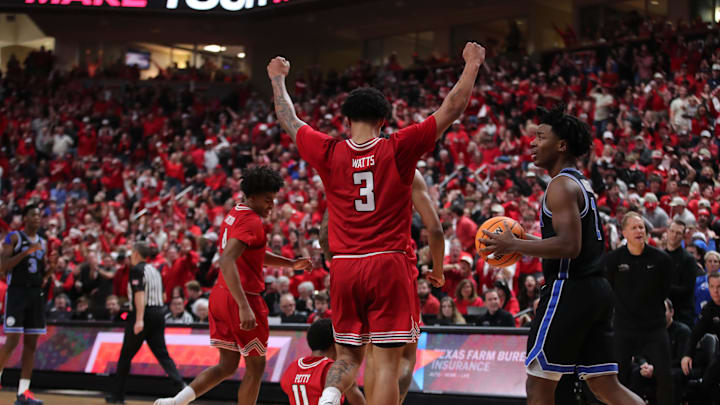
Down 61 to 52, Texas Tech almost finished perfectly with just over nine minutes to go. In the last eight minutes, they scored 32 points, eventually giving them a 13-point comeback victory over the Cougars. They finished their game by making 14 of 15 free throws and their last seven field goal attempts.
What a comeback by Texas Tech
— Cole Adams (@coleadamss) January 18, 2026
JT Toppin's performance was outstanding. The Big 12 Player of the Year was the best player on the floor in this game. Toppin had 27 points and 12 rebounds, which was his sixth double-double in a row. He sank three three-pointers from deep, one of which was a banked-in three that put Tech up for good at 66–65.
JT Toppin is COOKIN' 🔥
— SportsCenter (@SportsCenter) January 18, 2026
27 PTS and counting 🧑🍳
Watch No. 11 BYU vs. No. 15 Texas Tech NOW on ESPN and the ESPN App pic.twitter.com/B6ZtGw82s0
Tech's "Big Three" was better than BYU's The Red Raiders' Christian Anderson (22 points), Toppin (27 points), and LeJuan Watts (20 points) scored a total of 69 points against the Cougars. Their play in the game was too much for BYU's stars to handle and overcome, especially later in the second half. BYU didn't have the depth or scoring power to match their output on both ends of the floor in the last few minutes.
FINAL: No. 15 Texas Tech 84, No. 11 BYU 71
— Jeff Borzello (@jeffborzello) January 18, 2026
BYU led by nine with 8:15 to go -- Texas Tech responded with a 30-6 run to win. Ridiculous stretch.
Their own Big 3 did most of the damage: Toppin (27), Anderson (22), Watts (20). Combined for 45 in 2nd half.pic.twitter.com/quz9kqCWaw
The Red Raiders' defense played well against BYU star player AJ Dybantsa. Arguably the best true freshman scorer in the country only scored 13 points and made only 6 of 17 shot attempts in this game. Before this game, Dybantsa scored more than 23 points per game and had ten consecutive games where he scored 20 or more. However, Texas Tech had an outstanding defensive game plan that limited him on the offensive end of the play.
JT Toppin and LeJuan Watts on how Texas Tech held AJ Dybantsa to a season-low 13 points. pic.twitter.com/UrJXcn3gyU
— Nathan Giese (@NathanGiese) January 18, 2026
The three-point difference helped the Red Raiders win this game. Ultimately, Texas Tech emerged victorious from beyond the three-point arc. Texas Tech made an astonishing 38% (11-for-29) of their three-point shots, whereas BYU, which generally shoots many threes, only made 23% (5-for-22) from beyond the three-point arc. This should not come as much of a surprise, as a little over two weeks ago, the Red Raiders made an impressive 17 three-pointers against Oklahoma State.
‘round here everybody eats
— Texas Tech Basketball (@TexasTechMBB) January 3, 2026
Matched the program record with 17 3-pointers in our Big 12 opener against Oklahoma State. pic.twitter.com/yWFirNt9CC
Lubbock and the United Supermarkets Arena proved a big home-court advantage. After this win, Texas Tech improved to 10–0 at home this season. The 15,098 spectators in the crowd dramatically transformed the atmosphere during Tech's 11–0 second-half run that started their comeback. The home court advantage was in full effect in this game, which helped fuel and motivate the Texas Tech players.
The best home court in America 🌊🏄♂️ pic.twitter.com/q9A3X2bMIs
— Texas Tech Red Raiders (@TechAthletics) January 18, 2026
The Cougars' winning streak ended. BYU had won 13 games in a row until they lost this game to the Red Raiders. It was also the Cougars' first loss in Big 12 conference play. During BYU's winning streak, they had defeated Kansas State and Utah on the road as well as defeating Miami, Dayton, and Clemson on neutral courts.
BYU's 13-game winning streak is over. A dominant final ten minute segment from Texas Tech, holding the Cougars down after going down by 9 points.
— Sam Federman (@Sam_Federman) January 18, 2026
AJ Dybantsa only took 1 free throw, held to 6-17 from the field. Toppin, Watts, Anderson all 20+. Red Raiders brought it
The Red Raiders made key free throws down the stretch. Texas Tech took advantage of BYU's fouling in the last few minutes of the game by making 19 of 23 free throws. Anderson did an impressive job this game, making all six of his free throw attempts. At the end of the game, he successfully converted free throws to secure the victory and helped prevent the Cougars from making a comeback.
More From Texas Tech On SI
Stay up to date on Texas Tech Athletics by bookmarking Texas Tech On SI and follow us onTwitter.
 Add us as a preferred source on Google
Ryan Kay is a journalist who graduated from Michigan State in 2003 and is passionate about covering college sports and enjoys writing features and articles covering various collegiate teams. He has worked as an editor at Go Joe Bruin and has been a contributor for Longhorns Wire and Busting Brackets. He is a contributor for Texas Tech On SI.