
Tulane AD Harris' Vision for Tulane Athletics
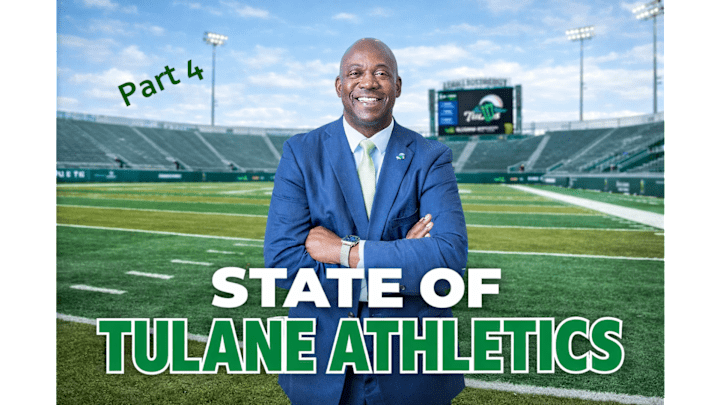
Today the final segment of our wide-ranging interview with Tulane athletic director David Harris on the State of Tulane athletics.
This four-part series focuses on the NIL and the possibility of a Collective Bargaining Agreement with student-athletes, the athletic programs that are successful at Tulane and those that have not seen the ceiling yet, athletic facilities and their future, and what Harris’ vision is for Tulane athletics. You can find all four parts on our YouTube channel.
- Part one focused on the Give Green campaign at Tulane, followed up by where Tulane in particular stands on NIL and where Harris thinks will go on a possible CBA for athletes. The entire video of the interview can be found here.
- Part two had the Tulane AD compare the Tulane programs that have been successful and those still striving for that more favorable outcome. This link will take you to the video.
- In Part 3, Harris gave us his take on where Tulane athletic facilities are now and where they can go in the future. Our YouTube Channel has the entire portion, which you can find by clicking here.
In today’s fourth and final segment, the Tulane AD gives us his vision on where he thinks Tulane athletics fits into the scheme of the NCAA as a whole. His answer gave this reporter a chance to reflect not just on championships, but an overall perception of what happens Uptown.
A Model for the NCAA
I believe that Tulane can be the model for college athletics. And by that, I mean, if you look at what college athletics is, or at least why many of us got into it, student athletes come here for an opportunity to get an education and to have a transformational experience through athletics that prepares them to go into whatever career, whatever, at its core, that's what we're doing every day. And if you look at Tulane and say, well, from an academic standpoint, the student athletes who come here get to be at the top in the world, and if you look at how they're performing, our graduation rate, it's the highest in the state and the highest in the conference.
Academics Lead the Way
We have a GPA that's well over a three-point. Our student athletes are doing the right things in the classroom each and every day, and they're getting a great education, one of the best that you can find anywhere. And so we feel that from an academic standpoint, our student athletes are having a great experience and they have a great opportunity here.
Athletics Need to be Built to Succeed
Then competitively, you want to be in a position where you're competing for championships across the board, right, to where, you know, no matter what sport program you decide to come here and be a part of, you feel like there's an investment that's being made. And the investment is not going to be equal across the board, but you want all of your student athletes to feel like they have an opportunity to be able to compete for a championship, and you want the success with athletics and in athletics to raise the overall profile of the university, because that's what athletics is supposed to do. Athletics is supposed to bring positive attention to the entire university.
We feel like we have a chance to have great balance, that you can have championship-level athletics and championship-level academics, so to speak, at the same time. But then in addition to that, our student athletes are going out and serving the community. They're doing over 6,000 hours a year in community service, and we were a finalist for a National Community Service Award last year.
And so you want your student athletes to be involved in the greater community, to love the city that they're a part of, and to serve it, and to be a part of the culture, and to have the people that live in the city see the city reflected in the sports teams and the student athletes that compete and the way that they compete. And to be in a great city like New Orleans, you know that you want to be able to show hard work, you want to be able to show resilience, you want to be able to show excellence, and you know it's unique. There's a unique culture that's represented here that we've tried very hard to represent in athletics as well.
Tulane: A Model for College Athletics
And so if you're the model for college athletics, I think your athletics department has to in some ways reflect the culture of the city that you're a part of as well. And so that's something that we're very intentional about. And then you want to make sure that you're investing in having the best facilities that you can have.
You want to be able to raise money to support the efforts that you're trying to get done within your operation. All of those things are important. You are always trying to find ways to drive revenue so that you can put that revenue back into the program.
And so when you look at facilities and you look at fundraising and revenue generation and service, you look at athletics and you look at academics and you put all that together, that's where I feel like the vision is about being the model for college athletics because I feel like we have an opportunity to do all of the things that I was always taught when I got into this industry 27 years ago that college athletics was supposed to do. That at Tulane we have a unique opportunity to be able to be true to what college athletics is supposed to do for young people.
 Add us as a preferred source on Google
Doug has covered a gamut of sporting events in his fifty-plus years in the field. He started doing sideline reporting for Louisiana Tech football games for the student radio station. Doug was Sports Director for KNOE-AM/FM in Monroe in the mid-80s, winning numerous awards from the Louisiana Sports Writers Association for Best Sportscast and Best Play-by-Play. High school play-by-play for teams in Monroe, Natchitoches, New Orleans, and Thibodaux, LA dot his resume. He did college play-by-play for Northwestern State University in Natchitoches for nine years. Then, moving to the Crescent City, Doug did television PBP of Tulane games and even filled in for legendary Tulane broadcaster, Ken Berthelot in the only game Kenny ever missed while doing the Green Wave games. His father was an alumnus of Tulane in the 1940s, so Doug has attended Tulane football games in old Tulane Stadium, the Superdome, and Yulman. He was one of the 86,000 plus on December 1, 1973, sitting in the North End Zone to seeTulane shutout the LSU Tigers, 14-0. He was there when the Posse ruled Fogelman and in Turchin when the Wave made it to the World Series. He currently is the public address voice of the Tulane baseball team.