
Diego Pavia Doesn’t Want His Confidence Mistaken for Arrogance
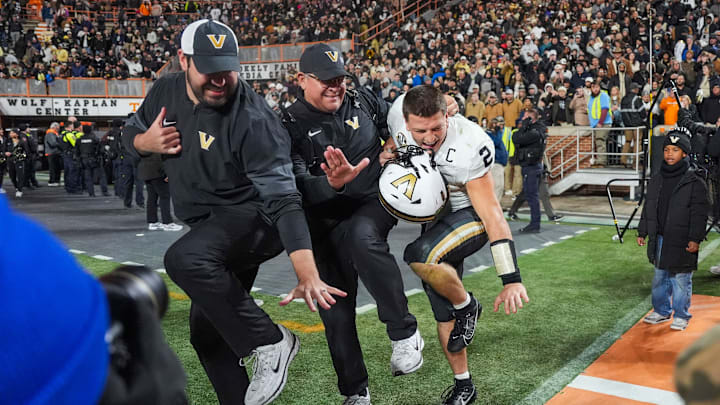
MANHATTAN — With 37 seconds left in the third quarter at FirstBank Stadium on Oct. 18, Diego Pavia may have had his Heisman moment.
The graduate quarterback, who has taken the college football world by storm in 2025, faked a jet pass to Washburn transfer Tre Richardson before scanning the field for an open receiver. Pavia spotted a slight opening between his center Jordan White and right guard Cade McConnell and took off, outrunning LSU linebacker Davhon Keys for a 21-yard touchdown run that would put Vanderbilt a two-score lead over the then-No. 10 ranked Tigers.
The play itself wasn’t extraordinary, but it was what followed that grabbed national headlines the next morning. After hugging a group of Vanderbilt ROTC students, Pavia struck the iconic Heisman pose, a moment that would become attached to his candidacy for the next two months. To some, the celebration felt premature — an unnecessary and delusional declaration to make in mid-October. To Pavia, though, it was just an expression of who he is: bold, energetic, and unmistakably confident.
Pavia's personality has been on center stage during his Heisman trophy run — a candidacy that, by the numbers alone, would place him on the podium Saturday night delivering a winning speech. The Commodores’ signal caller finished the 2025 regular season with 4,018 combined — more than 1,000 ahead of presumed front-runner Fernando Mendoza, who totaled 3,001. Mendoza’s candidacy has been driven largely by team success, leading his program to an undefeated 13-0 record and a Big10 Championship win over Ohio State that secured the Hoosiers the No. 1 seed in the College Football Playoff.
But there’s another element shaping this race: character and perception. And Pavia and Mendoza couldn’t be more different in that department.
The prevailing narrative has been straightforward. While Pavia was out striking Heisman poses in the middle of October, Mendoza was keeping his head down and winning games. If the trophy was meant to go to the most buttoned-up and humble candidate, it would almost certainly land in the Indiana Quarterback’s hands.
“I feel like I get the perspective that maybe I’m cocky or whatever,” Pavia said Friday. “But I feel like I’m just a confident person. I believe in my team. I believe in the people around me, and I don’t want it to come off as cocky or arrogant. I just think of that as myself.”
That oozing confidence — often mistaken for arrogance — doesn’t come from a place of selfishness or greed. Instead, it comes from a career defined by doubt. The quarterback now standing in front of New York media as one of the four best players in the country was once only good enough, in the eyes of recruiters, to be a walk-on at the New Mexico Military Institute. At that time, Pavia had little support from anyone besides his family and, of course, himself.
That was when he began to develop the chip-on-your-shoulder mentality and unwavering belief that he’s the best player on the field at any given time. He knew the only was to reach this point was to believe — fully and without hesitation — that he could.
“As an underdog paying to walk on to JUCO, you kind of have to be your own cheerleader,” Pavia said. “And it just never left my head, to be like ‘Oh I arrived, I don’t need to do that anymore.’”
But that chip started forming even earlier than his JUCO days. When Pavia was six years old, he wanted to play football, but the local league’s minimum age was seven. So, naturally, Pavia’s mother solved the problem by lying about his age on his birth certificate. Even then, though, Pavia faced an uphill climb — competing with the coach’s son for the starting quarterback role.
“We all know how that goes,” Pavia said of competing with a coach’s son.
Pavia's path has never been smooth. Adversity has followed him at every stage of his football life, and as a result, his confidence has developed as a defense mechanism, a way to tune out noise and skepticism. That hasn’t changed in the SEC, where the Commodore captain has accomplished more than any other quarterback in program history.
Those who haven’t spent time around Pavia or Vanderbilt football might mistake his belief for arrogance. But the narrative that he’s selfish — or worse, a bad teammate — couldn’t be further from the truth. The quarterback understands clearly that, without his offensive line, pass catchers, running backs, defense, and coaches, he wouldn’t be here.
“[The offensive line and me] are the tightest six-man group in the world,” Pavia shared. “To have one last celebration in New York would mean a lot, and those guys deserve it. Whatever they need the rest of their life, I’m going to be there.”
An arrogant, self-absorbed quarterback wouldn’t be spending his holidays volunteering with Special Olympics kids at Dick’s Sporting Goods. He isn’t lingering after games to take pictures and sign autographs with kids on the field after games, either.

Instead, he’s continued to be Diego Pavia — even if that means walking into the Heisman Trophy media room in downtown Manhattan wearing wired earbuds , or answering a question about whether Lamar Jackson or Johnny Manziel was the better quarterback with a third name: “Neither — me.” Some view those moments as attempts to grab attention or steal the spotlight. In actuality, they are simply part of the Diego Pavia experience.
In an era where Vanderbilt has long been labeled as a boring academic school with little to celebrate on the football field, that personality is exactly what the program needed. Voters shouldn’t punish Pavia for that; if anything, it should strengthen his case.
“I've never changed who I am or what I do and so people who really know me know that I'm a good guy at heart and that I care for people,” Pavia told Vandy OnSI back in July. “That’s really my biggest attribute, I think.”
Because without that absolute belief in himself, the Albuquerque, New Mexico, native would have never been standing up there with Mendoza, Julian Sayin, and Jeremiyah Love on Friday afternoon as a Heisman Trophy finalist. Without it, his career could’ve taken the wrong turn at any number of the key inflection points he’s been faced with.
The Heisman Trophy has always been about more than statistics. It’s meant to recognize greatness — not just in production, but in presence. For Pavia, that presence has never been fabricated or manufactured. It’s been forged through doubt, sharpened by adversity, and sustained by an unapologetic belief in himself. Whether voters choose to shy away from that or reward him for it, Pavia wants to make sure everyone understands who he truly is.
“It comes with great belief,” Pavia said. “I told myself I’d believe.”
 Add us as a preferred source on Google
Dylan Tovitz is a sophomore at Vanderbilt University, originally from Livingston, New Jersey. In addition to writing for Vanderbilt on SI, he serves as a deputy sports editor for the Vanderbilt Hustler and co-produces and hosts ‘Dores Unlocked, a weekly video show about Commodore sports. Outside the newsroom, he is a campus tour guide and an avid New York sports fan with a particular passion for baseball. He also enjoys listening to country and classic rock music and staying active through tennis and baseball.
Follow dtovitz