
Emmanuel Adebi Can't Do What Others Can, Yet He's Living Out His Dreams. He Believes You Can, Too.
In this story:
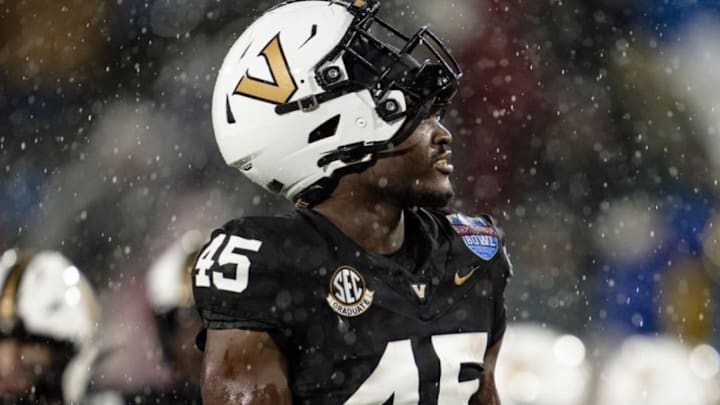
Nashville—If the doctors that delivered Vanderbilt tight end Emmanuel Adebi as a baby were to see him nowadays as he goes through fall camp each morning and is among the most physically imposing players on the field, they probably wouldn’t believe it was the same person.
Adebi was born three weeks early, was 12 pounds, 24 inches and was big enough prior to being born that his parents–who already had one son–wondered if they’d be having twins. As a result of his shoulders–which already foreshadowed his current figure–he was stuck in his mother’s womb. Adebi’s mom was crowning for over 10 minutes and to get her son out of the womb, they had to cut around 40 times in his shoulder area.
When Adebi finally made it out of the womb, he was “literally” blue. While he was stuck, his brain received so little oxygen that doctors feared that he wouldn’t make it during resuscitation and forced his father to leave the room after a few minutes of CPR. Doctors reassured Adebi’s parents that they were giving him the best care they could, but there was no assurance that he would make it through the first couple weeks of his life.
Upon his exit from the hospital, Adebi already had an onslaught of appointments scheduled. He and his parents would have to see the neurologist, geneticist, multiple physical therapists and cardiologists. They would have to do anything they could in order to address the problems that came with the damage that had been done to his shoulder, too.
The birth was "traumatizing" for Adebi as well as his mom Folake. It also meant that she would be without any sort of recovery post-delivery as her and her husband Peter did everything they could to keep their son alive. They went from “one specialist to another from day one” before Adebi ultimately made it through alive.
“In my mind, his birth was a miracle,” Adebi’s mom told Vandy on SI. “It’s still a miracle to me.”
Even after Adebi made it out of the birth process alive, doctors said that he wouldn’t be able to do “a lot of things,”--including playing sports–as a result of how his shoulder was affected at birth. The lack of oxygen in his brain also meant that he “wouldn’t really be able to do anything academic.”
He had to make it out of the ICU first, though. Adebi was there for around three weeks before finally being discharged. In the weeks between Adebi’s birth and discharge from the ICU, social workers with the state of New Jersey’s Department of Child Services showed up to the Adebi’s house to articulate that its representatives didn’t believe that Adebi’s parents could take care of their son because of the information they’d received from the hospital and offered to “help” the parents by “coming to pick him up, in a sense.”
The social workers involved were concerned that Adebi’s physical and mental health would suffer too much from his birth defects–which still didn’t allow him to move his right hand at that point–and that he couldn’t thrive in his current situation. As a result, they made Adebi’s parents aware that they could go to court and legally “surrender” their son to the state so that it could care for him.
“You’re in the wrong house,” Adebi’s mom said. “We will do our best. Don’t come back.”
“You will definitely regret this decision,” the representative told her. “You may not be able to care for him because he will need a lot of medical attention.”
“That was an absolute non-starter,” Adebi’s father said years later as he admits he believes the social worker was well intentioned but went about things the wrong way. “No matter what happened, he is our child and we will continue to do everything we can to support him. So, that was a non-option for us.”

Adebi’s parents knew that the road would be difficult for them and their son, but were "absolutely not” giving him up. They were going to do what they knew how to do, which was pray and do everything they could in order to properly care for him.
It would’ve been the cheaper, easier way for Adebi’s parents to give him up. Anyone who knew them had to know that they don’t often take that route, though.
Adebi’s father came to the United States from Lagos, Nigeria, over 20 years ago on a scholarship that he was awarded over a field of 10,000 applicants. The scholarship allowed him to attend Lincoln University–a historically black university in Pennsylvania while his mom attended The State University of New York for her undergrad and received a master’s degree from Stevens University after immigrating just before college. If they’d learned anything from their individual paths it was to not give up on the one that their son could chart.
“I imagined he would be alive and he would be well and he would overcome his injury,” Adebi’s dad told Vandy on SI. “My wife and I truly believed that.”
If Adebi had any chance of doing that, the people around him would have to make sound decisions and he’d have to work tirelessly at it. Perhaps things could’ve been different for him had his mother agreed to the surgeries that his physician recommended he have as an infant–which included taking ligaments from his legs and moving them to his arms. The Adebi’s believed that rather than the operation serving its purpose, it would take the range of motion from their son’s leg and wouldn’t fix the problem in his arm. “Are you crazy?” his mom told them.
Peter and Folake have been around for far too long and have seen far too many things to believe that the easy way out would be the one that their son would take. They knew that if he was going to get his health to the place he wanted it to be, he would have to walk around without being able to lift his arm up much for a while. They also knew that he’d probably have to work for it if he wanted to become better.
For the first 12 years of Adebi’s life, he went to physical therapy at least once a week in order to address the range of mobility in his right arm and to try to stretch the muscles.
“When he woke up every morning for what I’d say was the first 12 years of his life, there was always pain,” Adebi’s father said. “There was always pain on a part of his body, whether it was his right shoulder, right arm, there was always pain.”
Adebi always kept fighting, though. He’d go play football through the pain. He’d play the piano–which his parents say he did particularly well–while in pain. He learned how to write left-handed to avoid the pain in his right arm. He’d do his therapy exercises while in pain. Yet, he was still hampered by what happened to him at birth.
“It was just a part of my life growing up,” Adebi said of his struggles. “I knew I just couldn’t do certain things that other kids did.”
The now Vanderbilt tight end saw that particularly in his relationship with his older brother–who eventually went to MIT–Adebi says his brother’s brain “works a lot faster” than his and particularly did when they were kids. Whenever the brothers would play chess, do any sort of math or any “centralized” testing, Adebi would lose.
An older, more mature version of Adebi now admits that he struggled with comparing himself to his brother and says that comparison is the "thief of joy.” It appears as if it was difficult for Adebi to sit and watch his peers do things that he wished he could.
At some point all he could do through the mental and physical pain was pray.

Ever since Adebi’s parents were mature enough to think deeply, they’ve respected others’ lifestyles but have always believed that the way to live their lives is through their faith.
Adebi’s father’s parents worked to instill faith within their son since the time he was a kid. Their house in Nigeria backed up to a church, where Adebi’s grandmother would cook for the congregation. In a similar way, Adebi’s mom heard The Gospel from a young age and believed it. To each of them, it made sense.
Each of Adebi’s parents believes each person needs a “moral compass” as to how to live their lives. They believe that whenever they want to test a principle, it helps to have scripture to back it up. For example, they believe it’s wrong to steal and can find evidence of that in the Ten Commandments.
In a similar way, they believed that referencing scriptures of hope throughout Adebi’s--whose first name means "God with us"--childhood could provide him some hope that his situation wasn’t insurmountable. As a result, he knew that whatever he dealt with couldn’t knock him down if he didn’t let it.
“That was a part of him being able to cope with all of the challenges that he faced,” Adebi’s father said. “It worked out for him.”
Adebi’s dad says that faith has been a “foundational” part of the life of his family and that having it has served he, his wife and his kids well throughout their lives because of the compass that it’s given them as well as the comfort and guidance that they’ve received in their prayer lives.
Even now that Adebi has shedded a good portion of his childhood struggles, he still makes it a point to attend Avenue South Church in Nashville when he’s in town and to continue leaning on his faith.
“That’s the main thing my parents really instilled in me is to have a prayer life, have a relationship with Christ,” Adebi said. “Both my parents were like ‘money can disappear in a day. Assets can disappear in a day. But, the relationship with Christ is forever.’ That’s gotten me throughout my entire career.”

The Adebi’s believe that their son’s story is only possible through God.
After all, none of them would’ve drawn it up this way. Perhaps some along the line saw the potential for Adebi to be an effective football player, but even those who believed in him most didn’t have this on their bingo cards. One of them probably didn’t want it to be, either.
“We would like your boys to play football,” someone in the supermarket told Adebi’s mom while he was in elementary school. “They would be awesome.”
“You are absolutely out of your mind,” Adebi’s mom said while reminiscing on the moment with the laugh that she so often produces while recalling her protection of her kids. “My boys are not interested. I am not interested.”
Once she was done telling off the man in the supermarket, Adebi’s mom could feel her son looking at her and second-guessing the decision she made in the moment. She didn’t have to read his facial expressions for long to find out what he thought of her comments.
Instead, all she had to do was listen.
“I really want to play football,” Adebi said.
“You are not allowed to speak,” his mother said.
Adebi’s mother was finally convinced during Adebi’s seventh-grade year as he and his brother transferred to a middle school that required them to play three sports, including football. Adebi’s mom went to the school and asked what their safety measures were and how they could protect her sons.
The school said that it would do impact head injury testing and would play against local schools. That wasn’t enough to completely ease her worry–which is likely still present these days as Adebi plays in the SEC–but it was enough to convince her to allow her son–who was chomping at the bit–to finally play organized football.
Adebi says he didn’t take football seriously until high school and wasn’t set on playing college football until he was deferred and ultimately rejected from MIT. The rejection meant that Adebi wouldn’t be able to follow in his brother’s–who got his undergrad and master’s degree in engineering from MIT, played football there for one season before determining he needed to focus on completing his double major in computer science and physics and is currently getting a PhD in computer science at the University of Texas–footsteps.
The now Vanderbilt tight end was disappointed by the rejection, but was hopeful that it would help him fulfill the plan that God ultimately had for him. It also gave him a perspective change.
“My individuality came from getting rejected from MIT,” Adebi said while referring to his brother’s academic accomplishments. “I feel like if I would’ve gotten in, I would have done the same things that he did and then ended up not really playing or being me, truly.”
As a result of his deferral, Adebi went to Cornell–which was his second choice behind MIT. It allowed him to pursue his football career alongside his degree in electrical engineering in a different way than he would’ve been able to had he gone to MIT.
Adebi’s emphasis on football in a house with such a strong culture of high-level academic performance put his mother in a position where she initially didn’t know what to think. Now she’s embraced his accomplishments, though.
“I want to say ‘no,’” Adebi’s mother said in regards to the possibility that he could play college football.
“Mom, don’t,” Adebi’s brother Daniel replied. “You will be hurting him by doing that.”
Following that interaction, Adebi approached his mother about the possibility of going to Cornell and pursuing football more seriously than his brother did in his college tenure. But, he wanted to run it by her first.
“I’ll do whatever you want,” Adebi said, “But I would really like to play football.”
“Okay,” his mother said, “Go ahead.”
Adebi’s recruiting process was quiet and included him attending two camps, one at MIT and the other at Colgate. The now Vanderbilt tight end says the one at Colgate–which he went to as a result of being invited by a friend–was the one that started to get him exposure. He eventually was visited by coaches from Harvard and Cornell before ultimately embarking on a career at Cornell.
Perhaps Adebi’s calm, humble demeanor wouldn’t lend itself to an SEC football career on the surface, but his father says a switch flips once he gets out there. That’s made up for what some would say is a lack of fundamental refinement in his game relative to other players in his high school class.
“The tenacity in that kid is unbelievable,” Adebi’s father–a die-hard Philadelphia Eagles fan–says. “He lived many years of his life believing in himself, believing that he can do it.”
The now tight end started his career as an edge rusher, but still hadn’t earned the trust of the Cornell coaching staff while most of his classmates were receiving significant playing time. His break finally came later that season, though.
Adebi was a backup on special teams before the player he sat behind tore his ACL and allowed Adebi to receive his first opportunity. The then Cornell junior took advantage and blocked a kick in his first appearance.
The now Vanderbilt graduate student moved to tight end later that season after Cornell’s offensive coordinator asked him if he’d be interested in a position change that would accelerate his path to playing time, but it was special teams that appeared to define his career there.
Despite not being able to raise his right arm above his head and only playing for two seasons, Adebi holds Cornell’s all-time record for field goals blocked in career with seven.
“It’s definitely ironic,” Adebi said. “It’s funny.”
It also couldn’t have been done without Adebi’s partner in crime Maxwell Van Fleet–a defensive linemen that helped to free him up in order to get his hand up and in the path of kicks. When Adebi entered the transfer portal after his senior season it was all about him, though.
The former Cornell tight end was ultimately down to Vanderbilt, MTSU and Florida State before ultimately ending up as a Commodore. Adebi played in all 13 of Vanderbilt’s games in 2024 and was on the field for 98 of its offensive snaps. He still can’t do everything that everyone else can, but that’s not stopping him.
“It’s a miracle by God,” Adebi said. “Nothing man made or man produced can help me to do what I do. It is by God that I’m able to come out here, be around these guys and have a chance to be a part of a team like this.”

The “miracle” that Adebi’s story brings to light has had such an impact on his father that he’s decided to make an impact as a result of it.
“Since Emmanuel was born in 2002 I have worked in healthcare,” Adebi’s father, Peter, said. “That was how much of an impact his situation had on me.”
Adebi’s father is the Senior Vice President of Human Resources, the Chief Human Resources Officer for Cincinnati Children’s Hospital Medical Center. Prior to that, he was the Executive Vice President and Chief Human Resources Officer at Nemours Children's Health in Wilmington, Delaware.
Throughout his career–which Adebi says he has learned plenty about loyalty and hard work from–Adebi’s father has seen plenty of families with children in difficult situations. He doesn’t just have sympathy towards them when he sees them, he remembers what he felt like when he went through what they’re going through. He wants them to feel seen for that reason.
“It drives me,” Adebi’s father says. “When I see parents travelling with a sick child, regardless of what the condition is, I make a point to say to them ‘hey, I’ve kinda been through something like this. Anything is possible and you just have to keep giving it your best every day. It gets better. It truly does get better.’”
If they need an example, Adebi’s father can bring his son’s story to light. 23 years ago, he was in the position that some of them were in. He was fighting for his life.
Now, he’s an SEC football player deciding between the broad spectrum of career choices that he’ll have one day. He’s a Cornell graduate. He’s done a few internships relating to power grids and powering major cities like Pittsburgh. He also has an interest in cybersecurity. The possibilities are endless for the Vanderbilt tight end.
He wants you–and all the kids that go through difficulties like he did–to know that if he can do it, you can too.
"The people here, they didn’t create us, God did,” Adebi said. “So God sets the limits on what we can do, not anybody else. So don’t let anybody else tell you that you can’t do something that you have a dream to do. Pray about it, work towards it. Faith without works is dead, so you can’t just pray and hope–that’s manifesting, manifesting doesn’t exist–you have to pray and then work towards what you’re doing. Then, God will take care of the rest.”
 Add us as a preferred source on Google
_(1)-b3e453dfe426b2dd4b83a12540ebdb37.jpeg "Joey Dwyer")
Joey Dwyer is the lead writer on Vanderbilt Commodores On SI. He found his first love in college sports at nearby Lipscomb University and decided to make a career of telling its best stories. He got his start doing a Notre Dame basketball podcast from his basement as a 14-year-old during COVID and has since aimed to make that 14-year-old proud. Dwyer has covered Vanderbilt sports for three years and previously worked for 247 Sports and Rivals. He contributes to Seth Davis' Hoops HQ, Basket Under Review and Mainstreet Nashville.
Follow joey_dwy