
Hughes: Dual-Threat or Pocket Passer? The Dilemma Around Virginia Tech's Plan At Quarterback
In this story:
During his press conference on National Signing Day, new head coach James Franklin, fresh off officially signing on as Virginia Tech’s head whistle on Nov. 17, kept his cards close to the vest when asked about the type of offense he plans to install in Blacksburg. That lack of clarity leaves a sizable question looming over the program: what, exactly, will Virginia Tech’s offensive identity look like moving forward?
At this point, there are more questions than answers. Will the Hokies lean into a run-heavy approach, similar to what emerged down the stretch of last season when consistency was hard to come by through the air? Will they revisit a pass-first identity, as they attempted early in the 2025 campaign, an experiment that yielded mixed results at best and often stalled out entirely? Or will Franklin and his staff chart a different course altogether, one that departs from recent tendencies and reshapes how Virginia Tech wants to play on that side of the ball?
For obvious reasons, those answers are inseparable from the quarterback decision. The identity of the offense will be dictated by who lines up under center, and that makes the coming months critical. As it stands, it’s difficult to envision that answer coming from within the current roster.
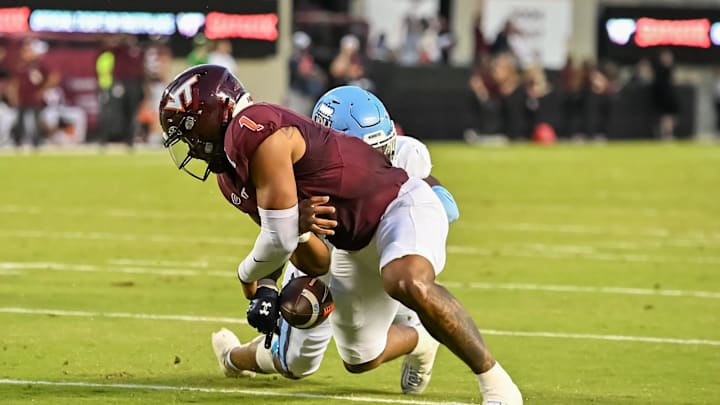
William “Pop” Watson III has had moments that suggest intrigue, particularly against lesser competition, where his athleticism and confidence have been able to shine. However, when the level of play ramped up, the results were far less encouraging. In limited action against Duke, Minnesota and Miami, Watson struggled to stay upright, absorbing a combined 14 sacks across those three contests.
POP. WATSON. III. 💪😤 pic.twitter.com/SMCK6HpNvL
— Virginia Tech Football (@HokiesFB) November 22, 2025
There were flashes that hinted at potential, though. Against Miami, with Virginia Tech mired in offensive stagnation, Watson briefly injected life into the unit, engineering a touchdown drive that gave the Hokies a pulse. Yet even that moment came with an asterisk. Following a successful onside kick that briefly swung momentum, Watson’s ensuing fumble, one he couldn’t recover, effectively extinguished what little hope remained of a comeback. Those sequences encapsulate the dilemma: glimpses of promise undercut by mistakes that proved costly.
Because of that, the notion that Virginia Tech’s next starting quarterback will emerge internally feels increasingly unlikely; 2025 third-stringer Garret Rangel is hitting the transfer portal, while AJ Brand and Kelden Ryan are entering their redshirt freshman campaigns. That reality pushes the conversation toward the transfer portal and, by extension, toward a broader philosophical question about what the Hokies should prioritize at the position.
In my view, this is an opportunity for Virginia Tech to pivot. The phrase “dual-threat quarterback” has become something of a buzzword in recent years, often used as a catch-all rather than a precise descriptor. Too frequently, it’s been treated as a prerequisite rather than a luxury. While mobility has its place, chasing that archetype hasn’t consistently yielded results for the Hokies.
Instead, there’s a compelling argument for leaning toward a true pocket passer: someone who can process quickly, deliver the ball on time and bring a level of stability to an offense that has lacked it for much of the past decade. That doesn’t mean ignoring athleticism altogether, but it does mean placing a greater premium on decision-making and command of the offense than on designed quarterback runs or off-schedule improvisation.
Perhaps, then, this moment calls for something new. Or, at the very least, something different from what Virginia Tech has tried repeatedly with limited success. Reinventing the offensive identity isn’t without risk, but standing pat carries its own. Given the program’s struggles to find sustained offensive footing over the last ten years, it’s fair to ask whether a philosophical shift could do more harm than good.
But the clock is already ticking. Virginia Tech has 253 days until its 2026 season kicks off on Sept. 5 against VMI.
More Virginia Tech Football News:
 Add us as a preferred source on Google
Hughes serves as Virginia Tech On SI's lead editor, a position that he has held since July 2025. Hughes is a junior at Virginia Tech majoring in sports media and analytics. He also serves as the open-wheel correspondent for the motorsports outlet Steering Wheel Nation, where he has written on Formula 1, the NTT IndyCar Series, the NASCAR Cup Series and the NASCAR CRAFTSMAN Truck Series. Hughes has previously authored bylines in 3304 Sports, Virginia Tech's multimedia student journalism outlet.
Follow thomashughes_05