
Hughes: Hitting Bottom Forced a Breakthrough for Virginia Tech Football
In this story:
There’s a strange clarity that comes when a program finally hits the floor. For Virginia Tech football, the bottom suddenly dropped. First, it was a 24-13 loss to South Carolina fueled by an anemic offensive display.
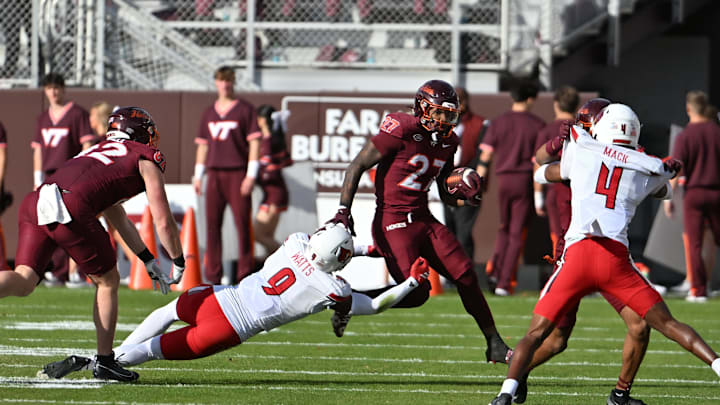
Then, a 44-20 collapse to Vanderbilt where the proverbial faucet was shut off in the second half. And finally, a 45-26 evisceration at the hands of Old Dominion. At one point, Virginia Tech trailed 31-0.
For fans that I talked to, it was painful, frustrating and, at times, disheartening. But it also did something the previous few years of middling results never could: it forced the administration to act.
Message to Hokie Nation from Brent Pry: pic.twitter.com/i0w28aYokF
— Virginia Tech Football (@HokiesFB) September 14, 2025
For a decade, the Hokies lived in a purgatory of “not bad enough to overhaul, not good enough to satisfy.” The decline from national contender to middle-of-the-pack wasn’t sudden. It was gradual enough to be tolerated, even rationalized; consequently, that allowed complacency to seep into the program. A couple of late-season pushes here, a plethora of bowl appearances entering at 6-6 there.
Then the dam finally broke.
Sept. 14 was the moment the administration could no longer view the program through the nostalgia of its own past. It stripped away the illusion of stability and made it impossible to pretend that minimal tweaks could restore the Hokies to relevance. Once that truth was unavoidable, the university had no choice but to acknowledge, publicly and financially, that the direction of the program was unacceptable.
And that’s exactly what happened.
The recent announcement of a $229 million investment over the next four fiscal years represents more than a budget line; rather, it’s the clearest proof yet that hitting rock bottom served a purpose. While roughly $120 million of that total comes from philanthropic support, the number still reflects a dramatic shift in how Virginia Tech plans to resource football and the broader athletic department. It’s the kind of reinvestment that doesn’t happen when a program is treading water. It happens when the floor gives way and leadership is forced to decide what it truly wants to be and how to improve from a substandard past.
It signals that the university is no longer content to rely on history, reputation or the memories of Lane Stadium at its loudest. Facilities, staffing, recruiting infrastructure, player development — these are the battlegrounds of modern college football, and the Hokies had fallen behind. The bottom made that obvious. The investment is the response.
That’s the hidden benefit of collapse: it resets the standard.
The rebuild under Brent Pry showed fleeting signs of momentum, but momentum only matters when it’s matched with institutional backing. Now, it finally is. The new financial commitment gives the Hokies a runway they haven’t had in years, one built on more than nostalgia or hope. It’s a statement that the era of drifting is over.
Virginia Tech had to break to move forward. It had to see the bottom to understand what was required to climb out. And now, for the first time in a long time, the steps being taken match the size of the problem.
Sometimes the best thing that can happen to a program is also the hardest thing to watch. For the Hokies, the collapse wasn’t the end. Rather, it was the catalyst to a potentially bright future.
Virginia Tech football's 2026 schedule kicks off on Sept. 5 against VMI in Lane Stadium.
More Virginia Tech Football News:
 Add us as a preferred source on Google
Hughes serves as Virginia Tech On SI's lead editor, a position that he has held since July 2025. Hughes is a junior at Virginia Tech majoring in sports media and analytics. He also serves as the open-wheel correspondent for the motorsports outlet Steering Wheel Nation, where he has written on Formula 1, the NTT IndyCar Series, the NASCAR Cup Series and the NASCAR CRAFTSMAN Truck Series. Hughes has previously authored bylines in 3304 Sports, Virginia Tech's multimedia student journalism outlet.
Follow thomashughes_05