%22%3E%0A%3Cpath%20d%3D%22M0%205.12903H12.8817C17.559%205.12903%2020.5268%206.30107%2022.3762%208.13977C23.9569%209.7204%2024.7848%2011.6881%2024.7848%2014.3978V14.4731C24.7848%2018.3118%2022.7848%2020.9892%2019.5805%2022.5375L25.7203%2031.5052H15.6558L10.6774%2023.9676H8.79565V31.5052H0V5.12903ZM12.6236%2017.6773C14.7311%2017.6773%2016.0107%2016.7311%2016.0107%2015.1182V15.043C16.0107%2013.344%2014.6881%2012.5161%2012.6558%2012.5161H8.81716V17.6773H12.6236Z%22%20fill%3D%22white%22%2F%3E%0A%3Cpath%20d%3D%22M25.8506%2021.3008V21.2256C25.8506%2015.4191%2030.6785%2010.4514%2037.4527%2010.4514C44.2268%2010.4514%2048.9795%2015.3546%2048.9795%2021.1503V21.2256C48.9795%2027.032%2044.1516%2031.9997%2037.3774%2031.9997C30.6032%2031.9997%2025.8506%2027.0965%2025.8506%2021.3008ZM40.7752%2021.3008V21.2256C40.7752%2019.1933%2039.2699%2017.5697%2037.3882%2017.5697C35.5064%2017.5697%2034.0763%2019.1933%2034.0763%2021.1503V21.2256C34.0763%2023.2578%2035.5817%2024.8814%2037.4634%2024.8814C39.3451%2024.8814%2040.7752%2023.2578%2040.7752%2021.3008Z%22%20fill%3D%22white%22%2F%3E%0A%3Cpath%20d%3D%22M50.4629%2021.3762V21.301C50.4629%2014.7849%2054.3768%2010.4516%2059.237%2010.4516C62.3661%2010.4516%2064.0972%2011.8064%2065.4198%2013.2795V4H73.9681V31.5052H65.4198V28.9784C64.022%2030.4837%2062.4413%2031.9891%2059.3123%2031.9891C54.3338%2031.9891%2050.4629%2027.6558%2050.4629%2021.3655V21.3762ZM65.6133%2021.258V21.1827C65.6133%2019.1505%2064.1402%2017.4945%2062.1833%2017.4945C60.2263%2017.4945%2058.7532%2019.1182%2058.7532%2021.1827V21.258C58.7532%2023.3332%2060.2263%2024.9461%2062.1833%2024.9461C64.1402%2024.9461%2065.6133%2023.3225%2065.6133%2021.258Z%22%20fill%3D%22white%22%2F%3E%0A%3Cpath%20d%3D%22M76.0537%2021.3333V21.2581C76.0537%2015.1183%2080.4623%2010.4409%2086.6451%2010.4409C93.9569%2010.4409%2097.3439%2015.5269%2097.3439%2021.7849C97.3439%2022.2366%2097.3439%2022.7634%2097.3009%2023.215H84.0752C84.6773%2025.0215%2086.1074%2025.9677%2087.9569%2025.9677C89.5053%2025.9677%2090.7848%2025.2473%2092.1397%2023.8602L96.731%2027.5161C94.6988%2030.1505%2091.7956%2031.9999%2087.344%2031.9999C80.6021%2031.9999%2076.043%2027.7419%2076.043%2021.3333H76.0537ZM89.5375%2019.4516C89.344%2017.4946%2088.1827%2016.3656%2086.6773%2016.3656C85.172%2016.3656%2084.2257%2017.5699%2083.9677%2019.4516H89.5483H89.5375Z%22%20fill%3D%22white%22%2F%3E%0A%3Cpath%20d%3D%22M98.7305%2021.3008V21.2256C98.7305%2015.4191%20103.558%2010.4514%20110.333%2010.4514C117.107%2010.4514%20121.859%2015.3546%20121.859%2021.1503V21.2256C121.859%2027.032%20117.031%2031.9997%20110.257%2031.9997C103.483%2031.9997%2098.7305%2027.0965%2098.7305%2021.3008ZM113.655%2021.3008V21.2256C113.655%2019.1933%20112.15%2017.5697%20110.268%2017.5697C108.386%2017.5697%20106.956%2019.1933%20106.956%2021.1503V21.2256C106.956%2023.2578%20108.462%2024.8814%20110.343%2024.8814C112.225%2024.8814%20113.655%2023.2578%20113.655%2021.3008Z%22%20fill%3D%22white%22%2F%3E%0A%3Cpath%20fill-rule%3D%22evenodd%22%20clip-rule%3D%22evenodd%22%20d%3D%22M131.368%204.36764C137.191%20-1.45588%20146.632%20-1.45588%20152.456%204.36764C158.279%2010.1912%20158.279%2019.6324%20152.456%2025.4559L141.912%2036L131.368%2025.4559C125.544%2019.6324%20125.544%2010.1912%20131.368%204.36764ZM134.009%207.55761C133.948%207.86849%20133.916%208.39718%20133.916%209.14566V10.4189C133.916%2011.1832%20133.948%2011.7198%20134.013%2012.0267C134.078%2012.3317%20134.278%2012.6168%20134.617%2012.8762C134.956%2013.1376%20135.403%2013.3316%20135.958%2013.4623C136.512%2013.593%20137.1%2013.6583%20137.837%2013.6583C138.573%2013.6583%20139.217%2013.591%20139.769%2013.4524C140.322%2013.3158%20140.761%2013.1178%20141.086%2012.8604C141.411%2012.6029%20141.605%2012.3178%20141.666%2012.0069C141.728%2011.6961%20141.759%2011.1674%20141.759%2010.4189V9.14566C141.759%208.38134%20141.728%207.84473%20141.662%207.53781C141.597%207.23287%20141.397%206.94972%20141.058%206.68834C140.72%206.42696%20140.272%206.23291%20139.718%206.10223C139.163%205.97154%20138.536%205.90619%20137.839%205.90619C137.102%205.90619%20136.459%205.97352%20135.906%206.11213C135.352%206.24875%20134.914%206.44677%20134.589%206.70418C134.265%206.9616%20134.071%207.24673%20134.009%207.55761ZM139.276%2024.8638C142.876%2024.8638%20144.557%2024.2064%20144.557%2021.862V21.858V21.3155C144.557%2019.6581%20143.516%2018.971%20140.252%2018.3136C139.278%2018.1136%20138.908%2017.9136%20138.908%2017.3136V16.9414C138.908%2016.6543%20139.177%2016.5117%20139.413%2016.5117C139.749%2016.5117%20139.918%2016.7137%20139.918%2016.9414V18.1136H144.391V17.3988C144.391%2015.4563%20143.347%2014.4266%20139.177%2014.4266C136.15%2014.4266%20133.896%2015.3414%20133.896%2017.3711V17.7433C133.896%2019.5155%20134.805%2020.3155%20138.201%2021.0303C138.28%2021.0472%20138.355%2021.063%20138.427%2021.0781C139.329%2021.2674%20139.647%2021.3341%20139.647%2021.9174V22.2897C139.647%2022.6619%20139.546%2022.8045%20139.142%2022.8045C138.67%2022.8045%20138.637%2022.5471%20138.637%2022.262V21.2897H133.894V21.7471C133.894%2024.149%20135.476%2024.8638%20139.276%2024.8638ZM145.424%2024.5569H149.925V14.7355H145.424V24.5569ZM146.955%2013.5019H149.925V6.06064H147.092V9.411L145.193%206.06064H142.359V13.5019H145.193V10.1199L146.955%2013.5019ZM138.269%2012.152C138.204%2012.2688%20138.055%2012.3262%20137.825%2012.3262L137.827%2012.3282C137.604%2012.3282%20137.459%2012.2767%20137.398%2012.1757C137.336%2012.0748%20137.305%2011.8074%20137.305%2011.3758V7.90068C137.305%207.51852%20137.352%207.28684%20137.445%207.20962C137.538%207.13239%20137.675%207.09279%20137.851%207.09279C138.059%207.09279%20138.198%207.14031%20138.265%207.23734C138.332%207.33239%20138.366%207.55416%20138.366%207.90068V11.3203C138.366%2011.7579%20138.334%2012.0352%20138.269%2012.152Z%22%20fill%3D%22white%22%2F%3E%0A%3C%2Fg%3E%0A%3Cdefs%3E%0A%3CclipPath%20id%3D%22clip0_15247_3552%22%3E%0A%3Crect%20width%3D%22157%22%20height%3D%2236%22%20fill%3D%22white%22%2F%3E%0A%3C%2FclipPath%3E%0A%3C%2Fdefs%3E%0A%3C%2Fsvg%3E%0A)
Southern Rock Pioneer Henry Paul Chronicles 5 Decades of Outlaw Country
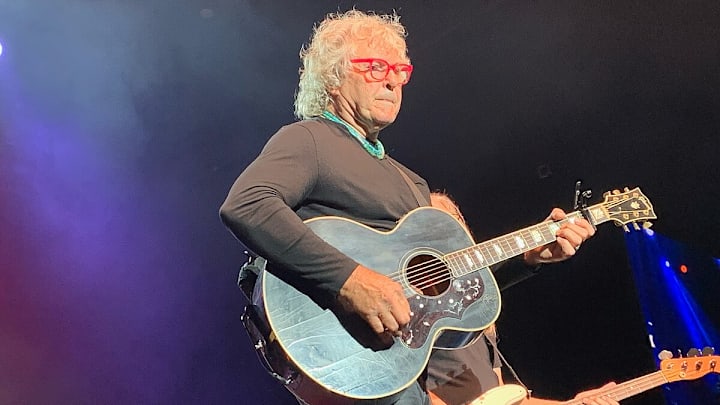
From coffeehouse grit to arena stages, Henry Paul’s journey is a masterclass in staying true to your voice—even when the industry changes around you. In “The Last Outlaw,” he doesn’t just tell his story—he honors the legends, the losses, and the legacy that shaped him.
Rodeo On SI was honored to spend some time talking with Paul and learning about his new memoir.
One of the standout quotes from Paul, “It’s not about being a household name. It’s about doing what you set out to do—and knowing you did it with heart.”
Enjoy our conversation.
SI: First off, congratulations on the book. How did all this come about—what made you decide to start writing?
HP: Good question—and thanks for the kind words. Honestly, when I first decided to do this, I had no idea what it would entail. It’s been an absolute beast of a process. But over the years, people kept suggesting I write a book, mostly because of my proximity to the mid-’70s Southern rock phenomenon.
When you look around at who was part of that scene... well, no one’s left. I swear, I’m one of maybe two or three people still standing from that era. The rest, sadly, are gone. And I still had my wits about me—I could put a sentence together, I had a good memory, and I remembered the details, the people, the stories.
I kept telling myself I’d do it on my own. But time would pass, and it wouldn’t get done. There was always something, a new record, a tour, life getting in the way. Finally, I reached out to Gary Hertz, who was my product manager at Arista back in the mid-’90s when we released “The Outlaws”’ greatest hits. He used to write my bios and press releases.
I asked him, “Would you want to try and do this together?” He said, “Well, I’ve never written a book.” And I said, “Neither have I.” But it turned out to be a great collaboration.
I laid everything out on a grid—about 30 segments, each reflecting a different time frame. Then I’d sit down with a handheld recorder, look at the section we were working on, and just talk through it in detail. That gave Gary a lot to work with. He’d run it through a program to convert it to text, then go through and polish it—add some structure, clean it up. It really worked.
SI: At what point did you realize—after five decades of stories and music—that you had a memoir in you? When did you really commit to writing it?
HP: That moment came about two years ago. We wrapped the manuscript late last year, and honestly, just thinking about it makes me tired. We were tweaking it right up until print time. I remember thinking, “This reads well.” We’re good. We’re done.” But we weren’t even close to done.
It’s a self-published book, so we had to go the extra mile to make it competitive—like we were going up against Simon & Schuster or whoever. We wanted it to reflect real effort and care. We crossed all the T’s, dotted the I’s. The book looks good, it reads well, the photographs are interesting. And now, it’s one more thing I can hold up and say, “I did this.” That means a lot to me.
SI: How did you decide what to include in the book? I imagine you’ve got several volumes worth of stories.
HP: Yeah, you’re right—I’ve thought about that a lot. After the fact, I realized if I ever wanted to go back and elaborate on what Gary and I put together, there’s definitely enough material. Not everything made it in. Some things probably deserved to be part of it but got overlooked. That’s the nature of storytelling—you always look back and think, “I could’ve done this better,” or “I should’ve added that.”
But what I really wanted was a kind of documentary—a reflection of the idea that you could live three separate careers in one lifetime: “The Outlaws,” “Henry Paul Band,” and then “Blackhawk.” And to come full circle, becoming the caretaker of both “The Outlaws” and the “Blackhawk” brand. “Henry Paul Band” still performs occasionally, but it’s a lot of work pulling everyone together, and I’ve had so much on my plate.
This book was a way to put a reflective image around my life and my work. I love that I did it. I can hold it up and say, “There it is. This is what I did.”
You know, people with steady jobs—they’ve got medical insurance, retirement plans, all that. You look at them and think, “Wow, I envy that.” It’s affordable, it’s respectable, and it’s secure. But for someone like me, self-employed my whole life, I’ve got 40 or 50 long-playing records and now a couple of books. That’s my legacy. That’s what I leave behind to remind people I was here. And not everyone gets that.
SI: I mean, your impact spans generations. You’ve toured with legends like Skynyrd, and your music has shaped lives. How do you see your role in all that?
HP: People applaud when I go to work, and that’s something I never take for granted. Music hits people differently. For some, it’s everything—for others, it’s just background noise. I can’t wrap my head around that. I don’t understand how music isn’t the core of everyday life. It’s how we feel, how we remember, how we connect.
Some folks just aren’t wired that way emotionally. Their elevator doesn’t go all the way up, you know? They’re focused elsewhere.
Just this morning, I was driving to school with the kids, and Rachel was reading me something about the state of the country. How America’s become this chaotic scramble—people cutting each other off in traffic, politics in disarray, religious division everywhere. It’s a mess. You’ve got folks moving overseas, chasing a simpler life in places like Sardinia.
And I get it. There’s a part of me that’s entertained that idea. But I don’t live in that world. I’m not in rush hour traffic every morning, fighting that dogfight. My life’s been different. Music gave me a different path.
SI: Over the last 50 years, what moments—on or off stage—have really shaped who you are? Or has it been more of a combination of everything?
HP: It’s definitely been a combination, but there were life-changing moments along the way. They tend to run together in the rhythm of everyday life, especially when you’re driven by the ambition to stay relevant in a line of work that actually means something.
One of the biggest moments was the night Clive Davis walked into our dressing room and told us he was signing us to Arista Records. That was a dream come true. It wasn’t some casual, incidental thing, it was a major turning point in my life. That night is way up there on the list.
Then there were surreal moments, like having Mick Jagger or Keith Richards come into our dressing room after we played a show ahead of their set. They complimented us, hung out, talked—on equal footing. I mean, it might not be “The Beatles,” but it’s “The Rolling Stones.” That’s no small thing.
Then going to Europe, playing with “The Who”—sharing the stage with Pete Townshend and Roger Daltrey, sitting around, and talking with them. Those are three very distinct, unforgettable moments.
The Atlantic Records deal with the Henry Paul Band was another huge milestone. It was a growth opportunity for me as a band leader putting my name on a band and landing my second major label deal.
Later in life, returning to Arista with “Blackhawk” was such a gift. It was a reward for persistence, and it turned out to be the most commercially successful of all three bands. I still love the “Blackhawk” musical persona, though “The Outlaws” were my first love.
That part of my story is rare. Most people are lucky to get one big shot. I’ve had three truly significant ones—and that’s pretty incredible.
SI: Was there any particular chapter in the book that was harder to write than the rest?
HP: Absolutely. The hardest chapter was about being asked to leave a band I helped found—one where I was the frontman and a core part of its musical identity. That moment was mortifying.
I’m sure you’ve had your own bouts of rejection. Nobody gets through life without being shown the door at some point. But this one cut deep. It was hurtful, polarizing... there were tears when I realized what had happened.
But I was motivated to move forward. I fought back, recreated myself, and reclaimed my place in the bigger picture. I won that war by being tenacious and refusing to give up. That chapter was tough to write, but it was also a turning point—and I think it shows.

SI: This book covers a lot, but one thing I know about you personally is the loss of your dear friend Van Stevenson. How did that affect you—your music, your life—and you’re involved with the Cancer Foundation in his name, right?
HP: Yes. I started a nonprofit in Van’s name and have donated over $500,000 to Vanderbilt’s cancer research lab. He was an incredibly instrumental figure in my life—not just musically, but personally. As an adult, Van taught me how to communicate, how to sort through things instead of sweeping them under the rug and letting them fester into resentment. He was successful in the AA program, and that gave him clarity and emotional intelligence that really impacted me.
He was an unusually gifted songwriter. Being in a room with him, being in a band with him—on and off stage—was a huge part of my life. He was complex, deeply artistic, and layered. Like many of us, he had a lot going on beneath the surface, but in his case, those layers were especially rich.
Van was one of those rare gifts life gives you when you least expect it. Sweet, smart, and incredibly talented. He had an enormous influence on me, and I carry that with me every day.
SI: Okay, to lighten things up—I have to ask. What’s the story behind actually living with Bette Davis’s cat?
HP: Yeah, that’s a wild one. I was working for a bookstore in New York, and my job was to drive around Manhattan and the boroughs in a Pontiac station wagon. I’d pick up review copies—books publishers sent out for promotion—and also personal collections people sold to the store. We’d go in, take inventory, settle on a price, write a check, box everything up, and I’d haul it back to the shop.
One day, I ended up at Bette Davis’s apartment. She had an assistant who handled everything for her. I was loading up the books she’d sold, and as I was wrapping up, the guy in charge said, “Mrs. Davis has moved to Connecticut and doesn’t have room for her cat.” He pointed to this massive male cat named Harry Lime—named after the Orson Welles character in “The Third Man”—and said, “He’s looking for a home.”
I said, “I’d love to have Harry.” He was huge—probably two feet long and 20 pounds. So, I got the cat, the litter box, and a bag of food, loaded him into a travel bag, and stuck him in the front seat of the station wagon. On the way back to the bookstore, I stopped at my apartment, set him up with food and litter, and went back to work. At the end of the day, I came home—and there was Harry, my cat.
I’m not necessarily a cat person, but I don’t hate them either. And Harry was just... charismatic. Big, beautiful, and full of personality. He lived with me until I moved back to Florida, and when I did, I took him with me. My friend’s wife down there loved cats, and when I moved out, she kept Harry until he passed away.
It was kind of poetic—like every other guy from New York who’s lucky enough to retire in Florida, Harry did too.
SI: That’s such a New York story. Everyone’s there. I mean, you even met Gene Shalit, right?
HP: Yeah! I went to NBC Studios to pick up books from him. He had that big curly hair, the mustache, the glasses—you know the look. While I was waiting, I wandered onto the Tonight Show set. This was around 1970 or ’71, and like the rest of the country, I was a huge Johnny Carson fan.
I sat in his chair; saw the row of pencils he always fiddled with... I don’t know, it was just one of those moments. New York was full of them. So memorable.
SI: Thinking back to your early days in New York—playing coffee shops, chasing the dream—did you have any idea that 50 years later you’d still be going strong?
HP: Good question. Of course, you can’t see into the future. Back then, it was just about putting one foot in front of the other. But I knew I wanted to be an artist—not necessarily a recording artist, but someone in the business of self-expression. I was committed to that idea, and I knew deep down it would become my life’s work. Mostly because I knew what I didn’t want to do.
I pursued my career with a level of commitment that probably made up for some of my shortcomings, talent-wise. It was hard work, nonstop ambition. I was always standing on the gas, trying to get it to go—dragging the band up the road to success on sheer willpower and drive.
So no, it doesn’t surprise me that I found success. It doesn’t surprise me that I stayed in it. There were times, sure, when I got shown the door—when the phone stopped ringing and I had to fight my way back in. You go from being someone to no one in a moment, and you’ve got to claw your way back.
When I left “The Outlaws” in the late ’80s and decided to start over in Nashville at the age of 41 or 42, I was past my youth—but I didn’t feel it. I’d started running, lost weight, was in great shape, had long brown curly hair. I looked and felt younger than I was.
Later in my career, working in my home studio, I learned how to become a better singer—just by listening to myself record demos. I was the epitome of preparation meeting opportunity. And when I stepped into that next chapter, it was enormous.
My relationship with Van was deep. My relationship with Dave was more distant, but still respectful. The people I worked with in Nashville—it wasn’t like the rock ’n’ roll scene, which was all smoke and mirrors. It was real. Substantial. You were writing songs that mattered—lyrically and musically.
That late-in-life revelation is still part of me today. The “Blackhawk” brand means so much to me—it’s joyful, it’s alive. And “The Outlaws”? That was my first love. It was my ticket to a dream come true. We told everyone who would listen that we were going to be somebody. Thank God, we got lucky and became someone.
I’m not a household name, but I got to do what I set out to do. And I’m thankful for that.
SI: I’m assuming “The Last Outlaw” came from the fact that you literally are the last of “The Outlaws”?
HP: Yes. There’s one other original member still alive, but he’s very ill and can’t play anymore. He and I are very close. The rest of the band left much earlier.
So yeah, it’s like—I’m next. I’m not in the on-deck circle anymore, I’m in the batter’s box. My strikes will be up, and my balls... well, not to coin a phrase, but I’ll be somewhere else soon enough.
I’ve come to terms with my mortality. I’ve reconciled my accomplishments, my effort, and my place in all of it. I’m still learning how to navigate life, but I’m better at it than I used to be.
SI: Over the span of your career, what do you think has been the biggest change in the music industry?
HP: Honestly, I think it’s the collapse of the music industry itself. Major labels, what used to be the backbone of everything, will probably be gone within a decade. There’s no real income stream anymore. Back then, it was all about selling a recording. That was the model. You sold records, tapes, CDs... and that’s how you made a living.
Now, music’s just out there in the atmosphere. It’s everywhere, but there’s no reliable way to monetize a musical career. Sure, people still love you enough to pay money to come see you live, and that’s a blessing. But the record industry? It’s all but gone.
And that’s sad in a way. Yes, labels were often vilified—exploitive, opportunistic—but they were also responsible for launching the careers of the artists who mean everything to us. Without a major label, you never heard of anyone. From Elvis to “The Beatles” to Garth Brooks—it was all built on that infrastructure, and now, it’s disappearing.
SI: Back in the day, record labels were the only way to go. Being an independent artist was almost taboo—some even saw it as self-sabotage. Now, being independent is more mainstream. What’s your take on that shift?
HP: It’s important—more so than anything. But back then, being with a major label was a trade. You gave up some things—musically, visually. There were compromises. I’m fiercely independent, and I remember the girl who ran the art department for our video shoots used to get on me about how tight my pants were. I told her, “Don’t worry yourself over what I wear.”
She wanted to dress me up, take me to the Buckle store, and get me something weird. But I remember one shoot—I wore a T-shirt that said Live at the Fox. It was the same shirt Ronnie Van Zant wore when Skynyrd recorded their live album at the Fox Theatre in ’76. I was on that show both nights. Ronnie was a friend. That shirt meant something.
I told her, “I’m wearing this.” And all these years later, one of the most redeeming things about that video is the T-shirt. I wouldn’t let go of it. We shot the video my way, and that shirt still stands out. It’s kind of a metaphor for our career—you have to fight for what matters. You have to know when you’re right.
She didn’t know who Ronnie was. She didn’t know the album. She didn’t know the story. She just needed to be quiet and let me wear what I wanted—because it meant something. It was my video.
That’s how it goes with major labels. There’s compromise. And you’ve got to be careful not to bend over too far to pick up the dime—because you can get hung out to dry.
SI: If you could go back to Greenwich Village and talk to your younger self, what advice would you give?
HP: I think I’d tell him not to be so naïve. It’s hard to put into words, but I wish I’d understood earlier the effect I had on people—and what that meant. Sometimes, the results of that connection were complicated.
I got into people’s lives more than I probably should have. I’ve always embraced the human spirit, and I still have a lot of people I consider friends. But looking back, I think I could’ve been a little less invested, a little more guarded—especially with fans.
I bent over backwards to be there for people, even when it meant stepping into parts of their lives that had nothing to do with my own, nothing to do with my children, my wife, my immediate family. Sometimes the lines got blurry. And if I could go back, I’d tell myself to protect those boundaries a little more.
SI: What do you hope your longtime fans—and those who read The Last Outlaw—will take away from it?
HP: I think they’ll see it as a documentary of how it all happened. Who did what, how the pieces came together. I leaned into the factual side of things—it’s steeped in emotion, sure—but it’s really an honest impression of how “The Outlaws” became who they were, how the Henry Paul Band came to be, and how “Blackhawk” found its voice.
It’s also about the people who left an impression on me—Ronnie Van Zant, Tommy Caldwell from the Marshall Tucker Band, his brother Toy, Dickey Betts, and Greg Allman. Greg and I were close for a while in the late ’70s, and it meant a lot to me to be his friend because of his artistic integrity.
The book lays it all out—no judgment, no finger-pointing. It sticks to the story and lets it breathe. It just tells the freaking story and lets it go.
Co-written with industry veteran Gary Hertz and featuring a foreword by Oscar® winner Billy Bob Thornton, The Last Outlaw recounts Paul’s musical journey from Greenwich Village folksinger to co-founding the Outlaws, the first rock act signed to Clive Davis’ Arista Records and whose 1975 debut album featured the enduring Southern Rock anthem “Green Grass and High Tides”. Tours with Lynyrd Skynyrd, The Allman Brothers, The Marshall Tucker Band, The Charlie Daniels Band, The Who and The Rolling Stones followed, but with triumphant performances and chart successes came internal strife, addiction, and being asked to leave the band he’d formed. Paul rebounded with The Henry Paul Band, releasing a series of acclaimed albums on Atlantic Records as well as the 1981 Pop radio hit “Keepin’ Our Love Alive”. In the '90s, Paul co-founded Country trio Blackhawk, whose first three Arista Nashville albums sold over seven million copies before tragedy struck with the death of bandmate Van Stephenson. Today, Paul has kept both Blackhawk and the Outlaws alive as popular recording and touring entities while simultaneously overseeing an equally successful cancer foundation in Stephenson’s name.
The Last Outlaw – which also commemorates the 50th Anniversary of the Outlaws’ debut album release – is a powerful memoir filled with loyalty and loss, fame and fallout, and the enduring power of music. It’s also the unbelievably true story of a determined and talented artist who’s crossed paths with Tom Waits, Keith Moon, Dick Clark, Barry Gibb, psychotic Southies, armed hippie radicals and Bette Davis’s cat, all while navigating the life of a working performer and family man.
About the Authors:
Henry Paul is the co-founder of the legendary Southern Rock band Outlaws, founder of ‘80s hitmakers The Henry Paul Band, co-founder of the multi-Platinum Country act Blackhawk, and author of the children’s book Mr. Staubel’s Dusty Cupcakes. He lives with his wife Rachael and their sons Jackson & Greyson on Big Guitar Farm outside Nashville, Tennessee.
Gary Hertz attended his first Outlaws concert in the ‘70s, saw The Henry Paul Band open for The Allman Brothers in the ‘80s, and worked with Blackhawk – as well as overseeing the Best of the Outlaws: Green Grass & High Tides album – at Arista Records in the ‘90s. Since then, he’s been a ghostwriter, screenwriter, DVD/Blu-ray producer, and marketing/branding consultant. He lives and writes in Vancouver, British Columbia and on Manhattan’s Upper West Side.
For more information please contact:
Denise Carberry
Ph: 516-680-2040
Email: dcarberry@newrhodesconsulting.com
Recommended Articles
 Add us as a preferred source on Google
Tresha Glowacki grew up on a dairy farm in East Tennessee, where hard work and storytelling went hand in hand. Now living in Texas, she’s a devoted writer with a love for all things Western-horses, rodeos, and music. Her writing reflects the life she lives: grounded, spirited, and full of heart. When she’s not riding or writing, she’s spending time with her kids and animals that keep her world turning.