%22%3E%0A%3Cpath%20d%3D%22M0%205.37646H8.15061L17.4195%2016.8819V5.37646H26.0647V31.4412H18.3227L8.64523%2019.4196V31.4412H0V5.37646Z%22%20fill%3D%22white%22%2F%3E%0A%3Cpath%20d%3D%22M29.2041%205.37649H43.8064C47.4193%205.37649%2049.6989%206.1937%2051.2258%207.72059C52.1505%208.64533%2052.8172%2010.0002%2052.8172%2011.7851V11.8497C52.8172%2014.9465%2050.9462%2016.8389%2048.172%2017.8067C51.5269%2018.7744%2053.6774%2020.5594%2053.6774%2024.1293V24.1938C53.6774%2028.3659%2050.258%2031.4197%2043.6558%2031.4197H29.2041V5.35498V5.37649ZM44.258%2013.7637C44.258%2012.6024%2043.3333%2011.9787%2041.4623%2011.9787H37.6988V15.6346H41.5053C43.3763%2015.6346%2044.258%2015.011%2044.258%2013.8497V13.7852V13.7637ZM42.0859%2020.9895H37.6988V24.8605H42.0644C43.9569%2024.8605%2044.9247%2024.0863%2044.9247%2022.968V22.9035C44.9247%2021.7852%2043.9999%2021.011%2042.0859%2021.011V20.9895Z%22%20fill%3D%22white%22%2F%3E%0A%3Cpath%20d%3D%22M64.8174%205.18286H73.4627L84.452%2031.4411H74.9896L73.6132%2027.9357H64.4949L63.1615%2031.4411H53.8496L64.8389%205.18286H64.8174ZM71.4412%2021.7636L69.054%2015.441L66.6669%2021.7636H71.4412Z%22%20fill%3D%22white%22%2F%3E%0A%3Cpath%20d%3D%22M95.2695%205.37646H105.248C115.592%205.37646%20120.775%2010.4733%20120.775%2018.1938V18.2583C120.775%2025.9788%20115.485%2031.4412%20104.947%2031.4412H95.2695V5.37646ZM104.001%2012.9679V23.8497H105.463C109.442%2023.8497%20112.022%2022.2153%20112.022%2018.4518V18.3873C112.022%2014.6239%20109.463%2012.9894%20105.463%2012.9894H104.001V12.9679Z%22%20fill%3D%22white%22%2F%3E%0A%3Cpath%20d%3D%22M123.098%2011.1182H131.549V15.2258C132.711%2012.4731%20134.56%2010.6881%20137.915%2010.8387V19.8065H137.012C133.442%2019.8065%20131.528%2021.785%20131.528%2026.2797V31.4625H123.076V11.1182H123.098Z%22%20fill%3D%22white%22%2F%3E%0A%3Cpath%20d%3D%22M137.808%2025.6772V25.6127C137.808%2021.5482%20140.818%2019.2901%20145.55%2019.2901C147.27%2019.2901%20149.464%2019.6557%20150.345%2020.0428V19.6987C150.345%2017.8277%20149.184%2016.7524%20146.582%2016.7524C144.496%2016.7524%20142.754%2017.204%20140.969%2017.9137L139.485%2012.3008C141.829%2011.3975%20144.517%2010.8169%20148.044%2010.8169C152.173%2010.8169%20154.862%2011.6771%20156.646%2013.4621C158.173%2014.989%20158.776%2016.9675%20158.776%2019.9137V31.5052H150.324V29.4622C148.904%2030.9891%20147.012%2031.9999%20144.474%2031.9999C140.56%2031.9999%20137.808%2029.7633%20137.808%2025.7417V25.6772ZM150.431%2023.9138V23.0536C149.937%2022.86%20149.206%2022.7095%20148.496%2022.7095C146.818%2022.7095%20145.894%2023.7202%20145.894%2024.9891V25.0536C145.894%2026.2364%20146.754%2027.0321%20147.829%2027.0321C149.313%2027.0321%20150.431%2025.8493%20150.431%2023.9138Z%22%20fill%3D%22white%22%2F%3E%0A%3Cpath%20d%3D%22M162.883%2017.6345H160.496V11.1183H162.883C162.926%208.96778%20163.442%207.20433%20164.711%205.9355C166.088%204.55915%20167.872%204%20170.668%204C173.163%204%20174.69%204.21506%20175.851%204.55914V9.84951C175.034%209.65596%20174.217%209.54843%20173.141%209.54843C171.83%209.54843%20171.163%2010.0646%20171.163%2011.1829V11.3334H175.851V17.6345H171.335V31.4411H162.883V17.6345Z%22%20fill%3D%22white%22%2F%3E%0A%3Cpath%20d%3D%22M178.883%2024.6238V17.613H176.496V11.0968H178.883V6H187.335V11.0968H192.023V17.613H187.335V22.7528C187.335%2024.2797%20188.045%2024.8389%20189.378%2024.8389C190.152%2024.8389%20191.055%2024.6238%20191.937%2024.2152V30.7314C190.604%2031.4411%20188.582%2031.8927%20186.539%2031.8927C181.55%2031.8927%20178.862%2029.5916%20178.862%2024.6238H178.883Z%22%20fill%3D%22white%22%2F%3E%0A%3Cpath%20fill-rule%3D%22evenodd%22%20clip-rule%3D%22evenodd%22%20d%3D%22M201.368%204.36764C207.191%20-1.45588%20216.632%20-1.45588%20222.456%204.36764C228.279%2010.1912%20228.279%2019.6324%20222.456%2025.4559L211.912%2036L201.368%2025.4559C195.544%2019.6324%20195.544%2010.1912%20201.368%204.36764ZM204.009%207.55761C203.948%207.86849%20203.916%208.39718%20203.916%209.14566V10.4189C203.916%2011.1832%20203.948%2011.7198%20204.013%2012.0267C204.078%2012.3317%20204.278%2012.6168%20204.617%2012.8762C204.956%2013.1376%20205.403%2013.3316%20205.958%2013.4623C206.512%2013.593%20207.1%2013.6583%20207.837%2013.6583C208.573%2013.6583%20209.217%2013.591%20209.769%2013.4524C210.322%2013.3158%20210.761%2013.1178%20211.086%2012.8604C211.411%2012.6029%20211.605%2012.3178%20211.666%2012.0069C211.728%2011.6961%20211.759%2011.1674%20211.759%2010.4189V9.14566C211.759%208.38134%20211.728%207.84473%20211.662%207.53781C211.597%207.23287%20211.397%206.94972%20211.058%206.68834C210.72%206.42696%20210.272%206.23291%20209.718%206.10223C209.163%205.97154%20208.536%205.90619%20207.839%205.90619C207.102%205.90619%20206.459%205.97352%20205.906%206.11213C205.352%206.24875%20204.914%206.44677%20204.589%206.70418C204.265%206.9616%20204.071%207.24673%20204.009%207.55761ZM209.276%2024.8638C212.876%2024.8638%20214.557%2024.2064%20214.557%2021.862V21.858V21.3155C214.557%2019.6581%20213.516%2018.971%20210.252%2018.3136C209.278%2018.1136%20208.908%2017.9136%20208.908%2017.3136V16.9414C208.908%2016.6543%20209.177%2016.5117%20209.413%2016.5117C209.749%2016.5117%20209.918%2016.7137%20209.918%2016.9414V18.1136H214.391V17.3988C214.391%2015.4563%20213.347%2014.4266%20209.177%2014.4266C206.15%2014.4266%20203.896%2015.3414%20203.896%2017.3711V17.7433C203.896%2019.5155%20204.805%2020.3155%20208.201%2021.0303C208.28%2021.0472%20208.355%2021.063%20208.427%2021.0781C209.329%2021.2674%20209.647%2021.3341%20209.647%2021.9174V22.2897C209.647%2022.6619%20209.546%2022.8045%20209.142%2022.8045C208.67%2022.8045%20208.637%2022.5471%20208.637%2022.262V21.2897H203.894V21.7471C203.894%2024.149%20205.476%2024.8638%20209.276%2024.8638ZM215.424%2024.5569H219.925V14.7355H215.424V24.5569ZM216.955%2013.5019H219.925V6.06064H217.092V9.411L215.193%206.06064H212.359V13.5019H215.193V10.1199L216.955%2013.5019ZM208.269%2012.152C208.204%2012.2688%20208.055%2012.3262%20207.825%2012.3262L207.827%2012.3282C207.604%2012.3282%20207.459%2012.2767%20207.398%2012.1757C207.336%2012.0748%20207.305%2011.8074%20207.305%2011.3758V7.90068C207.305%207.51852%20207.352%207.28684%20207.445%207.20962C207.538%207.13239%20207.675%207.09279%20207.851%207.09279C208.059%207.09279%20208.198%207.14031%20208.265%207.23734C208.332%207.33239%20208.366%207.55416%20208.366%207.90068V11.3203C208.366%2011.7579%20208.334%2012.0352%20208.269%2012.152Z%22%20fill%3D%22white%22%2F%3E%0A%3C%2Fg%3E%0A%3Cdefs%3E%0A%3CclipPath%20id%3D%22clip0_15247_3640%22%3E%0A%3Crect%20width%3D%22227%22%20height%3D%2236%22%20fill%3D%22white%22%2F%3E%0A%3C%2FclipPath%3E%0A%3C%2Fdefs%3E%0A%3C%2Fsvg%3E%0A)
NBA Draft Scouting Report: Alabama Guard Labaron Philon
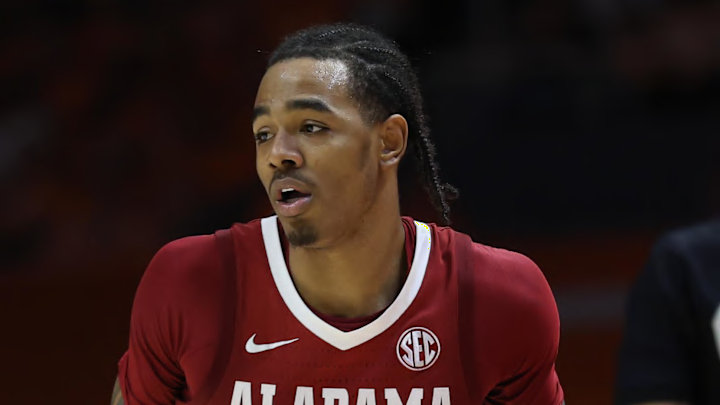
Alabama’s Labaron Philon had likely first-round stock in the 2025 draft cycle, but instead opted to return for his sophomore season with the Tide, answering numerous questions in the process and cementing himself as a top guard option in 2026.
He measured 6-2 and three-quarters at the 2025 draft combine, with a very solid 6-6 wingspan. He’s been among the best players in the entire nation for Alabama, averaging 21.4 points on 51% shooting, effectively doubling his scoring output from his freshman season. He’s a big part of what makes this 2026 guard class so deep, offering a really nice all-around option in the backcourt.
Philon’s standout strengths include his handling and craftiness, three-level scoring upside, play-making and feel, as well as pick-and-roll play.
Labaron Philon Scouting Report
Strengths:
Handling and Craftiness
Perhaps Philon’s best attribute, or at least his most unique as far as this guard class goes, is his handling of the ball and general craftiness, which are constantly on full display.
On-a-string is truly the best definition of Philon’s handling ability, which is probably best-in-class. He’s strong driving and using dribble-moves with either hand, utilizing snake-dribbles, wide crossovers, step-backs and plenty more to break down defenses. He’s not limited to simply one move and a drive, able to pair several together to create the limited space needed to squeeze shots off.
When you pair this with Philon’s general craftiness, which includes a good first step, start-stop, herky-jerky movement, quick directional changes, real speed, and the ability to finish in tons of different ways, it creates a player able to probe just about every area of the floor with ease. He has a great feel for when to keep countering and mixing things up, or simply attack the space available.
One of the primary questions surrounding Philon’s return to college was his finishing and at-rim numbers, and his progress could be the single-most comforting part of his sophomore season, with the handling and craft obviously playing a major part in this area.
Philon shot a so-so 54% at the rim in Year 1 on just 141 attempts, and through 27 games in Year 2 has boosted that to a blistering 67% on 144 attempts. That number especially points to his ability to attack space and use crafty moves to finish, given his athleticism is far from elite, and he’s not an above-the-rim player. He also has a pretty dangerous floater, taking more than two per game and hitting on an elite 48% of those.
Philon’s craftiness is also highlighted by six free throws attempted per game, as well as a .42 free throw attempt rate, both elite marks given less athleticism, and big plusses to his overall profile as a rim-pressuring scorer.
Philon’s great across numerous offensive areas, but his handling ability and subsequent craft is a sort of pillar for what makes him so effective, and it bleeds into his other areas with consistency.
Three-Level Scoring Upside
We’ve touched on one level of Philon’s scoring skillset, but his 21-and-a-half points per game with Alabama — good for third in the entire SEC conference — points to a much larger body of work offering success at all three levels. Again, that was another question-mark for him coming into his second season and he’s passed with flying colors.
Philon’s an established paint-touch, at his best working his way downhill, with his at-rim attempts account for 37% of his total field goals, adding in close-range floaters bumps that up to 53%. The rest of his scoring work comes via jumpers, on a phenomenal mix of catch-and-shoot and off-the-dribble shots.
The vast majority of his jumpers are coming from beyond the arc, which lessens his mid-range output, but it’s clear via the floater and off-the-dribble work that he’ll have enough touch to make his name in that area, and Alabama is certainly not a system that prioritizes that particular shot.
His 3-point volume has actually been spectacular for his overall profile. As a freshman he shot just 32% on three-and-a-half attempts per game, and has blossomed that to 39% on 5.7 attempts per game, which is undoubtedly his biggest development alongside the finishing ability.
His success from beyond the arc has really blown things wide open, offering up multi-level scoring ability that forces the defense to stay on their toes, never knowing whether he’s going to pull-up for what is now a pretty efficient shot, or use his choppy, fast-paced style to work his way into the paint.
And again, this is on a near-50-50 split of catch-and-shoot and off-the-dribble work, even from beyond the arc. He’s shot 78 threes off the catch and 74 off the dribble, grading ‘very good’ per Synergy on both at 41% and 34%, respectively.
He’s largely played on the ball this season with Alabama as the lead guard and initiator, but his outside numbers now indicate that he can be a workable floor-spacing option too, again adding to his versatility. There’s a ton of value in having a guard on the floor who can operate with high-usage, but also has enough touch to simply thrive alongside others too. Not that he’ll be some off-screen weapon beyond the arc, but he’s certainly displayed enough spot-up shooting success at 38% on high volume.
Philon likely isn't a finished product as a scorer, pointing to the upside part of this section in that he’ll still need work to be really potent at all three levels in the NBA. But it’s hard for a prospect to prove much more than Philon has in his second collegiate season: adept handling, crafty finishing, much improved rim and 3-point numbers, and obvious touch and feel all over the court.
The biggest concerns moving forward as his lack of elite strength or vertical athleticism, as well as his consistency in knocking down outside shots, both of which have been quelled to some degree, allowing for a pretty great offensive bet.
Play-Making and Feel
Philon’s obviously a gifted scorer, and he’s then able to parlay that into his play-making, which is also aided by his natural feel for the game.
If scoring is his primary skill, Philon’s passing is a solid secondary skill. He averaged 3.8 assists to 1.7 turnovers as a freshman, and has boosted that to just under five assists to 2.6 as a sophomore, and a believable lead-guard mark of a 32% assist rate.
Philon’s aforementioned ability to access all parts of the court is vitally important here, able to help him create unique angles and draw doubles that can lead to fairly easy one-away passes. I think this generally causes his assists to look a little simplistic, simply making the easy play more often than not, but this also speaks to his ability to create easy offense.
Philon does have some obvious passing feel, however, able to manipulate defenses, pass off a live-dribble with their hand and make tougher reads every so often. He doesn't have S-tier vision or processing speed, but again doesn’t need it to make things happen given his overall toolkit. And he does have plenty of creativity off the live-dribble, and a great sense for how actions are flowing and what’s opening up.
While some scouts and NBA decision-makers would likely prefer some higher-end passing, Philon’s skillset is at least replicable in that he’ll be able to create and capitalize on easy reads with consistency. Or if the defense doesn’t afford him attention, he’ll be able to score himself.
The second piece of good news here is that Philon’s handling ability and general feel for the game open up the potential for this area to get better and more consistent. He has clear feel, succeeding as a No. 1 option on a great Alabama team, and his upward trajectory especially leaves room for growth.
Ultimately, Philon’s baseline play-making liekly stands to get even better with time.
Pick-and-Roll Play
We’ve now touched on Philon’s upside as both a scorer and passer, and we can marry these things together in his pick-and-roll play, which accounts for the vast majority of his offense, and is an obviously important NBA skill, especially for a lead guard.
Philon’s combination of skills are made for the pick-and-roll: speed and directional quickness, crisp handling, finishing touch, pull-up scoring ability, his focus in capitalizing on easier reads. This all combines to make him one of the more effective pick-and-roll scorers in the country on high-volume.
Screening for Philon on the ball just opens up even more space for him to operate. He can also reject with consistency given his speed, and if you give him weapons there’s a good chance he’ll make something happen.
Through 27 games he’s capitalized on 247 pick-and-roll possessions, scoring 51% of his shots there for a true shooting percentage of 62%. Again, he’s at his best probing his way downhill, with two-pointers accounting for 75% of his shots in the pick-and-roll. He’s been effective in both areas though, converting on 55% from two and 41% from three.
Adding in pick-and-roll possessions counting passes, he’s run 461 total possessions, seeing the ball through the net at nearly 1.1 points per possession, and 49% shooting. We touched on the simplicity of his passing earlier, and this just closes things down even more, effectively giving him a couple different options in attacking himself, finding the roll-man or kicking out if defense over helps.
This just continues to build out Philon’s overall toolkit into what looks to be a pretty effective handler, initiator and scorer. There’s other avenues to offensive success for him outside of the pick-and-roll —the catch-and-shoot and spot-up numbers, his transition ability, his absurd efficiency as an isolation player at 1.4 points per possession despite limited volume — but his ability to cleanly run a scheme that the NBA uses on average about 18 times per game, is a great card in Philon’s hand.
Areas of Improvement:
Strength and Athleticism
There’s a few different places you could start in terms of areas of improvement for Labaron Philon, none of which would impact his all-around game more than added strength and athleticism, moreso the former given how hard it is to become a better athlete overall.
Philon officially weighed in at about 175 pounds at the ’25 draft combine, and while he’s naturally developed some over the course of the year, continuing to work on his physical profile, adding muscle and gaining useable NBA strength is going to be a real point of emphasis for him to reach his potential.
He’s still very slight and spindly for a lead guard right now, and while he’s certainly answered some questions, there are likely some still lingering in the back of decision-makers mind's in terms of the translatability to the NBA.
The NBA is drastically bigger-faster-stronger than the competition Philon’s facing right now, and there's going to be a good chance that when he hits the floor, he’ll be among the shorter, less traditionally athletic players out there. Strength can be such a boon for downhill guards, even ones that shade more toward speed and shiftiness such as Philon.
Added core strength will especially help his improving finishing ability, absorbing and powering through contact of much better rim-protectors. And it will certainly help on the defensive side of the ball as well, which we’ve yet to touch on.
Overall, becoming a stronger player able to handle the NBA’s physicality would really help to lessen any general concerns about his game. In terms of pure athleticism, he’s just not a high-rising, above-the-rim player, as showcased by his 11 dunks across 64 games in two seasons.
There’s been some cases of players becoming better athletes with some NBA years under their belt, but you can’t really count on or plan for that in scenarios such as these.
Defensive Consistency
Finally, we’ll touch on what is likely Philon’s swing skill and an obviously crucial piece to his overall puzzle: defensive consistency.
This is a bit of a loaded category for Philon. In his debut season with the Tide there were flashes of some genuinely good stuff on the defensive end. He had nearly a 3% steal percentage and a defensive-box-plus-minus of 4.1, which pointed to some tangible positive impact. He had far less offensive responsibility, allowing him to hone in on keeping the scoreboard moving in the right direction, and that included a lot of effort while defending.
This season, Philon’s been far less impressive on that end, both on tape and by the numbers. His steals and blocks per game are down, his steal and block percentages are down, his defensive-box-plus-minus has been halved at just 1.9, and I think a lot of his sophomore film backs this up.
The good happens when he uses his snappy movement to stay in front of handlers, as well has his reactive hands to poke and prod the ball away with relative consistency. He’s got the general wherewithal to make a difference when everything is sync’d up, showcasing motor, plus length, instincts and more.
The bad lies in the aforementioned strength disadvantage, which can see him ousted from spots with strong drives, and especially knocked off his path via screens. For as good a mover as he generally is, his screen navigation can be really poor at times, and this is likely to be highlighted even more by the screen-heavy NBA.
Philon’s general defensive effort has also been pretty up-and-down in his sophomore season, again likely a product of his added offensive load.
Philon isn't a strictly bad defender by any means, simply an inconsistent one. He has genuine lead guard potential at the NBA level offensively, with few holes in his game outside of athletic translation. But in that scenario he would be playing upwards of 30 minutes per night, and he’ll be somewhat pigeonholed positionally to some of the best scorers in the entire NBA in lead and shooting guards.
Will the offense outweigh inconsistent defense? If not, can he get back to a level of adequate defensive impact? How much will added strength or lack thereof play a factor on both ends? How decision-makers answer these questions will likely directly affect where Philon ranks on their boards.
Outlook:
By all accounts, Philon’s sophomore season has boosted his draft stock, landing him as one of the top lead guard options in a historically deep lead guard class. There’s obvious offensive upside to be had, with a few questions surrounding other areas of his game that could end up pretty negligible.
He stands be a useable initiator at the NBA level, with a ceiling that goes as high as star, and a floor that lands somewhere around a backup, spark-plug play-maker. In the 2026 class specifically, his being a sophomore could take a little of the shine that prospects such as Kingston Flemings and Mikel Brown Jr. have as true freshman. But the potential is still there for a team in need of guard help to grab him in the latter half of the top-10, with his range likely ending somewhere around the mid-first to early-twenties.
Some good fits for Philon include Dallas, which is going to be the top point guard landing spot with a long-term opening next to Flagg, and the ability to learn under Kyrie, as well as the Trail Blazers and Bucks, both of which have some talented guards, but none that should be necessarily thrown off from taking the best available player.
Range: Top-10 to Mid-First
Role: Primary Play-Maker, Backup Initiator
Impact: Starter, Rotation
Swing Skills: Strength, Defensive Consistency
Best Fits: Mavericks, Trail Blazers, Bucks
 Add us as a preferred source on Google
Derek Parker covers the National Basketball Association, and has brought On SI five seasons of coverage across several different teams. He graduated from the University of Central Oklahoma in 2020, and has experience working in print, video and radio.
Follow DParkOK