%22%3E%0A%3Cpath%20d%3D%22M0%205.37646H8.15061L17.4195%2016.8819V5.37646H26.0647V31.4412H18.3227L8.64523%2019.4196V31.4412H0V5.37646Z%22%20fill%3D%22white%22%2F%3E%0A%3Cpath%20d%3D%22M29.2041%205.37649H43.8064C47.4193%205.37649%2049.6989%206.1937%2051.2258%207.72059C52.1505%208.64533%2052.8172%2010.0002%2052.8172%2011.7851V11.8497C52.8172%2014.9465%2050.9462%2016.8389%2048.172%2017.8067C51.5269%2018.7744%2053.6774%2020.5594%2053.6774%2024.1293V24.1938C53.6774%2028.3659%2050.258%2031.4197%2043.6558%2031.4197H29.2041V5.35498V5.37649ZM44.258%2013.7637C44.258%2012.6024%2043.3333%2011.9787%2041.4623%2011.9787H37.6988V15.6346H41.5053C43.3763%2015.6346%2044.258%2015.011%2044.258%2013.8497V13.7852V13.7637ZM42.0859%2020.9895H37.6988V24.8605H42.0644C43.9569%2024.8605%2044.9247%2024.0863%2044.9247%2022.968V22.9035C44.9247%2021.7852%2043.9999%2021.011%2042.0859%2021.011V20.9895Z%22%20fill%3D%22white%22%2F%3E%0A%3Cpath%20d%3D%22M64.8174%205.18286H73.4627L84.452%2031.4411H74.9896L73.6132%2027.9357H64.4949L63.1615%2031.4411H53.8496L64.8389%205.18286H64.8174ZM71.4412%2021.7636L69.054%2015.441L66.6669%2021.7636H71.4412Z%22%20fill%3D%22white%22%2F%3E%0A%3Cpath%20d%3D%22M95.2695%205.37646H105.248C115.592%205.37646%20120.775%2010.4733%20120.775%2018.1938V18.2583C120.775%2025.9788%20115.485%2031.4412%20104.947%2031.4412H95.2695V5.37646ZM104.001%2012.9679V23.8497H105.463C109.442%2023.8497%20112.022%2022.2153%20112.022%2018.4518V18.3873C112.022%2014.6239%20109.463%2012.9894%20105.463%2012.9894H104.001V12.9679Z%22%20fill%3D%22white%22%2F%3E%0A%3Cpath%20d%3D%22M123.098%2011.1182H131.549V15.2258C132.711%2012.4731%20134.56%2010.6881%20137.915%2010.8387V19.8065H137.012C133.442%2019.8065%20131.528%2021.785%20131.528%2026.2797V31.4625H123.076V11.1182H123.098Z%22%20fill%3D%22white%22%2F%3E%0A%3Cpath%20d%3D%22M137.808%2025.6772V25.6127C137.808%2021.5482%20140.818%2019.2901%20145.55%2019.2901C147.27%2019.2901%20149.464%2019.6557%20150.345%2020.0428V19.6987C150.345%2017.8277%20149.184%2016.7524%20146.582%2016.7524C144.496%2016.7524%20142.754%2017.204%20140.969%2017.9137L139.485%2012.3008C141.829%2011.3975%20144.517%2010.8169%20148.044%2010.8169C152.173%2010.8169%20154.862%2011.6771%20156.646%2013.4621C158.173%2014.989%20158.776%2016.9675%20158.776%2019.9137V31.5052H150.324V29.4622C148.904%2030.9891%20147.012%2031.9999%20144.474%2031.9999C140.56%2031.9999%20137.808%2029.7633%20137.808%2025.7417V25.6772ZM150.431%2023.9138V23.0536C149.937%2022.86%20149.206%2022.7095%20148.496%2022.7095C146.818%2022.7095%20145.894%2023.7202%20145.894%2024.9891V25.0536C145.894%2026.2364%20146.754%2027.0321%20147.829%2027.0321C149.313%2027.0321%20150.431%2025.8493%20150.431%2023.9138Z%22%20fill%3D%22white%22%2F%3E%0A%3Cpath%20d%3D%22M162.883%2017.6345H160.496V11.1183H162.883C162.926%208.96778%20163.442%207.20433%20164.711%205.9355C166.088%204.55915%20167.872%204%20170.668%204C173.163%204%20174.69%204.21506%20175.851%204.55914V9.84951C175.034%209.65596%20174.217%209.54843%20173.141%209.54843C171.83%209.54843%20171.163%2010.0646%20171.163%2011.1829V11.3334H175.851V17.6345H171.335V31.4411H162.883V17.6345Z%22%20fill%3D%22white%22%2F%3E%0A%3Cpath%20d%3D%22M178.883%2024.6238V17.613H176.496V11.0968H178.883V6H187.335V11.0968H192.023V17.613H187.335V22.7528C187.335%2024.2797%20188.045%2024.8389%20189.378%2024.8389C190.152%2024.8389%20191.055%2024.6238%20191.937%2024.2152V30.7314C190.604%2031.4411%20188.582%2031.8927%20186.539%2031.8927C181.55%2031.8927%20178.862%2029.5916%20178.862%2024.6238H178.883Z%22%20fill%3D%22white%22%2F%3E%0A%3Cpath%20fill-rule%3D%22evenodd%22%20clip-rule%3D%22evenodd%22%20d%3D%22M201.368%204.36764C207.191%20-1.45588%20216.632%20-1.45588%20222.456%204.36764C228.279%2010.1912%20228.279%2019.6324%20222.456%2025.4559L211.912%2036L201.368%2025.4559C195.544%2019.6324%20195.544%2010.1912%20201.368%204.36764ZM204.009%207.55761C203.948%207.86849%20203.916%208.39718%20203.916%209.14566V10.4189C203.916%2011.1832%20203.948%2011.7198%20204.013%2012.0267C204.078%2012.3317%20204.278%2012.6168%20204.617%2012.8762C204.956%2013.1376%20205.403%2013.3316%20205.958%2013.4623C206.512%2013.593%20207.1%2013.6583%20207.837%2013.6583C208.573%2013.6583%20209.217%2013.591%20209.769%2013.4524C210.322%2013.3158%20210.761%2013.1178%20211.086%2012.8604C211.411%2012.6029%20211.605%2012.3178%20211.666%2012.0069C211.728%2011.6961%20211.759%2011.1674%20211.759%2010.4189V9.14566C211.759%208.38134%20211.728%207.84473%20211.662%207.53781C211.597%207.23287%20211.397%206.94972%20211.058%206.68834C210.72%206.42696%20210.272%206.23291%20209.718%206.10223C209.163%205.97154%20208.536%205.90619%20207.839%205.90619C207.102%205.90619%20206.459%205.97352%20205.906%206.11213C205.352%206.24875%20204.914%206.44677%20204.589%206.70418C204.265%206.9616%20204.071%207.24673%20204.009%207.55761ZM209.276%2024.8638C212.876%2024.8638%20214.557%2024.2064%20214.557%2021.862V21.858V21.3155C214.557%2019.6581%20213.516%2018.971%20210.252%2018.3136C209.278%2018.1136%20208.908%2017.9136%20208.908%2017.3136V16.9414C208.908%2016.6543%20209.177%2016.5117%20209.413%2016.5117C209.749%2016.5117%20209.918%2016.7137%20209.918%2016.9414V18.1136H214.391V17.3988C214.391%2015.4563%20213.347%2014.4266%20209.177%2014.4266C206.15%2014.4266%20203.896%2015.3414%20203.896%2017.3711V17.7433C203.896%2019.5155%20204.805%2020.3155%20208.201%2021.0303C208.28%2021.0472%20208.355%2021.063%20208.427%2021.0781C209.329%2021.2674%20209.647%2021.3341%20209.647%2021.9174V22.2897C209.647%2022.6619%20209.546%2022.8045%20209.142%2022.8045C208.67%2022.8045%20208.637%2022.5471%20208.637%2022.262V21.2897H203.894V21.7471C203.894%2024.149%20205.476%2024.8638%20209.276%2024.8638ZM215.424%2024.5569H219.925V14.7355H215.424V24.5569ZM216.955%2013.5019H219.925V6.06064H217.092V9.411L215.193%206.06064H212.359V13.5019H215.193V10.1199L216.955%2013.5019ZM208.269%2012.152C208.204%2012.2688%20208.055%2012.3262%20207.825%2012.3262L207.827%2012.3282C207.604%2012.3282%20207.459%2012.2767%20207.398%2012.1757C207.336%2012.0748%20207.305%2011.8074%20207.305%2011.3758V7.90068C207.305%207.51852%20207.352%207.28684%20207.445%207.20962C207.538%207.13239%20207.675%207.09279%20207.851%207.09279C208.059%207.09279%20208.198%207.14031%20208.265%207.23734C208.332%207.33239%20208.366%207.55416%20208.366%207.90068V11.3203C208.366%2011.7579%20208.334%2012.0352%20208.269%2012.152Z%22%20fill%3D%22white%22%2F%3E%0A%3C%2Fg%3E%0A%3Cdefs%3E%0A%3CclipPath%20id%3D%22clip0_15247_3640%22%3E%0A%3Crect%20width%3D%22227%22%20height%3D%2236%22%20fill%3D%22white%22%2F%3E%0A%3C%2FclipPath%3E%0A%3C%2Fdefs%3E%0A%3C%2Fsvg%3E%0A)
NBA Draft Scouting Report: Michigan Forward Yaxel Lendeborg
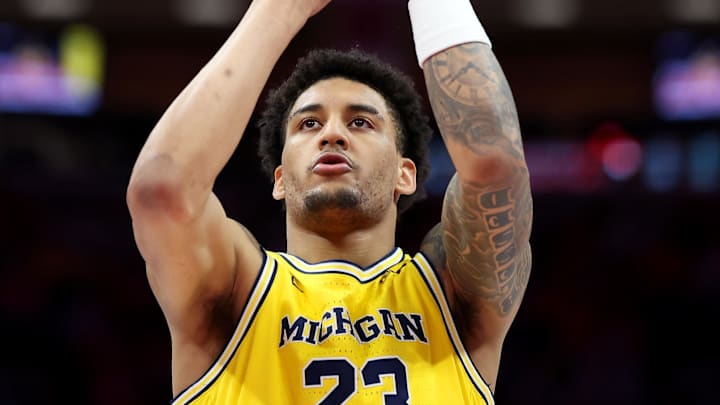
Forward Yaxel Lendeborg has seen a meteoric rise through college basketball, starting in organized basketball late in general, and beginning his collegiate career with three seasons of JUCO play, one of which he led the NJCAA in rebounding. He then transferred for two decorated seasons at UAB, and is now playing his fifth season with one of the best teams in the country in Michigan.
Lendeborg entered his name into the draft process last season, going through the combine and even standing out in the scrimmages. He measured at a solid 6-foot-8.5 barefoot, with a ludicrous but confirmed 7-foot-4 wingspan.
He’s is one of the older prospects in the class, coming in about three months shy of 24-years-old on draft night. But his late start and rapid development are great signs for further improvement.
Lendeborg is a malleable combo forward, offering scoring versatility, defensive play-making and versatility, connective play-making and rebounding.
Strengths:
Scoring Versatility
Yaxel Lendeborg’s offensive development is pretty remarkable. His No. 1 source of offense in his first season with UAB was put-backs, fast-forward two seasons and he’s seeing a healthy amount of handlers reps for what could very well be the best team in the country.
Having played at every level of basketball, Lendeborg’s run the gamut of offensive roles, and it’s really added versatility to his scoring game.
Lendeborg’s previous role in playing more of a true big with UAB still shines through, though Michigan’s moved him into a more wing-like role where he’s continued to thrive moving around the perimeter with comfortability.
Lendeborg’s strength at 240-pounds, unique length, mobility, naturally quick processing and a functional handle for his size have allowed him to blur the line between several different positions. With this combination of skills he can post up, face up to shoot or drive, function on either side of the pick-and-roll, and continue to do dirty work in play-finishing and crashing for put-backs.
With Michigan this season, he’s scoring 14.3 points per game on 50% shooting, doing so primarily by spotting up and getting out in transition. Lendeborg is quick past a hard closeout for his size, though he’s mostly set out to shoot triples with Michigan this season.
When he does manage to work his way to the rim, he’s highly efficient with length, great athleticism and touch, shooting 71% so far on about 50 layups and 20 dunks.
Secondarily for the Wolverines, he’s functioned as the pick-and-roll handler and sliding in for put-backs. Using him as the handler in big-big actions is especially intriguing — right now he’s generating 1.2 points per possession including passes.
There are questions about what exactly he’ll be positionally in the NBA, one’s that NBA decision-makers shouldn't be concerned with given his baseline success across so many different areas.
There’s likely malleability for him to continue playing on the wing or even see limited time as a small-ball five, but the truth is somewhere in the middle with him rounding out as a versatile combo forward. That would likely mean his primary means of offense continuing to be spotting up and getting out in transition, while fitting in where he’s needed in terms of the pick-and-roll, and off-ball needs like offensive-rebounding, cutting and more.
All this to say, while Lendeborg is a pretty unique prospect in terms of play-style, it feels like there’s plenty of pliability here given his size, skill and effectiveness.
Defensive Play-Making and Versatility
Lendeborg transfers his versatility over to the other end of the court as well, centering his defensive game around play-making and guarding across multiple positions.
Lendeborg’s combination of tools continues to apply here. He’s immovably strong, but fluid in moving across the court, and this is probably where his 7-3 wingspan makes the most difference, as a real weapon in terms of racking up stocks and deflections. And his processing and feel tie everything up in a neat, impactful bow.
Additionally, his try on this end of the court, for a player that’s top scorer, really stands out. Lendeborg takes obvious pride in being a great defender, and gives maximum effort constantly.
His pure numbers have long been good: he’s averaged 1.7 steals and 1.8 blocks per game in his last season with UAB, and those have only dipped slightly to 1.3 and 1.4 this season. Great numbers considering he’s flanking Morez Johnson Jr. and Aday Mara.
In terms of the actual steals and blocks, there’s a fair share of highlights here that only someone with his size and athleticism could put together. He’s just so good at mucking things up, be it getting a hand in, clogging a lane, contesting, chasing down players in transition, doubling and making life tough on scorers.
In tandem with Lendeborg’s offensive versatility, he can guard across multiple positions on defense, be it on the perimeter or in the post. He’s best-served guarding threes and fours, but his absurd size and length can give him some grace guarding fives and even big guards in moderation.
His strength allows him to tackle post-matchups, and he’s a genuinely good shot-blocked that should allow him to be a secondary rim-protector. He can really move his feet on the perimeter, looking more like a wing here than in any other aspect.
Lendeborg’s not a twitchy athlete, struggling with speedy guards as much as the next big, but again his feel, length and effort can make up the difference on occasion. He’s not an expert navigator of screens, but is, in the least, above-average for someone his size.
NBA teams should be able to use him in a variety of different schemes and roles, included switch-heavy schemes, as a small-ball center holding his own, as a secondary shot-blocker or a versatile rover who can generally wreak havoc.
Lendeborg might not be the best defensive player on the NBA court, but teams will be able to take solace in his positive impact and versatility.
Connective Play-Making and Feel
Lendeborg’s connective play-making helps to round out his offensive package, and it stems from his feel for the game, which is exceptional given his size and late start to basketball.
Potentially the single biggest development of his career came when UAB simply gave him the ball more, helping him to jump from an essential 1-to-1 assist-to-turnover ratio as a junior to 2-to-1 as a senior.
With Michigan, he’s dishing out 3.1 assists to 1.2 turnovers per game, which is pretty unbelievable levels of taking care of the ball given his role. Decision-making and some overzealous passing were past knocks, but this is one of a few areas he’s again improved.
Lendeborg’s got a great game-sense and floor game, with solid vision and instincts regarding how all 10 players are flowing and moving.
He can ball-move, throw lobs, is extremely good at post-entry with a big target in Mara, is patient and precise in the pick-and-roll, can grab-and-go in transition and adapt with numbers, shows composure after offensive rebounds. All things that connect offense without detracting from it.
Lendeborg’s a natural play-maker and offers the exact skillset you want in this area given the roles he’ll be playing.
Rebounding
It’s been established the Lendeborg’s a versatile two-way player, and his natural skill in rebounding the ball fits into that.
Across his 72 games with UAB, Lendeborg brought down a clean 11.0 boards per game, 7.5 of which were defensive and 3.5 being offensive. So far with Michigan he’s grabbing 7.7 rebounds per game, which again is pretty elite given he’s playing next to multiple bigs.
Lendeborg’s got a natural feel for positioning himself, getting his nose in no matter what position he’s playing. His strength makes him pretty immovable when he’s established position, and his overly-plus wingspan gives him advantages against similarly-sized matchups, and can bridge the gaps against bigger ones.
Notably, Lendeborg stays pretty composed when coming down with the ball, not panicking and holding onto it until he can pass out or push the break himself, and his 1.2 turnovers per game speak to that.
NBA teams could feel confident that when they put Lendeborg on the floor, rebounding is going to get a boost.
Areas of Improvement:
Shooting Consistency
The 3-point shooting consistency is far-and-away the one aspect of Lendeborg’s on-court game that needs further development, and is really the only thing for him right now that isn’t up to NBA standards.
He shot 35% from three across his two seasons with UAB, which even at just 1.5 attempts per game makes him a “shooter.” Lendeborg’s now taking over four triples per game with the Wolverines, but has seen highs and lows, sitting at about 29% through 24 games.
Obviously, that's not a great number, but he’s amid a really tough stretch right now as of mid-February having hit just nine of his last 50 tries, and I’d expect a small bounce-back soon. He started out the season shooting 41% on about 50 tries.
In terms of form, Lendeborg’s shooting motion is pretty smooth — it’s a fluid motion, he has a high release. The base isn’t great with a little bit of an inward knee dip, but there hasn't been much backlash on the form itself, mostly just the numbers.
The strong indicator in Lendeborg’s back pocket is his free throw percentage, which has been consistently good on high volume.
Lendeborg has one of the more drastic guarded to unguarded percentage dips seen among prospects in some time, shooting 23% on guarded catch-and-shoot threes, and 43% on unguarded catch-and-shoot triples. Obviously that bodes well for his continued ability to hit quality looks, but hitting contested shots is also a must in the modern NBA that emphasizes speedy, versatile defense.
To summarize, Lendeborg’s shot form is fine, his former numbers are fine for a big, and his current numbers leave plenty to be desired. He’s shown the capability to hit open shots, but has really struggled on tougher looks. And all these things leave his projection somewhat up in the air in an area that teams would really like to see consistency from.
Age
Age isn’t so much an area of improvement, seeing as Lendeborg can’t time travel, but there are several things that need touched on here. He’ll be 24 starting his rookie season in the NBA, which puts him in pretty rare air, at least among potential lottery-level players.
One shouldn't be totally under the opinion Yaxel Lendeborg is a finished product — his late start and steady growth point to him continuing an upward trajectory and potentially still adding things to his game. But there’s little question he’s up against it here, and that teams just aren’t going to be drafting him with development specifically in mind.
Not that he can’t be great, or that NBA organizations won’t be looking to help hone his game. He’s just not going to have the runway that younger, higher upside prospects will from an investment standpoint. This is a player that’s going to be 28-years-old by his second NBA contract, albeit very, very helpful to winning games by then.
All in all, it shouldn’t really affect how you see Yaxel Lendeborg the basketball player, but should be factored in when thinking of fit and roster-building.
Outlook:
Few players would likely be able to overcome the concerns that come with being 24 starting your rookie season. Yaxel Lendeborg, with an elite physical profile, proven impact and two-way versatility, feels like he’ll do just that.
He’s too good at too many things, and his history of improvement leads many to believe he can continue to improve even accounting for age.
In this talent-laden class specifically, his range will likely start somewhere in the late-lottery, and extend to the middle of the first round. His ceiling should be starter-level impact, with a floor of rotational-level play should the 3-point shot stay where it’s at.
Range: Late-lottery to mid-first
Role: Versatile two-way forward
Impact: Starter, rotation
Swing Skills: Shooting
Best Fits: Thunder, Grizzlies, Celtics
 Add us as a preferred source on Google
Derek Parker covers the National Basketball Association, and has brought On SI five seasons of coverage across several different teams. He graduated from the University of Central Oklahoma in 2020, and has experience working in print, video and radio.
Follow DParkOK