%22%3E%0A%3Cpath%20d%3D%22M0%205.37646H8.15061L17.4195%2016.8819V5.37646H26.0647V31.4412H18.3227L8.64523%2019.4196V31.4412H0V5.37646Z%22%20fill%3D%22white%22%2F%3E%0A%3Cpath%20d%3D%22M29.2041%205.37649H43.8064C47.4193%205.37649%2049.6989%206.1937%2051.2258%207.72059C52.1505%208.64533%2052.8172%2010.0002%2052.8172%2011.7851V11.8497C52.8172%2014.9465%2050.9462%2016.8389%2048.172%2017.8067C51.5269%2018.7744%2053.6774%2020.5594%2053.6774%2024.1293V24.1938C53.6774%2028.3659%2050.258%2031.4197%2043.6558%2031.4197H29.2041V5.35498V5.37649ZM44.258%2013.7637C44.258%2012.6024%2043.3333%2011.9787%2041.4623%2011.9787H37.6988V15.6346H41.5053C43.3763%2015.6346%2044.258%2015.011%2044.258%2013.8497V13.7852V13.7637ZM42.0859%2020.9895H37.6988V24.8605H42.0644C43.9569%2024.8605%2044.9247%2024.0863%2044.9247%2022.968V22.9035C44.9247%2021.7852%2043.9999%2021.011%2042.0859%2021.011V20.9895Z%22%20fill%3D%22white%22%2F%3E%0A%3Cpath%20d%3D%22M64.8174%205.18286H73.4627L84.452%2031.4411H74.9896L73.6132%2027.9357H64.4949L63.1615%2031.4411H53.8496L64.8389%205.18286H64.8174ZM71.4412%2021.7636L69.054%2015.441L66.6669%2021.7636H71.4412Z%22%20fill%3D%22white%22%2F%3E%0A%3Cpath%20d%3D%22M95.2695%205.37646H105.248C115.592%205.37646%20120.775%2010.4733%20120.775%2018.1938V18.2583C120.775%2025.9788%20115.485%2031.4412%20104.947%2031.4412H95.2695V5.37646ZM104.001%2012.9679V23.8497H105.463C109.442%2023.8497%20112.022%2022.2153%20112.022%2018.4518V18.3873C112.022%2014.6239%20109.463%2012.9894%20105.463%2012.9894H104.001V12.9679Z%22%20fill%3D%22white%22%2F%3E%0A%3Cpath%20d%3D%22M123.098%2011.1182H131.549V15.2258C132.711%2012.4731%20134.56%2010.6881%20137.915%2010.8387V19.8065H137.012C133.442%2019.8065%20131.528%2021.785%20131.528%2026.2797V31.4625H123.076V11.1182H123.098Z%22%20fill%3D%22white%22%2F%3E%0A%3Cpath%20d%3D%22M137.808%2025.6772V25.6127C137.808%2021.5482%20140.818%2019.2901%20145.55%2019.2901C147.27%2019.2901%20149.464%2019.6557%20150.345%2020.0428V19.6987C150.345%2017.8277%20149.184%2016.7524%20146.582%2016.7524C144.496%2016.7524%20142.754%2017.204%20140.969%2017.9137L139.485%2012.3008C141.829%2011.3975%20144.517%2010.8169%20148.044%2010.8169C152.173%2010.8169%20154.862%2011.6771%20156.646%2013.4621C158.173%2014.989%20158.776%2016.9675%20158.776%2019.9137V31.5052H150.324V29.4622C148.904%2030.9891%20147.012%2031.9999%20144.474%2031.9999C140.56%2031.9999%20137.808%2029.7633%20137.808%2025.7417V25.6772ZM150.431%2023.9138V23.0536C149.937%2022.86%20149.206%2022.7095%20148.496%2022.7095C146.818%2022.7095%20145.894%2023.7202%20145.894%2024.9891V25.0536C145.894%2026.2364%20146.754%2027.0321%20147.829%2027.0321C149.313%2027.0321%20150.431%2025.8493%20150.431%2023.9138Z%22%20fill%3D%22white%22%2F%3E%0A%3Cpath%20d%3D%22M162.883%2017.6345H160.496V11.1183H162.883C162.926%208.96778%20163.442%207.20433%20164.711%205.9355C166.088%204.55915%20167.872%204%20170.668%204C173.163%204%20174.69%204.21506%20175.851%204.55914V9.84951C175.034%209.65596%20174.217%209.54843%20173.141%209.54843C171.83%209.54843%20171.163%2010.0646%20171.163%2011.1829V11.3334H175.851V17.6345H171.335V31.4411H162.883V17.6345Z%22%20fill%3D%22white%22%2F%3E%0A%3Cpath%20d%3D%22M178.883%2024.6238V17.613H176.496V11.0968H178.883V6H187.335V11.0968H192.023V17.613H187.335V22.7528C187.335%2024.2797%20188.045%2024.8389%20189.378%2024.8389C190.152%2024.8389%20191.055%2024.6238%20191.937%2024.2152V30.7314C190.604%2031.4411%20188.582%2031.8927%20186.539%2031.8927C181.55%2031.8927%20178.862%2029.5916%20178.862%2024.6238H178.883Z%22%20fill%3D%22white%22%2F%3E%0A%3Cpath%20fill-rule%3D%22evenodd%22%20clip-rule%3D%22evenodd%22%20d%3D%22M201.368%204.36764C207.191%20-1.45588%20216.632%20-1.45588%20222.456%204.36764C228.279%2010.1912%20228.279%2019.6324%20222.456%2025.4559L211.912%2036L201.368%2025.4559C195.544%2019.6324%20195.544%2010.1912%20201.368%204.36764ZM204.009%207.55761C203.948%207.86849%20203.916%208.39718%20203.916%209.14566V10.4189C203.916%2011.1832%20203.948%2011.7198%20204.013%2012.0267C204.078%2012.3317%20204.278%2012.6168%20204.617%2012.8762C204.956%2013.1376%20205.403%2013.3316%20205.958%2013.4623C206.512%2013.593%20207.1%2013.6583%20207.837%2013.6583C208.573%2013.6583%20209.217%2013.591%20209.769%2013.4524C210.322%2013.3158%20210.761%2013.1178%20211.086%2012.8604C211.411%2012.6029%20211.605%2012.3178%20211.666%2012.0069C211.728%2011.6961%20211.759%2011.1674%20211.759%2010.4189V9.14566C211.759%208.38134%20211.728%207.84473%20211.662%207.53781C211.597%207.23287%20211.397%206.94972%20211.058%206.68834C210.72%206.42696%20210.272%206.23291%20209.718%206.10223C209.163%205.97154%20208.536%205.90619%20207.839%205.90619C207.102%205.90619%20206.459%205.97352%20205.906%206.11213C205.352%206.24875%20204.914%206.44677%20204.589%206.70418C204.265%206.9616%20204.071%207.24673%20204.009%207.55761ZM209.276%2024.8638C212.876%2024.8638%20214.557%2024.2064%20214.557%2021.862V21.858V21.3155C214.557%2019.6581%20213.516%2018.971%20210.252%2018.3136C209.278%2018.1136%20208.908%2017.9136%20208.908%2017.3136V16.9414C208.908%2016.6543%20209.177%2016.5117%20209.413%2016.5117C209.749%2016.5117%20209.918%2016.7137%20209.918%2016.9414V18.1136H214.391V17.3988C214.391%2015.4563%20213.347%2014.4266%20209.177%2014.4266C206.15%2014.4266%20203.896%2015.3414%20203.896%2017.3711V17.7433C203.896%2019.5155%20204.805%2020.3155%20208.201%2021.0303C208.28%2021.0472%20208.355%2021.063%20208.427%2021.0781C209.329%2021.2674%20209.647%2021.3341%20209.647%2021.9174V22.2897C209.647%2022.6619%20209.546%2022.8045%20209.142%2022.8045C208.67%2022.8045%20208.637%2022.5471%20208.637%2022.262V21.2897H203.894V21.7471C203.894%2024.149%20205.476%2024.8638%20209.276%2024.8638ZM215.424%2024.5569H219.925V14.7355H215.424V24.5569ZM216.955%2013.5019H219.925V6.06064H217.092V9.411L215.193%206.06064H212.359V13.5019H215.193V10.1199L216.955%2013.5019ZM208.269%2012.152C208.204%2012.2688%20208.055%2012.3262%20207.825%2012.3262L207.827%2012.3282C207.604%2012.3282%20207.459%2012.2767%20207.398%2012.1757C207.336%2012.0748%20207.305%2011.8074%20207.305%2011.3758V7.90068C207.305%207.51852%20207.352%207.28684%20207.445%207.20962C207.538%207.13239%20207.675%207.09279%20207.851%207.09279C208.059%207.09279%20208.198%207.14031%20208.265%207.23734C208.332%207.33239%20208.366%207.55416%20208.366%207.90068V11.3203C208.366%2011.7579%20208.334%2012.0352%20208.269%2012.152Z%22%20fill%3D%22white%22%2F%3E%0A%3C%2Fg%3E%0A%3Cdefs%3E%0A%3CclipPath%20id%3D%22clip0_15247_3640%22%3E%0A%3Crect%20width%3D%22227%22%20height%3D%2236%22%20fill%3D%22white%22%2F%3E%0A%3C%2FclipPath%3E%0A%3C%2Fdefs%3E%0A%3C%2Fsvg%3E%0A)
Why Going All-In On One Draft Could Be The Right Approach
In 1997, the Cleveland Cavaliers were going through an awkward rebuild, devoting the 1997-1998 season to both development, and giving an in-prime Shawn Kemp all the shots he wanted. It was a weird time, and one that made little sense given the otherwise interesting approach to the NBA draft.
The year prior, in 1996, the Cavs had selected center Zydrunas Ilgauskas 20th overall, who didn't play all year due to a foot injury. As the calendar swung to 1997, the Cavs were armed with two first-round picks, which were spent on Brevin Knight and Derek Anderson. In the second round, they selected Cedric Henderson.
Thus, coming into 1997-1998, the Cavs had four rookies on the roster, all of whom would end up playing over 27 minutes per game. At the time, and even still to this day in certain circles, was a high volume of rookies not encouraged. After all, rookies have a steep learning curve, and you need to develop them all at the same time.
(Some people within the NBA still believe in a more methodical approach where you get rookies in step by step, whereas others are open to bringing in an army of first-timers.)
Somewhat surprisingly, all four had a major impact on the Cavs, as the team won 47 games and finished with the fifth seed. While they were eventually bounced by the Indiana Pacers in the first round, the Cavs had - perhaps involuntarily - proved that it may not be that big of an issue to have that many rookies on hand.
Seven years later, the Chicago Bulls took on the Washington Wizards in the first round, having five rookies on the roster, four of which were rotation players. Ben Gordon, Luol Deng, Andrés Nocioni, and Chris Duhon.
Similar to the Cavs, they too were bounced, but proved a lack of experience wasn't necessarily a hindrance of success.
This leads us today.
Social media now exists, meaning every minor roster adjustment is going to get instantly analyzed by hundreds of people. The subject of rookies, tanking, and overall roster construction philosophy has never been more prevalent than it is right now.
As such, a team going all in on youth, such as the Process Sixers, or the Oklahoma City Thunder, will experience the full wrath of the people who disagree with that sort of approach.
Since there clearly aren't enough voices to this debate, let me add mine to the mix.
Any team going through a rebuild, that decides to bring in a major amount of rookies in one offseason is totally fine, pending two things:
1. They need to have the necessary personnel to handle such an influx of bright-eyed youngsters.
This means not just development coaches, but also veterans with at least a decade of playing experience. Every young player needs a mentor and a guide, and that need becomes even bigger when you, as an organization, decide to bring in multiple players who are either teenagers, or close to it. Even a 22-year-old college senior is still a kid in the eyes of the league.
Additionally, a team needs to have sports psychologists employed as well. Having multiple players join the professional ranks, all having to figure out their own role moving forward, can be exhausting and confusing.
2. The team in question needs to be aware of which draft they decide to go all-in.
It makes little sense to line up multiple draft picks to a year where the crop of players are projected to be average, or outright weak. That is of course unless your scouting staff believes otherwise.
Planning ahead, and circling a specific year to invest in the future can be a perfectly sound idea, especially if there is considerable talent to be found later in the draft as well.
"But Mort, what if all those rookies bust all at once? Isn't it better to spread it out over several years?"
A team can, in theory, select a player who doesn't meet expectations every single year. Here's how the Sacramento Kings drafted in the first round from 2011 up to and including 2016:
2011: Bismack Biyombo (seventh overall - traded for the rights to Jimmer Fredette)
2012: Thomas Robinson (fifth overall)
2013: Ben McLemore (seventh overall)
2014: Nik Stauskas (eight overall)
2015: Willie Cauley-Stein (sixth overall)
2016: Marquese (eight overall - traded for the rights to Georgios Papagiannis)
(In fairness, the Kings also received the rights to Bogdan Bogdanović who turned out good, but Papagiannis was the big get.)
Evidently, a team can make annual mistakes like clockwork.
But let's look at who the Kings could have gotten, who were projected in similar range to where they had their selection.
(This means no revisionist history of putting later selections like Giannis Antetokounmpo or Rudy Gobert on the list, for example, as they weren't projected or rumored to get selected in the area of where Sacramento was picking. All players mentioned below were rumored to be selected in that area.)
2011: Kemba Walker and Klay Thompson
2012: Damian Lillard, Harrison Barnes, and Andre Drummond
2013: CJ McCollum
2014: Zach LaVine
2015: Myles Turner and Devin Booker
2016: Domantas Sabonis
That, to me, shows the value of having multiple selections in the same draft. Not every single player is going to fail to live up to expectations. And if your organizational infrastructure, as outlined above, can sustain multiple young players, the question changes from "Why?" to "Why not?".
What the Thunder and Jazz are currently doing by hoarding draft picks is long-winded, and will test their fan base's patience. But it's a smart play, and one that only gets smarter if a team identifies a single draft where to invest heavily.
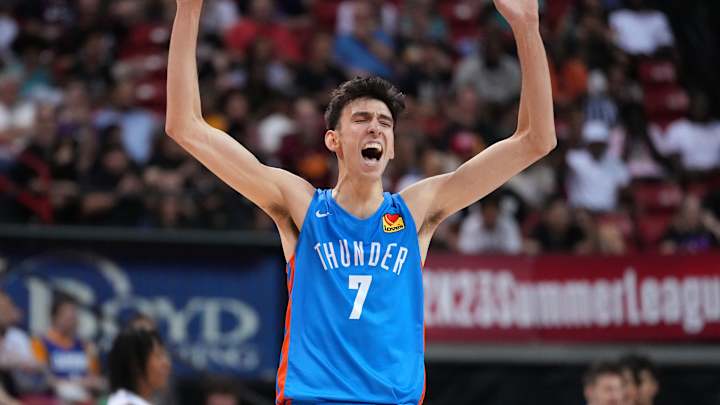
Sam Presti, to his credit, actually did this just a few months ago with the Thunder, as he walked away with Chet Holmgren (second overall), Ousmane Dieng (11th overall), and Jalen Williams (12th overall), having clearly seen something in the trio that warranted this amount of dedication to them.
One final benefit to cashing in on one draft? Salary structure. Rookie contracts remain a financial steal, and the longer you have those active, the more you can spend elsewhere. When the rookie crop is up for extensions, you can simply go over the cap to re-sign them, assuming ownership is on board.
That beats having to navigate around annual extensions, potential restricted free agency, or making financially driven trades to open up for more cap space. In Holmgren, Dieng, and Williams, Presti now has four years of team control, but will have to navigate that situation with deals that are up earlier, via for example Josh Giddey, who will be up for an extension after the 2023-2024 season.
This may all sound very 2K-ish, and I get that. But, nevertheless, there are benefits in going all-in on one draft. It's often just a matter of planning, and having the guts to go all-in, if you deem it worth it.
 Add us as a preferred source on Google
Morten has managed to create a stable career for himself, launching Denmark's first weekly NBA radio show, and co-hosting a weekly NBA TV show. He's a seasoned basketball analyst and is experienced covering the league and its upcoming prospects.
Follow msjnba