%20%20--%3E%0A%3Csvg%20version%3D%221.1%22%20id%3D%22Layer_1%22%20xmlns%3D%22http%3A%2F%2Fwww.w3.org%2F2000%2Fsvg%22%20xmlns%3Axlink%3D%22http%3A%2F%2Fwww.w3.org%2F1999%2Fxlink%22%20x%3D%220px%22%20y%3D%220px%22%0A%09%20width%3D%2239px%22%20height%3D%2240px%22%20viewBox%3D%220%200%2039%2040%22%20enable-background%3D%22new%200%200%2039%2040%22%20xml%3Aspace%3D%22preserve%22%3E%0A%3Cpath%20fill%3D%22%23FFFFFF%22%20d%3D%22M38.5%2C7H28.2v26h10.3V7z%22%2F%3E%0A%3Cpath%20fill-rule%3D%22evenodd%22%20clip-rule%3D%22evenodd%22%20fill%3D%22%23FFFFFF%22%20d%3D%22M26.1%2C25.5c0%2C5.8-4.1%2C7.5-12.9%2C7.5C3.9%2C33%2C0%2C31.2%2C0%2C25.2v-1.1h11.6%0A%09v2.4c0%2C0.7%2C0.1%2C1.4%2C1.2%2C1.4c1%2C0%2C1.2-0.4%2C1.2-1.3v-0.9c0-1.6-0.9-1.6-3.5-2.2C2.2%2C21.7%2C0%2C19.7%2C0%2C15.3v-0.9C0%2C9.3%2C5.5%2C7%2C12.9%2C7%0A%09c10.2%2C0%2C12.8%2C2.6%2C12.8%2C7.4v1.8h-11v-2.9c0-0.6-0.4-1.1-1.2-1.1c-0.6%2C0-1.2%2C0.4-1.2%2C1.1v0.9c0%2C1.5%2C0.9%2C2%2C3.3%2C2.5%0A%09c8%2C1.6%2C10.5%2C3.3%2C10.5%2C7.5V25.5z%22%2F%3E%0A%3C%2Fsvg%3E%0A)
The Coaching Squeeze

The Ravens have become the latest team to feel the wrath of NFL discipline, but unlike other cases—Patriots, anyone?—the NFL and its antagonist, the NFLPA, are in lockstep when it comes to punishing Baltimore.
The union is all in on sanctioning teams for running afoul of players’ rights, and this reprimand involves a long-standing subject of dispute between NFL teams and their players, one that became a focus of the most recent collective bargaining negotiations.
No pads, even for rookies
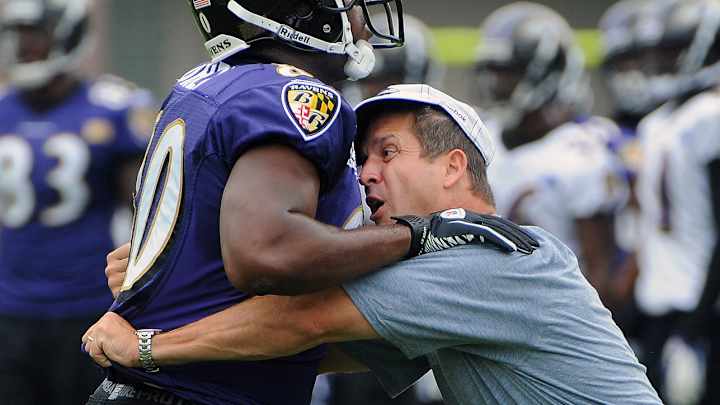
The NFL sanctioned the Ravens last week after an investigation found the team had suited up rookies in full pads for practice on May 6, a clear violation of the CBA. The team later acknowledged the mistake, and was docked three OTA days (Organized Team Activities) and fines of nearly $500,000 were assessed to the organization and coach John Harbaugh.
It was reported that the Ravens did not understand that the same CBA rules that govern full-squad OTAs also apply to rookie-only practices. As we are now in the fifth offseason of the new CBA rules, I find that excuse to be, well, curious at best. Even if the team truly believed that, it was essentially saying, “We know we can’t beat up the veterans in the offseason, but hey, these guys are just rookies.” Well, rookies are union members, too.
From the league’s perspective, they have to be consistent with players and teams in applying the rules of the CBA. They have regularly trumpeted the power of the CBA—in arbitration and court proceedings over the past few years extolling the commissioner’s power. Now they are appropriately doing the same in enforcing another key part of the negotiated CBA. Screwing around with the no-contact rules in the offseason is certain to draw the ire of both the union and the league.
The NFLPA doesn’t trust coaches
Having covered the 2011 NFL lockout more than any (sane) person should have, I witnessed the bargaining priorities and objectives of each side. The owners’ highest priority never wavered: increasing profit by lowering player costs. The players’ priorities shifted, but player safety—with emphasis on increased time away from the team in the offseason—was paramount. As I commented at the time of the negotiations, the resulting limits on both practice time overall and time in pads (an easy “give” from ownership) would make future offseasons look not very different than the locked-out 2011 offseason.
Although NFLPA head DeMaurice Smith has a different management style and demeanor than his predecessor, the late Gene Upshaw, both leaders prioritized reining in overzealous coaches. In the plainest terms possible, they have not and do not trust them to leave the players alone.
When Upshaw made his annual visit to Green Bay, we would have lunch and I would listen to him pontificate on various topics, one of which was always coaches’ restlessness in the offseason. I can hear him now, as he would shake his head and say, “These coaches sit around all offseason with nothing to do. When they see players, they can’t help themselves—they want to put them in pads and do drills.”
During Upshaw’s tenure as union head, NFL teams were regularly docked days—even weeks—of offseason work as punishment for overeager coaching and contact. Smith and present union leadership have carried on that watchfulness. Indeed, the genesis of this most recent discipline came from a member of the NFLPA’s executive board, the Ravens’ newly acquired tight end Benjamin Watson, who informed Harbaugh that his plan for rookies to wear pads during the minicamp was a CBA violation.
As mentioned, the current union leadership was steadfast about this issue in bargaining negotiations. The reasoning was to: 1) allow players more time to refresh and recharge away from the constant scrutiny of the coaching staff, 2) give players an opportunity to return to school to pursue undergraduate or advanced degrees, and 3) prolong and add longevity to careers.
Although it’s still too early to judge whether these objectives are working, my sense is the goal of increased longevity, while certainly well intentioned, is difficult to accomplish through collective bargaining. More teams appear to be relying on “draft and develop” and similar team-building approaches, trusting younger (cheaper) players in roles previously occupied by older veterans, reduced offseason or not. The fact that veteran players are experiencing less wear and tear in the offseason is certainly a positive for their long-term health, but probably not for extending playing careers.
Coach conundrum
As a final note, although there are certainly issues with overeager and restless coaches, I empathize with them in this “new NFL.” While the players and owners hammered out a 10-year governing agreement for NFL policies and procedures, coaches were not consulted. It was a business negotiation between owners, lawyers and player leadership; the coaches’ voices were nowhere to be found.
Just like incoming rookies getting their contracts dramatically changed in this new CBA without a seat at the table, the coaches’ views were similarly sacrificed. They have complained about the lack of time they get with players in the offseason and the diminished quality of football that it brings. However, the current CBA has four more offseasons of this limited offseason availability, and with more pressing business issues certain to take priority, coaches again will be an underserved constituency.
When it comes to player-management relations, coaches are a conflicted group. In one sense, they need the respect and trust of players to motivate and inspire them. However, in the labor-management equation, they are clearly on the side of owners. As NFLPA leaders have made clear to players: coaches may be your bosses, but they are not your friends.
• Question or comment? Email us at talkback@themmqb.com.

Andrew Brandt is the executive director of the Moorad Center for the Study of Sports Law at Villanova University and a contributing writer at Sports Illustrated. He has written a "Business of Football" column for SI since 2013. Brandt also hosts a "The Business of Sports" podcast and publishes a weekly newsletter, "The Sunday Seven." After graduating from Stanford University and Georgetown Law School, he worked as a player-agent, representing NFL players such as Boomer Esiason, Matt Hasselbeck and Ricky Williams. In 1991, he became the first general manager of the World League's Barcelona Dragons. He later joined the Green Bay Packers, where he served as vice president and general counsel from 1999 to 2008, negotiating all player contracts and directing the team's football administration. He worked as a consultant with the Philadelphia Eagles and also has served as an NFL business analyst for ESPN.