
Red Wings' Offensive Problems Run Deeper Than Their Latest Shutout
In this story:
For 20 minutes Saturday night, the Detroit Red Wings looked capable of dictating the proceedings against the Colorado Avalanche.
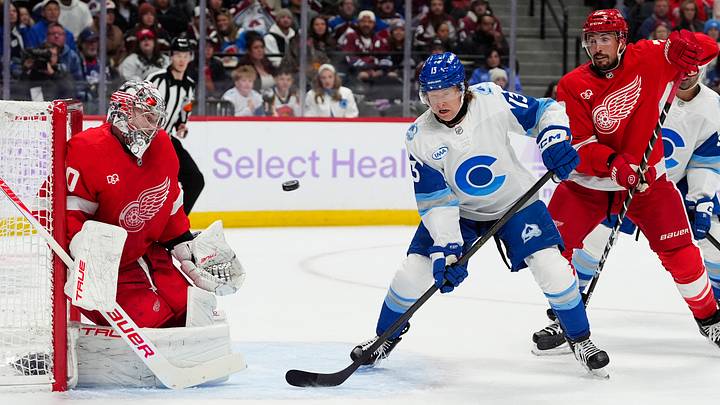
They controlled possession, generated quality scoring opportunities and forced Avalanche goaltender Mackenzie Blackwood into several difficult saves. The opening period offered little indication that the Red Wings were headed toward another discouraging defeat.
By the final horn, however, the Red Wings has been blanked 4-0, extending their losing streak to three games.
The most concerning development wasn't necessarily the final score, but how quickly the Red Wings' offensive presence disappeared.
An Encouraging Start, an Abrupt Reversal
The Red Wings outshot the Avalanche 13-5 during the opening period, holding a 7-3 advantage in high-danger scoring opportunities.
Blackwood prevented the visitors from capitalizing, including consecutive saves against J.T. Compher and John Leonard late in the frame.
The Red Wings had established precisely the kind of temp necessary to challenge an Avalanche lineup featuring Nathan MacKinnon, Cale Makar and Martin Necas.
Then the complexion of the contest changed.
The Red Wings were assessed five penalties during the brief stretch of the second period. The Avalanche capitalized twice with the man advantage, building a lead that fundamentally altered the game's direction.
The Red Wings managed just two shots in the middle frame.
By the conclusion of the evening, the Red Wings had slipped to 7-8-3, having lost four of their previous five games.
The Missing Ingredient Around the Net
Although penalties disrupted the Red Wings' rhythm, they didn't fully explain their inability to manufacture goals.
The Red Wings actually outshot the Avalanche 25-16 at five-on-five, according to the team's official postgame report.
That statistic presents an intriguing contradiction: the Red Wings generated more shots during even-strength play yet failed to solve Blackwood on any of their 27 attempts.
Andrew Copp identified a potentially revealing deficiency afterward. Speaking to team reporter Jonathan Mills, Copp acknowledged the Red Wings weren't consistently creating follow-up opportunities around the crease.
“I think 5-on-5, we played a pretty decent game,” Copp said to outlets, including NHL.com. “Obviously, we didn’t score, maybe didn’t generate quite enough, but I thought we did a really good job of hanging with their speed and transition game. Kind of got away from us in the second period with all those penalties."
A shot on goal can represent an isolated attempt. Sustained offensive pressure requires players to recover rebounds, establish position near the net and force defenders into repeated decisions under duress.
The Red Wings have struggled to translate promising sequences into that kind of consistent punishment.
Blackwood deserves credit for his performance, especially during the first period. Regardless, a team cannot continually depend on its initial scoring opportunities being enough to defeat accomplished goaltenders.

Against the Avalanche, the Red Wings frequently lacked the finishing touch necessary to reward their territorial advantage.
A Problem That Demands More Than Patience
The absence of injured or unavailable personnel can disrupt line combinations and diminish offensive chemistry.
But the Red Wings' current difficulties also concern execution.
Todd McLellan's team showed that it could compete with the Avalanche's speed during even-strength situations. What it couldn't do was maintain that standard throughout the contest or convert favorable stretches into meaningful production.
For a club already facing considerable pressure to return to the postseason, those shortcomings carry consequences beyond an isolated November defeat.
The Red Wings visit St. Louis on Tuesday before continuing on their road trip.
 Add us as a preferred source on Google

Jason Fink is an NHL writer and lifelong hockey fan who fell in love with the game when he watched Wayne Gretzky’s Edmonton Oilers defeat the Philadelphia Flyers in the 1987 Stanley Cup Final. When he’s not writing, Jason enjoys spending time with his wife Michelle and their son Theo and daughter Stella. Whether he’s following the latest NHL news or cheering from the rink, his passion for the sport has been a constant throughout his life.