%20%20--%3E%0A%3Csvg%20version%3D%221.1%22%20id%3D%22Layer_1%22%20xmlns%3D%22http%3A%2F%2Fwww.w3.org%2F2000%2Fsvg%22%20xmlns%3Axlink%3D%22http%3A%2F%2Fwww.w3.org%2F1999%2Fxlink%22%20x%3D%220px%22%20y%3D%220px%22%0A%09%20width%3D%2239px%22%20height%3D%2240px%22%20viewBox%3D%220%200%2039%2040%22%20enable-background%3D%22new%200%200%2039%2040%22%20xml%3Aspace%3D%22preserve%22%3E%0A%3Cpath%20fill%3D%22%23FFFFFF%22%20d%3D%22M38.5%2C7H28.2v26h10.3V7z%22%2F%3E%0A%3Cpath%20fill-rule%3D%22evenodd%22%20clip-rule%3D%22evenodd%22%20fill%3D%22%23FFFFFF%22%20d%3D%22M26.1%2C25.5c0%2C5.8-4.1%2C7.5-12.9%2C7.5C3.9%2C33%2C0%2C31.2%2C0%2C25.2v-1.1h11.6%0A%09v2.4c0%2C0.7%2C0.1%2C1.4%2C1.2%2C1.4c1%2C0%2C1.2-0.4%2C1.2-1.3v-0.9c0-1.6-0.9-1.6-3.5-2.2C2.2%2C21.7%2C0%2C19.7%2C0%2C15.3v-0.9C0%2C9.3%2C5.5%2C7%2C12.9%2C7%0A%09c10.2%2C0%2C12.8%2C2.6%2C12.8%2C7.4v1.8h-11v-2.9c0-0.6-0.4-1.1-1.2-1.1c-0.6%2C0-1.2%2C0.4-1.2%2C1.1v0.9c0%2C1.5%2C0.9%2C2%2C3.3%2C2.5%0A%09c8%2C1.6%2C10.5%2C3.3%2C10.5%2C7.5V25.5z%22%2F%3E%0A%3C%2Fsvg%3E%0A)
Benn, Price carry Canada past U.S. and into gold medal game
SOCHI – The invitation to the Mike Babcock Memorial Ball Hockey Tournament and Barbecue must have been lost in the mail by Canada Post. There were 25 other forwards across the vast northern country that received those coveted letters with the embossed RSVP cards -- invites to Canada's pre-Olympic orientation camp last summer -- but Jamie Benn, one of the most talented natural wingers in a country brimming with centers, somehow was left off the guest list.
This was a major oversight, although how Hockey Canada could fail to miss Benn is hard to imagine. He is 6-foot-2 and 208 pounds, fast and sturdy, perfect for the Big Boy hockey that Babcock preaches.
Of course Benn was ultimately named to the team and thrown on a premium line with Ryan Getzlaf and Corey Perry for the Olympic elimination games, and any slight is in the past … sort of like the U.S. team.
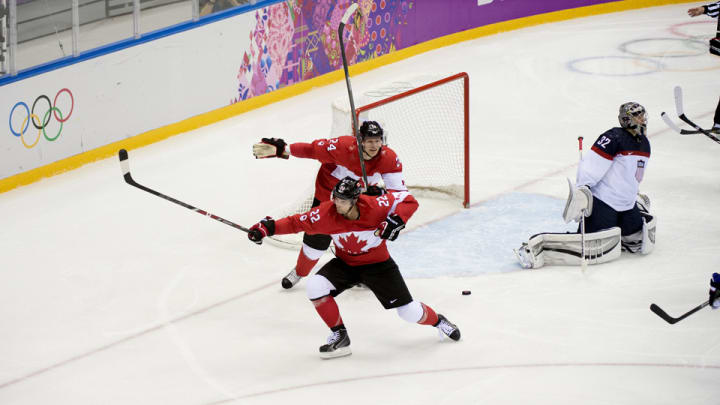
And it was all so sudden. After rolling through the early games of the Olympic tournament, Team USA -- with scoring depth and brio -- seemed tantalizingly capable of winning the first American gold medal in 34 years. On Friday, however, it was reduced to the red, white and bronze. In a sport that is grounded in mistakes, Canada turned its semifinal victory over the U.S. into a dazzling display of near perfection. Benn scored early in the second period, and the 1-0 Canadian rout was on, a conceit that seems to stretch credulity nearly as much as Canada stretched the Americans in this Olympic taffy pull.
OK, maybe Canada was not impeccable. But put the commanding Canadians' performance in this context: Latvia was able to score one more goal against them than Team USA.
This was not a 1-0 pitcher’s duel. This was not a Euro-snooze of 1-4 trapping or collapsing in front of the crease or Katya-bar-the-door. (That’s a shout out to the host country.) This was a reminder that possession of the puck is nine-tenths of a victory. There were times when the Americans couldn’t have gotten the puck even if they had raised their hands and said pretty please. They looked almost cowed at times.
Canada was feral, pushing the pace and tilting the ice in the direction of U.S. goalie Jonathan Quick, blanketing the dangerous Phil Kessel and turning the vaunted Beef Line into filler. Canada tracked back with its forwards, taking away American defensemen, including Cam Fowler, who like to come late on the rush. And through it all Canada never wavered, never showed a hint of nerves while knowing that the Americans were -- in theory, at least -- just one shot away.
As goalie Carey Price so eloquently put it later, “[This team] can play in tough situations and feel comfortable being uncomfortable.”
“Talk about matchups,” American coach Dan Bylsma said. “They they came at us with 20 guys tonight. They came at us with speed for 60 minutes. That was a fast game. That was as fast a game as I’ve ever been a part of. We weren’t able to counter that. We weren’t able to answer that in terms of getting offense and getting a goal. I thought our guys … laid it on the line. They did have some great opportunities, [and] we blocked shots. Our goalie was our best player on the ice. We just weren’t able to turn that back the other way and get forward with our game.”
The Americans rarely got clean looks and when they did, their shots usually found the big white Maple Leaf on Price’s jersey. He is not acrobatic like Quick, doesn’t scurry from post to post with his legs moving furiously like a duck’s beneath the surface. Price has an almost too-cool-for-school demeanor, something that has irked some of his NHL coaches; the guy is as unhurried as a Sunday morning with The New York Times. But his positioning is textbook and, as Babcock said, he is “a guy who I think is big and square and soft.” That is not soft as in, say, mentally soft. That is soft as in absorbent. Price absorbs rebounds in the same way he absorbs criticism.
The great Canadian parlor game for the past 18 months has been centered on the question of who would be in goal in Sochi -- the lone area of self-doubt that had crept into the country’s hockey superiority complex. With the array of grand goalies heading to the Olympics -- Sweden’s Henrik Lundquist, Finland’s Tuukka Rask, the American duo of Quick and Ryan Miller -- the hockey chattering class in Canada wondered if its goalies, especially Price, always considered the presumptive starter, would be reliable enough on the world stage.
After five games, Price has allowed three goals -- two deflections and a breakaway. He stopped 31 shots against Team USA.
There is the answer.
“I thought he was great,” Babcock said. “You know, it’s like anything. As you build a résumé over time in your career -- whether you’re a coach or a writer or whether you’re holding a camera -- you build a résumé that gives you confidence. And he’s done that over time. He’s been an excellent goalie in the NHL. He gives your team confidence. It was 1-0. It’s tight. All those shots coming at once, and he had to make big saves, just like Quick did. It’s not like there [weren't] chances tonight. There were chances.”
“I don’t think my impression of [Price] has changed,” said Canadian center Jonathan Toews, whose line drove Kessel to distraction -- and a third period hooking penalty. “I always had a good impression of what [Price] was capable of. This is the ultimate pressure for a Canadian hockey player, and he’s not coming up short by any means.”
Neither is Benn, the only player not invited to the summer orientation shindig that made the charter flight to Sochi. Earlier in the tournament, Babcock singled the left winger out as a player whose gifts he had not fully appreciated. Benn has slowly insinuated himself into the core of the team, starting with nine minutes in the opener and getting 15 against the Americans. He actually created his own goal, starting with the face-off in the left circle against David Backes. He won the draw cleanly, pushed the puck back to Jay Bouwmeester at the left point and then headed up the middle to the net, opening up his stick for a shot-pass from the Canadian defenseman. He redirected the puck into the net 101 seconds into the second period.
You could not have drawn up the sequence any better for a team that could not play any better.
Canada 1, USA 0
Speed and ferocity and Price and a Benn diagram.
 Add us as a preferred source on Google
Along with the pages of Sports Illustrated, you'll find senior writer Michael Farber in the Hockey Hall of Fame. Farber joined the staff of Sports Illustrated in January 1994 and now stands as one of the magazine's top journalists, covering primarily ice hockey and Olympic sports. He is also a regular contributor to SI.com. In 2003 Farber was honored with the Elmer Ferguson Award from the Hockey Hall of Fame for distinguished hockey writing. "Michael Farber represents the best in our business," said the New York Post's Larry Brooks, past president of the Professional Hockey Writers' Association. "He is a witty and stylish writer, who has the ability to tell a story with charm and intelligence." Farber says his Feb. 2, 1998 piece on the use and abuse of Sudafed among NHL players was his most memorable story for SI. He also cites a feature on the personal problems of Kevin Stevens, Life of the Party. His most memorable sports moment as a journalist came in 1988 when Canadian Ben Johnson set his controversial world record by running the 100 meters in 9.79 seconds at the Summer Olympic Games, in Seoul. Before coming to Sports Illustrated, Farber spent 15 years as an award-winning sports columnist and writer for the Montreal Gazette, three years at the Bergen Record, and one year at the Sun Bulletin in Binghamton, NY. He has won many honors for his writing, including the "outstanding sports writing award" in 2007 from Sports Media Canada, and the Prix Jacques-Beauchamp (Quebec sportswriter of the year) in 1993. While at the Gazette, he won a National Newspaper award in 1982 and 1990. Sometimes Life Gets in the Way, a compendium of his best Gazette columns, was published during his time in newspapers. Farber says hockey is his favorite sport to cover. "The most down-to-earth athletes play the most demanding game," he says. Away from Sports Illustrated, Farber is a commentator for CJAD-AM in Montreal and a panelist on TSN's The Reporters (the Canadian equivalent of ESPN's The Sports Reporters in the United States, except more dignified). Farber is also one of the 18 members on the Hockey Hall of Fame selection committee. Born and raised in New Jersey, Farber is a 1973 graduate of Rutgers University where he was Phi Beta Kappa. He now resides in Montreal with his wife, Danielle Tétrault, son Jérémy and daughter Gabrielle.