%22%3E%0A%3Cpath%20d%3D%22M214.538%204.86816C220.361%20-0.955348%20229.802%20-0.955327%20235.625%204.86816C241.449%2010.6917%20241.449%2020.1325%20235.625%2025.9561L225.082%2036.5L214.538%2025.9561C208.714%2020.1325%20208.714%2010.6917%20214.538%204.86816ZM222.347%2014.9268C219.32%2014.9268%20217.066%2015.8417%20217.066%2017.8711V18.2441C217.066%2020.016%20217.975%2020.8155%20221.371%2021.5303C222.446%2021.76%20222.816%2021.7883%20222.816%2022.418V22.79C222.816%2023.1623%20222.715%2023.3047%20222.311%2023.3047C221.84%2023.3046%20221.806%2023.0476%20221.806%2022.7627V21.79H217.064V22.2471C217.064%2024.6489%20218.646%2025.3642%20222.446%2025.3643C226.046%2025.3643%20227.727%2024.7068%20227.727%2022.3623V21.8154C227.727%2020.1584%20226.685%2019.4718%20223.422%2018.8145C222.448%2018.6145%20222.078%2018.4141%20222.078%2017.8145V17.4414C222.078%2017.1546%20222.347%2017.0118%20222.583%2017.0117C222.919%2017.0117%20223.087%2017.2138%20223.087%2017.4414V18.6143H227.561V17.8994C227.561%2015.9569%20226.517%2014.9268%20222.347%2014.9268ZM228.594%2015.2363V25.0576H233.095V15.2363H228.594ZM221.008%206.40625C220.272%206.40626%20219.628%206.47371%20219.076%206.6123C218.522%206.74889%20218.084%206.94683%20217.759%207.2041C217.435%207.4614%20217.241%207.7469%20217.179%208.05762C217.118%208.3685%20217.085%208.898%20217.085%209.64648V10.9189C217.085%2011.6833%20217.118%2012.2204%20217.183%2012.5273C217.249%2012.8322%20217.448%2013.1176%20217.787%2013.377C218.125%2013.6383%20218.573%2013.8322%20219.127%2013.9629C219.682%2014.0936%20220.27%2014.1592%20221.006%2014.1592C221.743%2014.1592%20222.387%2014.0917%20222.939%2013.9531C223.491%2013.8165%20223.932%2013.6178%20224.256%2013.3604C224.581%2013.103%20224.775%2012.8176%20224.836%2012.5068C224.898%2012.1959%20224.929%2011.667%20224.929%2010.9189V9.64648C224.929%208.88216%20224.898%208.345%20224.833%208.03809C224.767%207.73315%20224.567%207.44985%20224.228%207.18848C223.889%206.92717%20223.442%206.7332%20222.887%206.60254C222.333%206.47191%20221.705%206.40625%20221.008%206.40625ZM225.529%206.56055V14.002H228.363V10.6201L230.125%2014.002H233.095V6.56055H230.261V9.91113L228.363%206.56055H225.529ZM221.021%207.59277C221.229%207.59279%20221.368%207.64037%20221.435%207.7373C221.502%207.83235%20221.536%208.05485%20221.536%208.40137V11.8203C221.536%2012.2577%20221.504%2012.5354%20221.439%2012.6523C221.374%2012.7692%20221.224%2012.8262%20220.995%2012.8262L220.998%2012.8281C220.774%2012.8281%20220.629%2012.7768%20220.568%2012.6758C220.507%2012.5748%20220.474%2012.3076%20220.474%2011.876V8.40137C220.474%208.01934%20220.522%207.78727%20220.615%207.70996C220.708%207.63274%20220.845%207.59277%20221.021%207.59277Z%22%20fill%3D%22white%22%2F%3E%0A%3Cpath%20d%3D%22M195.595%2032.2359L193.251%2028.0096L190.907%2032.2359H181.648L188.41%2021.7469L181.648%2011.2578H191.061L193.366%2015.4842L195.71%2011.2578H204.97L198.246%2021.7469L205.008%2032.2359H195.595Z%22%20fill%3D%22white%22%2F%3E%0A%3Cpath%20d%3D%22M171.663%209.75861V4.1875H180.692V9.75861H171.663ZM171.817%2032.2352V11.257H180.538V32.2352H171.817Z%22%20fill%3D%22white%22%2F%3E%0A%3Cpath%20d%3D%22M154.969%2032.2358V11.2577H163.691V15.4841C164.882%2012.6409%20166.803%2010.7966%20170.261%2010.9503V20.2099H169.339C165.65%2020.2099%20163.691%2022.2462%20163.691%2026.8952V32.2358H154.969Z%22%20fill%3D%22white%22%2F%3E%0A%3Cpath%20d%3D%22M129.161%2032.2349V5.33984H141.263C148.41%205.33984%20153.289%208.52882%20153.289%2014.9068V14.9836C153.289%2021.4769%20148.333%2024.9348%20141.071%2024.9348H138.151V32.2349H129.161ZM138.151%2018.5184H140.572C142.877%2018.5184%20144.414%2017.481%20144.414%2015.5599V15.4831C144.414%2013.5236%20142.992%2012.5247%20140.61%2012.5247H138.151V18.5184Z%22%20fill%3D%22white%22%2F%3E%0A%3Cpath%20d%3D%22M101.625%2032.7346C96.5531%2032.7346%2092.5957%2028.3162%2092.5957%2021.8998V21.8229C92.5957%2015.176%2096.5915%2010.7576%20101.548%2010.7576C104.737%2010.7576%20106.504%2012.1407%20107.849%2013.6392V4.1875H116.571V32.2352H107.849V29.6609C106.427%2031.1978%20104.814%2032.7346%20101.625%2032.7346ZM104.545%2025.5498C106.543%2025.5498%20108.041%2023.8977%20108.041%2021.7845V21.7077C108.041%2019.6329%20106.543%2017.9424%20104.545%2017.9424C102.547%2017.9424%20101.048%2019.5945%20101.048%2021.7077V21.7845C101.048%2023.8977%20102.547%2025.5498%20104.545%2025.5498Z%22%20fill%3D%22white%22%2F%3E%0A%3Cpath%20d%3D%22M68.4463%2032.2354V11.2573H77.1679V14.1773C78.5126%2012.4484%2080.6258%2010.7578%2083.5842%2010.7578C88.0027%2010.7578%2090.769%2013.6778%2090.769%2018.4037V32.2354H82.0474V21.2084C82.0474%2019.4026%2080.9716%2018.3653%2079.6653%2018.3653C78.359%2018.3653%2077.1679%2019.4026%2077.1679%2021.2084V32.2354H68.4463Z%22%20fill%3D%22white%22%2F%3E%0A%3Cpath%20d%3D%22M51.2163%2032.7335C47.182%2032.7335%2044.3389%2030.4283%2044.3389%2026.2787V26.2019C44.3389%2022.014%2047.451%2019.6702%2052.3305%2019.6702C54.0979%2019.6702%2056.3647%2020.0545%2057.2868%2020.4387V20.0929C57.2868%2018.1718%2056.0957%2017.0576%2053.4063%2017.0576C51.2547%2017.0576%2049.4489%2017.5186%2047.6047%2018.2487L46.0678%2012.447C48.4884%2011.5249%2051.2547%2010.9102%2054.9047%2010.9102C59.1694%2010.9102%2061.9358%2011.7938%2063.78%2013.6381C65.3553%2015.2134%2065.97%2017.2497%2065.97%2020.285V32.2341H57.2484V30.1209C55.7884%2031.6962%2053.8289%2032.7335%2051.2163%2032.7335ZM54.6742%2027.7003C56.211%2027.7003%2057.3636%2026.4708%2057.3636%2024.4729V23.5892C56.8642%2023.3971%2056.0958%2023.2434%2055.3657%2023.2434C53.6368%2023.2434%2052.6763%2024.2808%2052.6763%2025.5871V25.664C52.6763%2026.8935%2053.5599%2027.7003%2054.6742%2027.7003Z%22%20fill%3D%22white%22%2F%3E%0A%3Cpath%20d%3D%22M29.3491%2032.2358V11.2577H38.0707V15.4841C39.2618%2012.6409%2041.1828%2010.7966%2044.6408%2010.9503V20.2099H43.7186C40.0302%2020.2099%2038.0707%2022.2462%2038.0707%2026.8952V32.2358H29.3491Z%22%20fill%3D%22white%22%2F%3E%0A%3Cpath%20d%3D%22M15.0995%2032.8113C6.72371%2032.8113%200%2027.2018%200%2018.8643V18.7875C0%2010.7574%206.33949%204.76367%2014.8306%204.76367C19.4411%204.76367%2023.168%206.30053%2026.088%208.83635L21.0548%2014.9069C19.2874%2013.4085%2017.328%2012.5632%2015.0995%2012.5632C11.6032%2012.5632%209.0674%2015.2527%209.0674%2018.9028V18.9796C9.0674%2022.7833%2011.7185%2025.396%2015.4837%2025.396C17.0206%2025.396%2017.8659%2025.1655%2018.5574%2024.7812V22.0917H13.9469V16.3285H26.9717V28.7771C24.0517%2031.1592%2019.979%2032.8113%2015.0995%2032.8113Z%22%20fill%3D%22white%22%2F%3E%0A%3C%2Fg%3E%0A%3Cdefs%3E%0A%3CclipPath%20id%3D%22clip0_17412_50443%22%3E%0A%3Crect%20width%3D%22240%22%20height%3D%2236%22%20fill%3D%22white%22%20transform%3D%22translate(0%200.5)%22%2F%3E%0A%3C%2FclipPath%3E%0A%3C%2Fdefs%3E%0A%3C%2Fsvg%3E%0A)
Inside Honda Racing Corporations’ IMSA Gamble One Year In
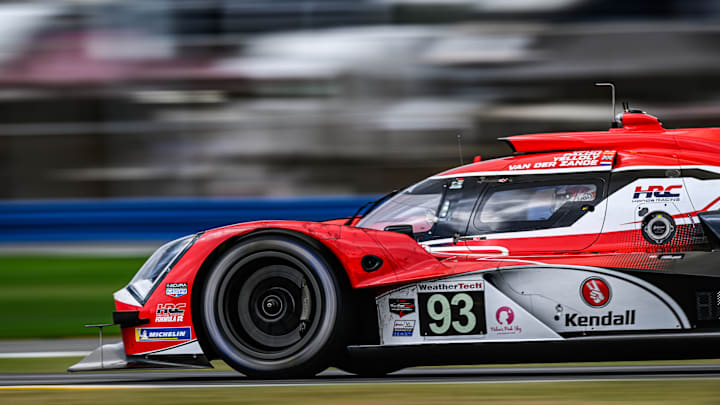
When Honda Racing Corporation announced that they would ‘run’ the Acura Meyer Shank Racing #93 car in IMSA for the 2025 season, the move was dubbed a ‘big chance’ and was simply something that had not been done in our modern era of racing.
After all, Honda Racing Corporation is an engine manufacturer, not a brand that manages strategy, provides race engineers, etc, right? Wrong. As a matter of fact, the HRC-run car #93 is now entering its second year as the only car in IMSA run by its engine supplier.
How does this impact the drivers? The pace? Team Dynamics?
Grand Prix on SI sat down with the 2026 Rolex 24 Hours of Daytona #93 lineup of 4-time IndyCar Champion Alex Palou, endurance racing veterans Renger Van der Zande and Nick Yelloly, and Honda Formula Dream Driver, Kaku Ohta, to answer these questions.
Why the Gamble was worth taking
Before the #93 ever put in a single lap at Daytona, the concept itself challenged the 'norm' that IMSA operates within. An engine manufacturer stepping beyond supply and into race execution was a novelty. For the drivers, though, the appeal was a welcome challenge.

For Alex Palou, the opportunity combined his familiarity with the HRC family with exploration into yet another mountaintop to reach. To put it simply, Palou "loves racing." For him, the fact that this project was "so different to IndyCar" was a massive opportunity to learn. He emphasized that "at the end of the day it's Acura, so it's Honda - the same family that I have in IndyCar".
Similarly, Nick Yelloly and Renger Van der Zande - two IMSA and endurance racing veterans - emphasized that working directly within a manufacturer's organization, not just 'alongside one', drew them to the #93 and working with the Acura Meyer Shank Racing cars (#93 and #60) in the first place.
For Yelloly specifically, he said that the setup felt less like a risk and more like an opportunity to "work with a manufacturer really in-depth to create a great program." Clear accountability, shared responsibility, and a lineup built to collaborate rather than compete internally.
Grand Prix on SI also sat down with Kelvin Fu, Vice President at HRC U.S., who explained that the decision to run the #93 end-to-end was driven by a desire to collapse the distance between decision-making on all ends.

He explained that "there's always a difference in racing pace and factory pace. We wanted to take that one extra step". That step wasn't for control's sake, though, but to improve HRC as a whole, through all of their racing programs.
"It helps our company be better. It gets us closer to the track, so it helps us develop good technology. It just makes our people sharper.”Kelvin Fu, HRC US
What ultimately makes this 'gamble' work for both Honda Racing Corporation and the drivers is the common language that Honda brings across series, continents, and career stages.
For drivers like Palou, an IndyCar Champion, and Kaku Ohta, Honda's Formula Dream Project driver, the #93 isn't just a shared seat but a point of convergence. Honda sits at the center of the structure as both the technical backbone and cultural anchor.
That unifying presence of HRC is what allows the #93 to function not as four individuals sharing a car, but as a cohesive program, and it demonstrates exactly how this lineup works in the car.
Honda as a unifying force across racing disciplines
What separates Honda's approach to the #93 from every other IMSA entry comes down to how information, responsibility, and trust move through the garage. From the inside, the structure and flow of information is deliberately "unsiloed," even to the other Acura Meyer Shank Racing entry of the #60.
"We all share everything here. We sit in the same room, the 60 and the 93. We work towards developing the car together [as opposed to] IndyCar where we just work on the setup.”Alex Palou

Nick Yelloly echoed that sentiment, pushing back on the assumption that the #93’s HRC-led operation creates separation.
“I think people presume that it’s slightly different from the outset because obviously HRC are running the 93 car, but it is one big group. We share everything, which has been really nice.”Nick Yelloly
That openness allows the different skill sets of drivers to coexist and strengthen one another. Yelloly continued to explain that there are staff from the HRC side in Santa Clarita and Meyer Shank Racing sides of the business that equally merge factory knowledge with race-hardened experience across the entire racing program.
For 2x Rolex 24 Hours winner Renger Van der Zande, that exchange was essential, especially in year one.
“The experience was the only thing that was lacking. The racing experience, the gut feeling of how to call a race from the pit crew. We had the 60 car… so we kind of picked their brains and they picked our resources on our end.”Renger Van der Zande
However, information alone doesn't make a diverse four-driver program work. Culture is at the center of the operation... and that is where the #93 separates itself.
Synergy of the #93 drivers and Honda Racing Corporation
Something that became incredibly evident in my conversations with all four drivers and Kelvin from HRC U.S. is that the core reason the #93 has found success is the ability of the drivers to utilize Honda and their own personalities as drivers to learn from each other.
Van der Zande plainly explained that in racing, there are often egos, but on their team, those egos are checked at the door. The group operates with collective accountability that is reinforced from the top. He noted that "Whatever David [David Salters, President, HRC US] wants to win, that's what we're going for."
That mindset shapes how even the most decorated drivers approach the car and the team. Palou, especially, as a 4-time IndyCar Champion and Indy 500 champion surprised me with his answer about his role within the team, especially in reference to Nick Yelloly and Renger Van Der Zande as the full-timers on the #93 car.
"It's not my house. This is their house, their car. My work is not to try to get the car to match my driving style. It's to adapt."Alex Palou
On the opposite end of the spectrum, for Kaku Ohta, this environment has accelerated his transition from a Honda-backed prospect to a successful member of the #93 team. He is constantly learning and finds that all 3 of the other drivers serve specific roles for his development.
Ohta said he sees Yelloly as a "mentor"; Van der Zande as a "fighter"; Palou as "inspiration" for his success and composure on track. All three veteran drivers noted in return that they learned about a different culture of racing from Ohta and love watching him grow within the program.
What truly stood out is that while Grand Prix on SI had the conversations with these drivers in the same room, hours later in conversation with Kelvin from HRC U.S., he gave nearly identical characterizations of the four drivers in their #93 car lineup.
That synergy, lack of ego, and mutual respect are key to the smallest moments as much as the biggest calls, with a focus, according to Yelloly, being on "improving ourselves." After all, while this is the team for Daytona, a 24-hour race, the #93 is a season-long contender in IMSA, where communication matters as much as speed.

By the time the green flag drops, the #93 isn’t operating as four drivers from four disciplines sharing track time. It’s operating as a single unit shaped by Honda’s central role. A role where data, feedback, and decision-making flow freely, and where the team functions as one.
The 2026 IMSA season ahead
The 2026 Rolex 24 at Daytona ultimately delivered what Honda Racing Corporation set out to prove – for a second year in a row. Regardless of where the #93 finished on the timing screen, the weekend again validated HRC’s decision to run an entire IMSA entry.

When the manufacturer sits at the center of engineering, strategy, and personnel, the sum is a highly competitive car at the highest levels of sports-car and endurance racing. The same is true of the driving team that they have assembled.
Different backgrounds, careers, and racing styles are aligned by a single structure and a shared trust in the process that HRC has laid out before them.
For IMSA, the #93 represents a different model of manufacturer involvement that blurs the traditional line between team and supplier. For HRC, this race will inform how the program evolves in 2026, how information flows, how drivers collaborate under pressure, and how to win in the future.
Consistency and synergy are the real through lines of the story of the #93. Whether in a 24-hour endurance race or a season-long title fight that Yelloly and Van der Zande are soon to embark on, HRC isn’t chasing a single weekend win. It’s about building a unified approach to performance without losing the common language that unites the drivers behind the wheel.
The Latest From Grand Prix On SI
 Add us as a preferred source on Google
Kaitlin Tucci has been a fan of motorsport for close to a decade. Before joining On SI in 2025, she contributed heavily to the marketing and media efforts at FanAmp, a motorsports startup for which she was the Head of Marketing. She has contributed to a number of publications covering series such as Formula 1, IndyCar, IMSA, and more... Kaitlin graduated from the Massachusetts Institute of Technology with both a degree in Business/Marketing and Political Science. She works full time as a marketer at high-growth tech startups while spending her weekends immersed in the world of racing. Kaitlin was raised in Las Vegas, Nevada, but has lived in New York City for the past 5 years with her 'giant chihuahua' Willow. You'll often catch Willow watching races alongside Kaitlin, but unfortunately she doesn't have enough airline miles to join her at the track just yet.