
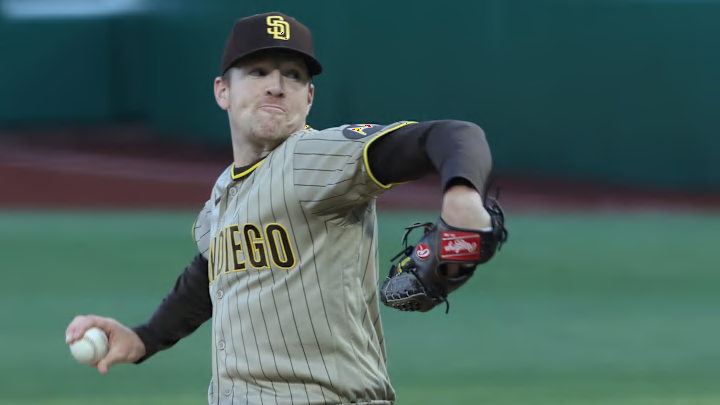
Nick Pivetta Could See Fantasy Value Rise in Potential Trade to Mets
In this story:
A Nick Pivetta mock trade scenario focuses on a pitcher who brings immediate value through strikeouts, durability when healthy, and the ability to stabilize a rotation in a playoff race. Pivetta’s profile is built on swing-and-miss stuff and innings potential, making him a strong fit for teams looking to add a mid-rotation arm capable of handling meaningful starts down the stretch.
However, his trade market is complicated by recent concerns, as he left his most recent start with arm tightness and will need to be re-evaluated, which introduces uncertainty about his short-term availability and medical outlook. That kind of risk can lower or reshape his trade value, but teams in contention may still be willing to bet on his upside if the injury proves minor.
Nick Pivetta exited with an injury after retiring the first nine Rockies hitters he faced pic.twitter.com/4ZeQTUFYMi
— Talkin' Baseball (@TalkinBaseball_) April 12, 2026
Even with that uncertainty, his overall value remains tied to his strikeout ability and playoff usefulness for a contender.
Here’s what it would take for the Mets to acquire him:
San Diego Padres - New York Mets MLB Mock Trade Details & Fantasy Baseball Impact
Padres Acquire:
SP Christian Scott
INF Ronny Mauricio
Mets Acquire:
SP Nick Pivetta
Fantasy Impact
Nick Pivetta (to Mets):
Pivetta gains fantasy value by moving into a stronger Mets context where win support and team competitiveness improve. His 2026 profile still features strong strikeout production with moderate ERA volatility, but better run support makes him more reliable for fantasy managers. He profiles as a solid SP3/SP4 with added value in points leagues due to Ks and innings.
Christian Scott (to Padres):

Scott remains a high-upside but inconsistent fantasy arm, showing strong strikeout ability in 2026 MLB action alongside uneven results and a rocky AAA stint. His value is tied to development and command improvement, but in San Diego he becomes a deeper-league stash or streaming option with breakout potential if he stabilizes.
Ronny Mauricio (to Padres):
Mauricio offers a power-speed fantasy profile but with limited consistency, coming off a 2025 season marked by modest production and streaky hitting. His value depends heavily on playing time, and a new opportunity in San Diego could unlock 15/15 upside, though his low OBP and contact issues keep him risky in standard leagues.
Why The Mets Make The Trade

The Mets make this trade because they are in win-now mode and need to maximize their rotation stability for a playoff push.
Adding Nick Pivetta gives them a proven strikeout arm who can step into the middle of the rotation immediately. Even with some volatility, his ability to miss bats and handle a starter’s workload helps shorten games and gives the Mets a stronger chance in both the regular season and October-style matchups.
In return, they give up Christian Scott and Ronny Mauricio, both of whom are upside-based, long-term pieces. Scott is still developing after injury and inconsistency, and Mauricio has struggled with consistency at the plate and is not fully established as an everyday MLB bat. For a team chasing a playoff spot now, those future-focused assets are more expendable.
Overall, the Mets make this move to prioritize immediate rotation help and increased playoff odds, sacrificing developmental upside for a more established arm in the present.
Why The Padres Make The Trade

The Padres make this trade because they are balancing present competitiveness with long-term roster flexibility, while betting on upside talent they can develop.
By acquiring Christian Scott and Ronny Mauricio, they are adding two controllable, high-upside players who fit different needs. Scott brings strikeout potential and rotation upside, even if his 2026 results have been uneven, while Mauricio offers athleticism, power-speed tools, and the chance to grow into a productive everyday infielder if he earns consistent playing time.
The Padres also benefit from moving Nick Pivetta, a veteran arm who is valuable but more of a short-term piece. In return, they avoid committing long-term value to a mid-rotation starter and instead add younger players who can contribute for multiple seasons at a lower cost.
Overall, the Padres make this deal because they prioritize upside, cost control, and player development, turning one established pitcher into two potential long-term core pieces.
 Add us as a preferred source on Google
Ryan Shea is a seasoned sports enthusiast with a sharp eye for strategy and a deep love for the game—no matter the sport. Whether he’s analyzing roster moves or spotting trends before they hit the headlines, Ryan brings a unique mix of research, instinct, and insider perspective to his writing. With over a decade of experience dominating fantasy leagues, he knows what it takes to build championship-caliber lineups. A diehard fan of all things New York, Ryan proudly reps the Jets, Yankees, Knicks, and Rangers—win or lose.