
Sonny Gray to Cubs Mock Trade: Veteran Rotation Fix and Fantasy Impact Breakdown
In this story:
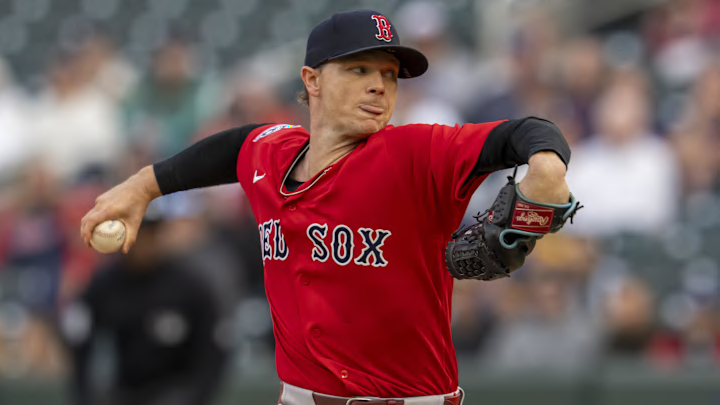
A veteran like Sonny Gray provides exactly the kind of stability contending teams need when injuries hit the rotation. For a first-place Cubs team dealing with multiple starting pitching losses, Gray brings consistency, command, and the ability to steady the staff through a playoff race.
In fantasy terms, he profiles as a high-floor starter who benefits from a strong team context, offering reliable wins and quality starts rather than elite strikeout upside.
Given Chicago’s urgency and need for rotation depth, here’s what it would take for the Cubs to acquire him.
Chicago Cubs- Boston Red Sox MLB Mock Trade Details & Fantasy Baseball Impact
Cubs Get:
SP Sonny Gray
Red Sox Get:
RHP Brandon Birdsell ( Cubs # 16 Prospect)
OF Kevin Alcántara ( Cubs # 5 Propspect)
UTIL James Triantos ( Cubs # 9 Prospect)
Fantasy Impact
Sonny Gray → Chicago Cubs
Gray’s 2026 line (3.54 ERA, 1.29 WHIP over 28 innings) shows a steady, low-to-mid-rotation veteran profile who immediately stabilizes Chicago’s fantasy pitching staff.
While not a dominant strikeout arm anymore, his command and ability to limit damage make him a reliable weekly starter in deeper fantasy leagues, especially valuable on a contending team where wins and quality starts should be more consistent.
Kevin Alcántara → Boston Red Sox
Alcántara’s 2026 AAA production (.246 AVG, .948 OPS, 13 HR in 33 games) makes him the most impactful fantasy piece in the return.
Despite the modest average, the elite OPS and power surge suggest legitimate 25–30 HR upside. In a better MLB lineup environment, he projects as a high-ceiling fantasy outfielder capable of strong power and run production if the contact stabilizes.
The Jaguar swipes a share of the Minor League home run lead 🐾@Cubs No. 4 prospect Kevin Alcántara laces his 13th homer of the season for the Triple-A @IowaCubs -- 108 mph | 417 ft pic.twitter.com/ujIEn3WymE
— MLB Pipeline (@MLBPipeline) May 9, 2026
Brandon Birdsell → Boston Red Sox
Birdsell’s 2025 AAA performance (3.38 ERA, 18 K in 18.2 IP, 1.29 WHIP) highlights strong swing-and-miss ability, though his 2026 development has been slowed by injury, which adds volatility.
In fantasy dynasty terms, Boston is betting on long-term upside—if healthy, he projects as a potential strikeout-heavy SP back-end option, but currently profiles more as a stash than an immediate contributor.
James Triantos → Boston Red Sox
Triantos’ 2026 line (.302 AVG, .788 OPS, 4 HR in 31 games) reflects a high-contact, high-floor hitter with versatility but limited power ceiling.
In fantasy terms, he profiles as a utility infielder type who can help in batting average and runs in deeper formats, but he is unlikely to develop into a major power contributor, making him a steady but lower-upside piece in the deal.
#Cubs prospect James Triantos has shown growth in the power department in 2026.
— The Prospect Report (@TheProspctReprt) April 29, 2026
Hitting .304/.340/.829, his ISO of .185 is much improved over his career ISO and he’s doing it while maintaining his high contact ability (13.4% K rate). He has 4 HRs already. His career high is 7. pic.twitter.com/NUKczoHP8Y
Why The Red Sox Make The Trade

The Red Sox would make this trade because their 2026 season has shifted toward retooling rather than contending. At 17–23 and after moving on from manager Alex Cora, Boston looks more like a team resetting than pushing for a playoff spot.
In that context, trading Sonny Gray makes sense as a way to turn a short-term veteran into controllable long-term talent. They acquire upside pieces like Kevin Alcántara, pitching depth in Brandon Birdsell, and a steady utility bat in James Triantos.
Overall, it’s a pivot toward youth and upside, using Gray’s value to accelerate a retool around future contributors instead of chasing a difficult 2026 season.
Why The Cubs Make The Trade

The Cubs would make this trade because they are in a strong win-now position, but are suddenly facing a rotation crisis. Sitting in first place in the NL Central at 27–14, Chicago is firmly in contention, but injuries to key starters like Cade Horton, Justin Steele, and Matthew Boyd have left their rotation depleted at exactly the wrong time.
Adding Sonny Gray gives them an immediate stabilizing force at the top of the staff. Even without overpowering strikeout totals, Gray’s 2026 production (3.54 ERA, 1.29 WHIP) brings veteran command, consistency, and the ability to deliver quality starts—exactly what a first-place team needs to stay ahead in a tight division race.
For Chicago, this is a classic deadline-style urgency move: they already have the offense and standing to compete, but the injuries force them to convert prospect depth into reliable MLB pitching. Gray doesn’t just patch a hole—he helps preserve their division lead while the rotation heals.
More Fantasy Sports On SI News
 Add us as a preferred source on Google
Ryan Shea is a seasoned sports enthusiast with a sharp eye for strategy and a deep love for the game—no matter the sport. Whether he’s analyzing roster moves or spotting trends before they hit the headlines, Ryan brings a unique mix of research, instinct, and insider perspective to his writing. With over a decade of experience dominating fantasy leagues, he knows what it takes to build championship-caliber lineups. A diehard fan of all things New York, Ryan proudly reps the Jets, Yankees, Knicks, and Rangers—win or lose.