
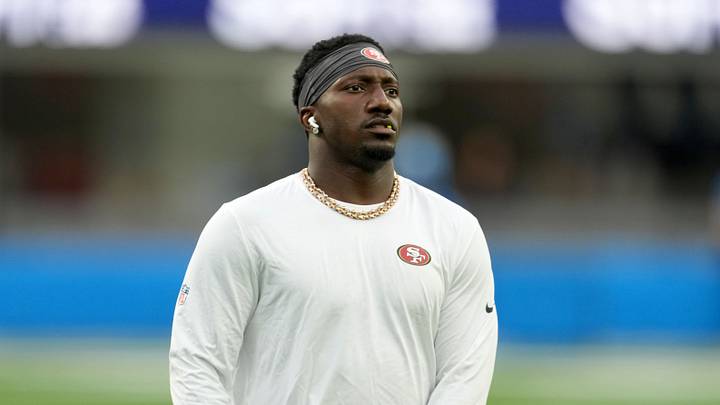
Deebo Samuel Sr. Headlines Fantasy Football Last Minute Busts to Avoid Before Your 2026 Draft
In this story:
Drafting a winning fantasy football roster isn't about identifying bad football players. It's about identifying risk.
When a player's Average Draft Position (ADP) requires near-flawless health, historic touchdown conversion, or an immediate leap in offensive efficiency just to return breaking-even value, they become a liability.
If you want to avoid draft-night landmines in 2026, keep these names off your high-leverage queue.
James Cook, RB, Buffalo Bills
The Trap: Chasing Unsustainable Touchdown Efficiency in a Split Backfield
Cook delivered a banner season in 2025, breaking the 1,600-yard mark and scoring at an elite clip inside the 5-yard line. Chasing last year's touchdowns is one of the most well-documented mistakes in fantasy football.

The thee-time Pro Bowl running back remains a vital piece of Buffalo's offense, but quarterback Josh Allen remains the primary goal-line threat for the Bills. Regression to the mean on Cook's short-yardage conversions means you are paying for a 2025 outcome that is statistically unlikely to repeat.
Marvin Harrison Jr., WR, Arizona Cardinals
The Trap: Paying Top-12 Prices for Blue-Chip Pedigree Over Proven Efficiency
Harrison Jr. remains one of the most talented receiving prospects of the decade, but drafting him as a locked-in WR1 ignores the harsh reality of his analytical profile. In 12 games during the 2025 season, Harrison Jr. produced a stat line of 41 receptions for 608 yards and 4 touchdowns on 73 targets.
Avoid Marvin Harrison Jr?🤔
— PFF Fantasy (@PFF_Fantasy) August 10, 2026
5 Wide Receivers to AVOID in Fantasy Drafts This Season⬇️https://t.co/oXpWI2Vmkg
The underlying issue isn't Harrison Jr.'s talent, but it's consistency and target distribution in Arizona. With Trey McBride vacuuming up high-percentage, short/intermediate looks, Harrison Jr.'s target quality remains volatile. To beat his 2026 ADP, he needs a massive jump in both catch rate and target volume which is a gamble you shouldn't take in Round 2.
Deebo Samuel Sr., WR, San Francisco 49ers
The Trap: Declining Efficiency Meets High Target Competition
Samuel Sr. built his fantasy legacy on hyper-efficient run-after-catch (YAC) play and high-volume rushing touches. Entering 2026, the age curve and offensive dynamics have shifted the floor out from under him.
Purdy ➡️ Deebo 🎯
— TheFantasyFormula (@AFantasyFormula) August 17, 2026
Might have to take Deebo late in drafts. The connection is already established and he could play his hybrid WR/RB role again in 2026.
I’m skeptical, but in for now💰
pic.twitter.com/ZMRzDUP7yO
In 2025, Samuel finished with just 101.3 standard fantasy points across 14 games, aveaging a modest 7.3 per contest. His rushing involvement, dropped to just 17 attempts on the year, signaling that San Francisco may manage his physical wear and tear.
With dynamic young playmakers claiming larger roles in Shanahan's system, Samuel Sr. can no longer be trusted as a weekly WR2. Drafting him on brand recognition alone is a recipe for disaster.
D'Andre Swift, RB, Chicago Bears
The Trap: Uncomfortable ADP Built on Volatile Volume and Weak Per-Touch Metrics
Swift posted respectable total volume in 2025 with 223 carries for 1,087 yards and 9 touchdowns which pushed his 2026 ADP into the early RB2 range. Advanced metrics show a running back heavily relying on game-script and goal-line conversions rather than true rushing efficiency.

Swift's 4.87 yards per carry were inflated by long break-away runs, masking a low success rate on a down-to down basis. If Chicago introduces goal-line back or shifts more red-zone touches to their passing game, Swift's fantasy floor collapses quickly.
Jordan Addison, WR, Minnesota Vikings
The Trap: High Volatility and Target-Ceiling Limits Alongside Elite Teammates

Addison's game-breaking speed makes him a threat to score from anywhere on the field, but his fantasy profile is plagued by extreme variance. Playing alongside Justin Jefferson means Addison's target share faces a hard ceiling. In games where Minnesota's offense struggles or relies on heavy-two-tight-end sets, Addison's floor drops to near-zero.
Conclusion
The fundamental rule of a successful fantasy football draft is simple: value is not created by taking the best players, but by exploiting draft-market inefficiences.
Avoiding these five players at their current Average Draft Position doesn't mean writing off their talent. It means recognizing that their draft prices demand peak-level performance while ignoring inherent structural risks, from TD regression and age curves, to low-efficiency touches and team target caps.
 Add us as a preferred source on Google
Daniel Outerbridge covers the NBA, NFL, WNBA, and MLB with an emphasis on the numbers behind the game. His work breaks down player performance, team strategy, and emerging statistical trends to provide actionable insights for fans and fantasy players. Outerbridge has written for a myriad of other outlets including Anubis Sports and FanSided.