%22%3E%0A%3Cpath%20fill-rule%3D%22evenodd%22%20clip-rule%3D%22evenodd%22%20d%3D%22M156.868%204.36764C162.691%20-1.45588%20172.132%20-1.45588%20177.956%204.36764C183.779%2010.1912%20183.779%2019.6324%20177.956%2025.4559L167.412%2036L156.868%2025.4559C151.044%2019.6324%20151.044%2010.1912%20156.868%204.36764ZM159.509%207.55761C159.448%207.86849%20159.416%208.39718%20159.416%209.14566V10.4189C159.416%2011.1832%20159.448%2011.7198%20159.513%2012.0267C159.578%2012.3317%20159.778%2012.6168%20160.117%2012.8762C160.456%2013.1376%20160.903%2013.3316%20161.458%2013.4623C162.012%2013.593%20162.6%2013.6584%20163.337%2013.6584C164.073%2013.6584%20164.717%2013.591%20165.269%2013.4524C165.822%2013.3158%20166.261%2013.1178%20166.586%2012.8604C166.911%2012.6029%20167.105%2012.3178%20167.166%2012.0069C167.228%2011.6961%20167.259%2011.1674%20167.259%2010.4189V9.14566C167.259%208.38134%20167.228%207.84473%20167.162%207.53781C167.097%207.23287%20166.897%206.94971%20166.558%206.68834C166.22%206.42696%20165.772%206.23291%20165.218%206.10223C164.663%205.97154%20164.036%205.90619%20163.339%205.90619C162.602%205.90619%20161.959%205.97352%20161.406%206.11213C160.852%206.24875%20160.414%206.44677%20160.089%206.70418C159.765%206.9616%20159.571%207.24673%20159.509%207.55761ZM164.776%2024.8638C168.376%2024.8638%20170.057%2024.2064%20170.057%2021.862V21.858V21.3155C170.057%2019.6581%20169.016%2018.971%20165.752%2018.3136C164.778%2018.1136%20164.408%2017.9136%20164.408%2017.3136V16.9414C164.408%2016.6543%20164.677%2016.5117%20164.913%2016.5117C165.249%2016.5117%20165.418%2016.7137%20165.418%2016.9414V18.1136H169.891V17.3988C169.891%2015.4563%20168.847%2014.4266%20164.677%2014.4266C161.65%2014.4266%20159.396%2015.3414%20159.396%2017.3711V17.7433C159.396%2019.5155%20160.305%2020.3155%20163.701%2021.0303C163.78%2021.0472%20163.855%2021.063%20163.927%2021.0781C164.829%2021.2674%20165.147%2021.3341%20165.147%2021.9174V22.2897C165.147%2022.6619%20165.046%2022.8045%20164.642%2022.8045C164.17%2022.8045%20164.137%2022.5471%20164.137%2022.262V21.2897H159.394V21.7471C159.394%2024.149%20160.976%2024.8638%20164.776%2024.8638ZM170.924%2024.5569H175.425V14.7355H170.924V24.5569ZM172.455%2013.5019H175.425V6.06064H172.592V9.411L170.693%206.06064H167.859V13.5019H170.693V10.1199L172.455%2013.5019ZM163.769%2012.152C163.704%2012.2688%20163.555%2012.3262%20163.325%2012.3262L163.327%2012.3282C163.104%2012.3282%20162.959%2012.2767%20162.898%2012.1758C162.836%2012.0748%20162.805%2011.8074%20162.805%2011.3758V7.90068C162.805%207.51852%20162.852%207.28684%20162.945%207.20962C163.038%207.13239%20163.175%207.09279%20163.351%207.09279C163.559%207.09279%20163.698%207.14031%20163.765%207.23734C163.832%207.33239%20163.866%207.55416%20163.866%207.90068V11.3203C163.866%2011.7579%20163.834%2012.0352%20163.769%2012.152Z%22%20fill%3D%22white%22%2F%3E%0A%3Cpath%20d%3D%22M134.707%2035.9991C129.823%2035.9991%20126.029%2035.0305%20122.478%2033.2547L125.303%2027.7255C127.765%2029.017%20130.227%2029.8242%20133.254%2029.8242C136.684%2029.8242%20138.5%2028.0484%20138.5%2024.9811V24.3354C137.249%2025.7479%20135.191%2027.3623%20132.124%2027.3623C126.433%2027.3623%20122.316%2023.3264%20122.316%2017.2322V17.1515C122.316%2010.9766%20126.514%206.90039%20131.599%206.90039C134.828%206.90039%20136.724%208.11115%20138.339%209.76586V7.42506H147.5V23.8914C147.5%2027.9677%20146.653%2030.7524%20144.635%2032.7704C142.657%2034.748%20139.63%2035.9991%20134.707%2035.9991ZM134.868%2020.6627C137.128%2020.6627%20138.541%2019.1291%20138.541%2017.1919V17.1112C138.541%2015.2143%20137.088%2013.6807%20134.868%2013.6807C132.608%2013.6807%20131.195%2015.2547%20131.195%2017.1919V17.2726C131.195%2019.1695%20132.648%2020.6627%20134.868%2020.6627Z%22%20fill%3D%22white%22%2F%3E%0A%3Cpath%20d%3D%22M96.9492%2029.4629V7.42701H106.111V10.4943C107.523%208.67813%20109.743%206.90234%20112.851%206.90234C117.492%206.90234%20120.398%209.96961%20120.398%2014.9337V29.4629H111.236V17.8799C111.236%2015.9831%20110.106%2014.8934%20108.734%2014.8934C107.362%2014.8934%20106.111%2015.9831%20106.111%2017.8799V29.4629H96.9492Z%22%20fill%3D%22white%22%2F%3E%0A%3Cpath%20d%3D%22M84.8096%205.85202V0H94.2939V5.85202H84.8096ZM84.971%2029.4619V7.42602H94.1324V29.4619H84.971Z%22%20fill%3D%22white%22%2F%3E%0A%3Cpath%20d%3D%22M58.877%2029.4619V0H68.0384V10.3722C69.451%208.55606%2071.6707%206.90135%2074.7783%206.90135C79.4196%206.90135%2082.3254%209.96862%2082.3254%2014.9327V29.4619H73.164V17.8789C73.164%2015.9821%2072.0339%2014.8924%2070.6617%2014.8924C69.2895%2014.8924%2068.0384%2015.9821%2068.0384%2017.8789V29.4619H58.877Z%22%20fill%3D%22white%22%2F%3E%0A%3Cpath%20d%3D%22M47.3991%2029.9876C43.1211%2029.9876%2039.2466%2028.8979%2036.0986%2026.7992L39.2063%2021.5929C41.8699%2023.2477%2044.8565%2024.0548%2047.3587%2024.0548C48.2466%2024.0548%2048.6906%2023.853%2048.6906%2023.3284V23.2477C48.6906%2022.8037%2048.287%2022.5212%2046.0673%2021.9562C40.4977%2020.584%2037.0672%2019.0907%2037.0672%2014.5302V14.4494C37.0672%209.60638%2040.9417%206.90234%2046.6726%206.90234C50.3049%206.90234%2053.8969%207.8306%2056.5605%209.44495L53.6547%2014.8934C51.3139%2013.6019%2048.4888%2012.8351%2046.6323%2012.8351C45.7444%2012.8351%2045.3408%2013.0772%2045.3408%2013.5212V13.6019C45.3408%2014.0458%2045.8251%2014.3284%2048.0448%2014.8934C53.6143%2016.2656%2056.9641%2017.7992%2056.9641%2022.3194V22.4001C56.9641%2027.2028%2053.3722%2029.9876%2047.3991%2029.9876Z%22%20fill%3D%22white%22%2F%3E%0A%3Cpath%20d%3D%22M25.5312%205.85202V0H35.0156V5.85202H25.5312ZM25.6927%2029.4619V7.42602H34.8541V29.4619H25.6927Z%22%20fill%3D%22white%22%2F%3E%0A%3Cpath%20d%3D%22M0%2029.4621V1.21094H23.6503V9.2827H9.44396V12.8746H22.6413V20.2199H9.44396V29.4621H0Z%22%20fill%3D%22white%22%2F%3E%0A%3C%2Fg%3E%0A%3Cdefs%3E%0A%3CclipPath%20id%3D%22clip0_16330_64756%22%3E%0A%3Crect%20width%3D%22182%22%20height%3D%2236%22%20fill%3D%22white%22%2F%3E%0A%3C%2FclipPath%3E%0A%3C%2Fdefs%3E%0A%3C%2Fsvg%3E%0A)
4 Best Crankbait Styles For Catching More and Bigger Bass
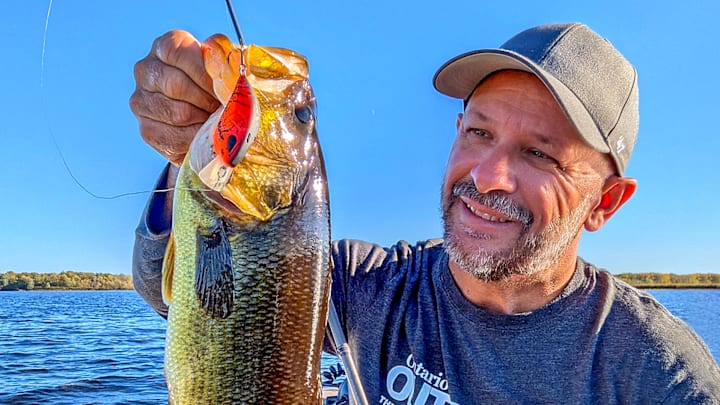
When it comes to catching bass, crankbaits deserve a treasured spot in every anglers tackle tray. Lifelike in all attributes, including size, profile, sound, swimming action, and colour, the crankbait is hands-down the most natural looking bait on the market. This is why they excel at triggering bass into biting.

There are many different crankbait designs specifically catered to bass fishing. And although all catch fish, the following list of four have a proven track record when it comes to catching more and bigger bass.
Crankbaits are also one of the easiest lures to fish. Classed as a 'chuck and wind' bait, a simple straight retrieve is all that is ever really needed. The action of the bait does the brunt of the work.
1. Square Bill Crankbaits Pull Bass Out of Shallow Cover
A square bill crankbait is easily recognizable by its short square circuit board lip. Designed to move with its tail tilted up and its diving lip doubling as a hook guard, this lure can deflect off wood and rock without snagging, making it deadly in shallow cover.

With most square bill crankbaits running to depths between 2 and 4 feet deep, this lure is perfect for working over shallow weed flats, alongside docks, across rocky shoals, and into sunken trees and stumps.

Producing a tantalizing side-to-side wobble, square bill crankbaits work best with a simple straight retrieve. When making contact with cover, simply stop reeling for a second to allow your bait rise up from the snag slowly. Bass will often clobber these lures on that pause.
Top Choices for a Square Bill Crankbait
- Rapala OG Big Rocco 6
- Lunkerhunt Impact Shock 2.5F Squarebill
- Bagley Balsa B2 Squarebill
2. Lipless Crankbaits Cover Water Effectively When Searching for Bass
Lipless crankbaits are easy to identify by their flat body, pointed ends, internal rattles, and as the name implies, no lip. Often referred to as 'Rat-L-Traps' - as this was the original lipless crankbait that was brought to market in 1960's by Bill Lewis - there are a wide variety of manufacturers producing this style of bait now.

A sinking bait that descends at a rate of approximately one foot per second, the lipless crankbait can be fished at any depth by simply counting it down after the initial cast. Without a built-in lip, this style of crankbait requires a medium-fast retrieve to work it effectively at the desired depth.
Lipless crankbaits are designed to quickly cover water. An excellent choice when fishing a new lake or river or when trying to intercept roaming fish, this style of bait can't really be fished too quickly.
Triggering fish both with the tight wobble and shimmy, as well as loud knocking of rattles, bass will often hit this bait hard out of pure aggression and hunger.

Work a lipless crankbait across expansive flats, rocky shoals, over underwater humps or saddles, and adjacent to weedlines. Once you connect with some bass, slowing down to work the area with a horizontal bait is often recommended.
Top Choices for a Lipless Crankbait
- Bill Lewis Original Rat-L-Trap
- Lunkerhunt Impact Reactor
- Strike King Red Eye Shad
3. Deep Diving Crankbaits Dredge the Depths for Bottom-Dwelling Bass
My first introduction to the effectiveness of deep diving crankbaits came eight years ago when I was invited by Berkley and Abu Garcia to field test lures and gear on the world famous waters of Mexico's Lake El Salto.
On this trip we were field testing the soon-to-be-released Dredger 25.5 - a deep diving crankbait that could hit the magical depth of 25 feet.

Sharing a boat with professional bass angler Adrian Avena and a guide one early evening, we worked a mud and rock flat that bottomed out at around 25 feet deep. Throwing the new Berkley Dredger, we would make contact with the bottom and ultimately trigger bass after bass into hitting. I lost count during that short session on the water, but we boated over 40 fish in only an hour.

The advantage of using a deep diving crankbait is in its ability to dive quickly to an astounding depth. Ideal for fishing humps, points, or deep channels or flats, getting your bait to dig down into structure, stirring up sediment and deflecting direction, is often the trigger to get those bottom-dwelling bass to strike.
Top Choices for a Deep Diving Crankbait
- Berkley Dredger 25.5
- Megabass Deep-X 300
- Strike King 10XD
4. Wakebaits Churn Water for Surface Striking Bass
Wakebaits, similar to square bills, feature a square lip design but one that is much more steeply angled. This variation allows a wakebait to run slightly below the surface, creating a wide and erratic swimming action that triggers aggressive strikes from shallow dwelling bass.

An excellent search bait for both largemouth and smallmouth bass, wakebaits mimic a struggling baitfish swimming wildly just below the surface. Perfect for working over shallow weed flats or rocky shorelines, the bait itself produces all of the action, making simple work for an angler with nothing more than a steady and straight retrieve.

Top Choices for a Wakebait
- 6th Sense Movement 80WK
- Bagley Balsa Wake 1
- Strike King HC KVD Wakebait
Quick Tips to Help You Catch More Bass on Crankbaits
- Vary Your Retrieve: A simple straight retrieve will often work, but if bites are few and far between, add variations like pauses, speed cranking, and a yo-yo adaptation (lipless crankbait).
- Match the Hatch: Choose crankbaits that mimic the size of baitfish that bass are feeding on.
- Concentrate on Color: If fishing clear water stick with natural hues; stained water brighter colors.
- Sound is Important: Some days bass react positively to a crankbait with internal rattles. Other days they want the silent version. Offer them both to figure out what is working.
- Work the Angles: Experiment with casting angles when working structure, hitting the cover from different vantage points.
- Long Bomb Casts: Cast as far as possible when working open water to keep your crankbait in the strike zone the longest.
- Cast Past Targets: Factor in the distance it takes your crankbait to dive when working specific structure.
You Might Also Like These Bass Fishing Stories:
 Add us as a preferred source on Google
Justin Hoffman is an outdoor writer and photographer with 25 years of experience producing media content for a host of North American fishing and hunting publications. With an ardent passion for bass fishing, as well as chasing panfish on the fly, this Ontario-based angler is always seeking out new water to wet a line - and along with that, interesting stories to write and share.
Follow HoffmanOutdoors