%22%3E%0A%3Cpath%20fill-rule%3D%22evenodd%22%20clip-rule%3D%22evenodd%22%20d%3D%22M156.868%204.36764C162.691%20-1.45588%20172.132%20-1.45588%20177.956%204.36764C183.779%2010.1912%20183.779%2019.6324%20177.956%2025.4559L167.412%2036L156.868%2025.4559C151.044%2019.6324%20151.044%2010.1912%20156.868%204.36764ZM159.509%207.55761C159.448%207.86849%20159.416%208.39718%20159.416%209.14566V10.4189C159.416%2011.1832%20159.448%2011.7198%20159.513%2012.0267C159.578%2012.3317%20159.778%2012.6168%20160.117%2012.8762C160.456%2013.1376%20160.903%2013.3316%20161.458%2013.4623C162.012%2013.593%20162.6%2013.6584%20163.337%2013.6584C164.073%2013.6584%20164.717%2013.591%20165.269%2013.4524C165.822%2013.3158%20166.261%2013.1178%20166.586%2012.8604C166.911%2012.6029%20167.105%2012.3178%20167.166%2012.0069C167.228%2011.6961%20167.259%2011.1674%20167.259%2010.4189V9.14566C167.259%208.38134%20167.228%207.84473%20167.162%207.53781C167.097%207.23287%20166.897%206.94971%20166.558%206.68834C166.22%206.42696%20165.772%206.23291%20165.218%206.10223C164.663%205.97154%20164.036%205.90619%20163.339%205.90619C162.602%205.90619%20161.959%205.97352%20161.406%206.11213C160.852%206.24875%20160.414%206.44677%20160.089%206.70418C159.765%206.9616%20159.571%207.24673%20159.509%207.55761ZM164.776%2024.8638C168.376%2024.8638%20170.057%2024.2064%20170.057%2021.862V21.858V21.3155C170.057%2019.6581%20169.016%2018.971%20165.752%2018.3136C164.778%2018.1136%20164.408%2017.9136%20164.408%2017.3136V16.9414C164.408%2016.6543%20164.677%2016.5117%20164.913%2016.5117C165.249%2016.5117%20165.418%2016.7137%20165.418%2016.9414V18.1136H169.891V17.3988C169.891%2015.4563%20168.847%2014.4266%20164.677%2014.4266C161.65%2014.4266%20159.396%2015.3414%20159.396%2017.3711V17.7433C159.396%2019.5155%20160.305%2020.3155%20163.701%2021.0303C163.78%2021.0472%20163.855%2021.063%20163.927%2021.0781C164.829%2021.2674%20165.147%2021.3341%20165.147%2021.9174V22.2897C165.147%2022.6619%20165.046%2022.8045%20164.642%2022.8045C164.17%2022.8045%20164.137%2022.5471%20164.137%2022.262V21.2897H159.394V21.7471C159.394%2024.149%20160.976%2024.8638%20164.776%2024.8638ZM170.924%2024.5569H175.425V14.7355H170.924V24.5569ZM172.455%2013.5019H175.425V6.06064H172.592V9.411L170.693%206.06064H167.859V13.5019H170.693V10.1199L172.455%2013.5019ZM163.769%2012.152C163.704%2012.2688%20163.555%2012.3262%20163.325%2012.3262L163.327%2012.3282C163.104%2012.3282%20162.959%2012.2767%20162.898%2012.1758C162.836%2012.0748%20162.805%2011.8074%20162.805%2011.3758V7.90068C162.805%207.51852%20162.852%207.28684%20162.945%207.20962C163.038%207.13239%20163.175%207.09279%20163.351%207.09279C163.559%207.09279%20163.698%207.14031%20163.765%207.23734C163.832%207.33239%20163.866%207.55416%20163.866%207.90068V11.3203C163.866%2011.7579%20163.834%2012.0352%20163.769%2012.152Z%22%20fill%3D%22white%22%2F%3E%0A%3Cpath%20d%3D%22M134.707%2035.9991C129.823%2035.9991%20126.029%2035.0305%20122.478%2033.2547L125.303%2027.7255C127.765%2029.017%20130.227%2029.8242%20133.254%2029.8242C136.684%2029.8242%20138.5%2028.0484%20138.5%2024.9811V24.3354C137.249%2025.7479%20135.191%2027.3623%20132.124%2027.3623C126.433%2027.3623%20122.316%2023.3264%20122.316%2017.2322V17.1515C122.316%2010.9766%20126.514%206.90039%20131.599%206.90039C134.828%206.90039%20136.724%208.11115%20138.339%209.76586V7.42506H147.5V23.8914C147.5%2027.9677%20146.653%2030.7524%20144.635%2032.7704C142.657%2034.748%20139.63%2035.9991%20134.707%2035.9991ZM134.868%2020.6627C137.128%2020.6627%20138.541%2019.1291%20138.541%2017.1919V17.1112C138.541%2015.2143%20137.088%2013.6807%20134.868%2013.6807C132.608%2013.6807%20131.195%2015.2547%20131.195%2017.1919V17.2726C131.195%2019.1695%20132.648%2020.6627%20134.868%2020.6627Z%22%20fill%3D%22white%22%2F%3E%0A%3Cpath%20d%3D%22M96.9492%2029.4629V7.42701H106.111V10.4943C107.523%208.67813%20109.743%206.90234%20112.851%206.90234C117.492%206.90234%20120.398%209.96961%20120.398%2014.9337V29.4629H111.236V17.8799C111.236%2015.9831%20110.106%2014.8934%20108.734%2014.8934C107.362%2014.8934%20106.111%2015.9831%20106.111%2017.8799V29.4629H96.9492Z%22%20fill%3D%22white%22%2F%3E%0A%3Cpath%20d%3D%22M84.8096%205.85202V0H94.2939V5.85202H84.8096ZM84.971%2029.4619V7.42602H94.1324V29.4619H84.971Z%22%20fill%3D%22white%22%2F%3E%0A%3Cpath%20d%3D%22M58.877%2029.4619V0H68.0384V10.3722C69.451%208.55606%2071.6707%206.90135%2074.7783%206.90135C79.4196%206.90135%2082.3254%209.96862%2082.3254%2014.9327V29.4619H73.164V17.8789C73.164%2015.9821%2072.0339%2014.8924%2070.6617%2014.8924C69.2895%2014.8924%2068.0384%2015.9821%2068.0384%2017.8789V29.4619H58.877Z%22%20fill%3D%22white%22%2F%3E%0A%3Cpath%20d%3D%22M47.3991%2029.9876C43.1211%2029.9876%2039.2466%2028.8979%2036.0986%2026.7992L39.2063%2021.5929C41.8699%2023.2477%2044.8565%2024.0548%2047.3587%2024.0548C48.2466%2024.0548%2048.6906%2023.853%2048.6906%2023.3284V23.2477C48.6906%2022.8037%2048.287%2022.5212%2046.0673%2021.9562C40.4977%2020.584%2037.0672%2019.0907%2037.0672%2014.5302V14.4494C37.0672%209.60638%2040.9417%206.90234%2046.6726%206.90234C50.3049%206.90234%2053.8969%207.8306%2056.5605%209.44495L53.6547%2014.8934C51.3139%2013.6019%2048.4888%2012.8351%2046.6323%2012.8351C45.7444%2012.8351%2045.3408%2013.0772%2045.3408%2013.5212V13.6019C45.3408%2014.0458%2045.8251%2014.3284%2048.0448%2014.8934C53.6143%2016.2656%2056.9641%2017.7992%2056.9641%2022.3194V22.4001C56.9641%2027.2028%2053.3722%2029.9876%2047.3991%2029.9876Z%22%20fill%3D%22white%22%2F%3E%0A%3Cpath%20d%3D%22M25.5312%205.85202V0H35.0156V5.85202H25.5312ZM25.6927%2029.4619V7.42602H34.8541V29.4619H25.6927Z%22%20fill%3D%22white%22%2F%3E%0A%3Cpath%20d%3D%22M0%2029.4621V1.21094H23.6503V9.2827H9.44396V12.8746H22.6413V20.2199H9.44396V29.4621H0Z%22%20fill%3D%22white%22%2F%3E%0A%3C%2Fg%3E%0A%3Cdefs%3E%0A%3CclipPath%20id%3D%22clip0_16330_64756%22%3E%0A%3Crect%20width%3D%22182%22%20height%3D%2236%22%20fill%3D%22white%22%2F%3E%0A%3C%2FclipPath%3E%0A%3C%2Fdefs%3E%0A%3C%2Fsvg%3E%0A)
How To Catch Largemouth Bass: A Fishing Guide For Beginners
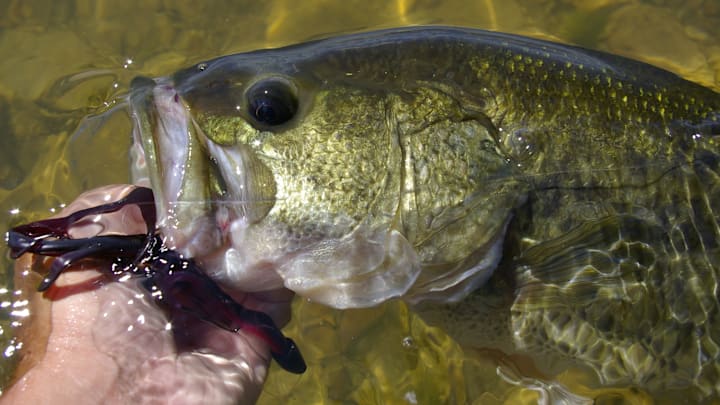
How to Identify Largemouth Bass?
The largemouth bass is a freshwater species of fish commonly found in waters ranging from the Great Lakes to giant reservoirs to rivers to local, neighborhood ponds throughout the United States, southeastern Canada as well as northern Mexico. Due to its thrilling fight skills and ability to attain significant size, it is rated as the most popular sportfish anglers target in North America.
Easily identifiable by its extra-large mouth and greenish-gray body with dark colored irregular blotches, the largemouth bass shouldn't be hard to differentiate from its cousin, the smallmouth bass, which has a much smaller mouth and is more brown in color.
Largemouth bass, generally speaking, relate to warm weedy water areas whereas smallmouth bass prefer colder water and rock structure.

Where Do Largemouth Bass Live?
In general, Largemouth bass prefer shallow water, ranging primarily from a few feet deep upwards of 20. As a warm water species, largemouth bass inhabit lakes, rivers and reservoirs where current is minimal to non-existent. A cover-orientated fish, largemouth bass often relate to vegetation including lily pads, reeds, hydrilla, coontail and millfoil, boat docks, undercut banks, and submerged trees or wood.

Fish Lily Pads for Largemouth Bass
Lily pads provide shade and comfort for largemouth bass and are a top spot to search for these cover-conscious fish. Large pad beds or isolated patches both produce. Lily pads thrive in shallow water, and the old saying applies to this surface vegetation, that as long as the water underneath can cover a bass' back, a cast with your lure should always be made.
The best time to fish lily pads for bass is during the summer months, especially on the hottest days of the season.

Top Lure Choices for Fishing Lily Pads for Largemouth Bass
1. Hollow-body Frog or Mouse
2. Texas-rigged Worm or Craw
3. Weedless Soft Plastic Stickbait (Senko)
Target Submerged Vegetation to Find Largemouth Bass
Weed beds and isolated clumps can be found in nearly any lake or river with the three most common being coontail, cabbage and millfoil. This submerged vegetation offer largemouth bass concealment (in amongst the vegetation or tight to the bottom) and a perfect spot to set up shop to ambush unsuspecting prey that swims by.

Easiest to find and most abundant in clearer water, submerged vegetation can cover large expansive flats or be isolated, with a few clumps spaced out. If access to deeper water is found nearby, these weeds definitely rise in real estate value.
An excellent choice to target most of the year, weed are particularly productive during the summer and fall.
Top Lure Choices for Fishing Weeds for Largemouth Bass
1. Texas-rigged Worm, Creature Bait or Craw
2. Flipping Jig
3. Chatterbait
Work Boat Docks to Catch Hidden Largemouth Bass
Man-made boat docks lure largemouth bass in for the shade, security and prey opportunities they provide. Docks low to the water are best, and those with a variety of structure adjacent to them, be it slop, weed, rock, or wood, make them that much more inviting.

Shielding the sunlight, which therefore makes the water underneath cooler, is a big plus for largemouth bass during the hot summer months. This shade also provides a sense of security to fish, including an excellent spot to ambush prey.
Target boat docks during the summer and early fall for your best success.
Top Lure Choices for Fishing Docks for Largemouth Bass
1. Flipping Jig
2. Texas-rigged Creature Bait or Craw
3. Shallow Square Billed Crankbait
Fish Floating Cattail Bogs to Tangle with Largemouth Bass
Floating cattail bogs are found along shorelines or offshore in lakes and rivers. Easily identifiable by the tall cattail stalks, these undercut bogs feature open water underneath where largemouth bass love to live.

Look for clean edges along the sides of floating cattail bogs as well as spots with vegetation pushed up against it. Fish are drawn to these floating canopies for the shade they provide and the ambush edge they offer for picking off passing baitfish.
Floating cattail bogs can be a hot location to target during the summer months but are also worth checking out during late spring and early fall.
Learn more about fishing floating cattail bogs HERE.
Top Lure Choices for Fishing Floating Cattail Bogs for Largemouth Bass
1. Flipping Jig
2. Texas-rigged Creature Bait
3. Weedless Soft Plastic Stickbait (Senko)
Find Submerged Trees and Wood to Catch Largemouth Bass
Largemouth bass love to relate to submerged trees and wood, hunkering down beneath limbs or alongside trunks for the security and cover they provide. Shoreline trees with overhead shade as well as submerged wood with mixed structure or vegetation strewn in, increase the odds of fish being present.

An excellent structure to target during the summer and fall months, submerged trees and wood are even more attractive to bass when situated over deeper water or when deeper water is nearby.
What are the Best Lures for Largemouth Bass Fishing?

It can be overwhelming for a beginner bass angler to walk into a tackle store and see shelves lined with hundreds of fishing lures. And although most will catch fish, there are a handful of proven producers that deserve a spot in your tackle box. Here are a few tips to help you understand the general categories of lures along with my Top 9 must-have picks.
Horizontal Baits to Search for Bass Over Large Areas
Horizontal baits, such as spinnerbaits, crankbaits, chatterbaits, and jerkbaits, are cast out and reeled back in. This style of lure covers a lot of water and excels at searching for active largemouth bass.
1. Spinnerbait (Horizontal)
The spinnerbait is classified as a 'chuck and wind' lure, meaning you simply cast it out and reel it back in. The flashing blade(s) and living rubber skirt attract the attention of bass. Toss a spinnerbait along open water flats, over clumps of weeds, or adjacent to docks and wood.

2. Square Billed Crankbait (Horizontal)
Mimicking a fleeing baitfish, a square billed crankbait is a great search lure to find largemouth bass that are on shallow flats, sitting in clumps or weed, or hiding in submerged wood or grasses. Toss this bait out and retrieve in a stop-and-go cadence. A bait that dives 2-to-6 feet deep is a good overall choice.

3. Jerkbait (Horizontal)
Similar to the square billed crankbait, a jerkbait is designed to be fished in an exagerated stop-and-go—more of a rip-and-stop manner. This makes the lure look like a fleeing or dying minnow. Work the jerkbait in the same areas you would fish a crankbait.

4. Topwater Popper (Horizontal)
A topwater popper provides a bass angler with thrilling surface strikes. Cast this bait out, let it sit for a few seconds, then retrieve it with sharp snaps of the rod tip. This will create a popping sound and bubbles for largemouth bass to key in on. Work a popper over any and all submerged cover.

5. Chatterbait (Horizontal)
Similar to the spinnerbait, a chatterbait is another 'chuck and wind' lure. Giving the illusion of a baitfish swimming along, the 'chatter' vibration of this lure draws fish in. Fish this bait virtually anywhere except in the thickest weeds.

6. Hollow Body Frog or Mouse (Horizontal)
A hollow body frog or mouse works wonders when dragged over lily pads or matted surface vegetation, referred to as slop. Opportunistic largemouth bass, when sensing movement overhead, will smash through the vegetation and swallow the bait, retreating under the weed growth in the blink of an eye.

Anglers are advised to wait a second or two before setting the hook to make sure the bass has hold of the lure. You'll also want to use a fairly stiff rod and a heavier than average pound test line—30 lb as a minimum. The best times to fish a hollow body frog or mouse is definitely summer, but the late spring and early fall bite can also be fantastic.
Vertical Baits to Pick Apart Specif Bass Hiding Spots
Vertical baits, like flipping jigs and Texas-rigged creatures or worms, are pitched or cast out and allowed to fall to the bottom. This style of lure doesn't quickly cover a large area of water like horizontal baits do, but they work extremely well for working over a specific structure point or fishing hiding spot, such as a dock, fallen tree, or floating cattail bog.
7. Flipping Jig (Vertical)
The flipping jig, when paired with a soft plastic craw or creature bait, produces fish when pitched or flipped to specific structure points, such as docks, floating cattail bogs, slop, and submerged wood.

A big bass producer during all seasons of the year, this lure always seems to get the attention of hungry bass. Be sure to let a flipping jig drop on a semi-slack line and work it up or down or with short hops or drags back to the boat.
Learn more about fishing flipping jigs HERE.
8. Texas-rigged Worm, Craw or Creature Bait (Vertical)
Texas-rigging a soft plastic bait, be it a worm, craw, or creature bait, allows for a weedless presentation and the ability for the lure to be fished in the thickest cover.

Toss a Texas-rigged plastic bait up into lily pads, slop, undercuts, and submerged wood or docks.
Learn more about rigging soft plastic baits HERE.
9. Soft Plastic Stickbait/Senko (Vertical)
A soft plastic stickbait, or what is commonly called a Senko, is a do-nothing bait that tempts largemouth bass with its tantalizing fall and shimmy.

Cast this bait to the edge of visible cover, alongside docks or submerged wood, or on open flats. If vegetation is thick be sure to rig this plastic bait weedless.
Best Rod and Reel for a Beginner Largemouth Bass Angler
A spinning rod and reel is the easiest type for a beginner largemouth bass angler. Choose a 7-foot medium action rod and pair it up with a 2000 or 2500 size reel. This combo will allow you to fish most baits, including poppers, chatterbaits, square bill crankbaits, and Senkos. It won't, however, have enough backbone to work lures in very heavy cover. You will want to add a 7'2" medium heavy rod to tackle those situations.
If you want to give baitcasting gear a try, a 7 foot medium-heavy casting rod is a excellent choice for the beginner largemouth bass angler. Pair it up with a decent-quality 7.1 gear ratio baitcast reel to complete the combo. All lures mentioned in the list above can be cast and worked with this model of rod.
Best Line for a Beginner Largemouth Bass Angler
Whether you go the route of spinning or baitcast gear, braid is the hands down best line you can choose when starting out. Braid is super strong, has no line memory, and is easy to use.
For spinning reels, a 15lb braid line is a good overall choice. If spooling up a baitcast reel, pick a 50lb braid. This line strength will allow you to fish both thick cover and bigger lures as well as open water and smaller baits.
Top 10 Tips to Help Beginner Anglers Catch More Largemouth Bass
1. Bass love cover, so especially when the sun is high and hot, find bass around structure like docks, slop, lily pads, and floating cattail bogs.
2. The morning and evening periods will find largemouth bass cruising shallow open water. Toss topwaters, such as a popper, buzzbait, or hollow body frog or mouse for exciting surface strikes.
3. Largemouth bass put the feedbag on in the fall. Toss bigger baits to trigger more strikes.
4. If a largemouth bass misses your lure during a surface retrieve, toss a soft plastic Senko to the spot where the fish came up short.
5. Fish windblown shorelines, slop, or points. Largemouth bass will stack up in these spots.
6. The healthier the weed (vegetation) the more likely it is to hold largemouth bass.
7. Use horizontal baits (spinnerbait, buzzbait, crankbait) to cover water quickly and find actively feeding fish.
8. Match the hatch is the simplest formula when choosing lure colors to catch more fish. Using colors that mimic the colors of local baitfish, bluegils and crawfish are always a good bet.
9. Alter your retrieve, with pauses and jerks, when using crankbaits or jerkbaits to trigger strikes from largemouth bass.
10. Have fun! Bass fishing is an addictive hobby and I guarantee you'll become hooked in no time flat!
You Might Also Like These Bass Fishing Stories:
 Add us as a preferred source on Google
Justin Hoffman is an outdoor writer and photographer with 25 years of experience producing media content for a host of North American fishing and hunting publications. With an ardent passion for bass fishing, as well as chasing panfish on the fly, this Ontario-based angler is always seeking out new water to wet a line - and along with that, interesting stories to write and share.
Follow HoffmanOutdoors