%22%3E%0A%3Cpath%20fill-rule%3D%22evenodd%22%20clip-rule%3D%22evenodd%22%20d%3D%22M156.868%204.36764C162.691%20-1.45588%20172.132%20-1.45588%20177.956%204.36764C183.779%2010.1912%20183.779%2019.6324%20177.956%2025.4559L167.412%2036L156.868%2025.4559C151.044%2019.6324%20151.044%2010.1912%20156.868%204.36764ZM159.509%207.55761C159.448%207.86849%20159.416%208.39718%20159.416%209.14566V10.4189C159.416%2011.1832%20159.448%2011.7198%20159.513%2012.0267C159.578%2012.3317%20159.778%2012.6168%20160.117%2012.8762C160.456%2013.1376%20160.903%2013.3316%20161.458%2013.4623C162.012%2013.593%20162.6%2013.6584%20163.337%2013.6584C164.073%2013.6584%20164.717%2013.591%20165.269%2013.4524C165.822%2013.3158%20166.261%2013.1178%20166.586%2012.8604C166.911%2012.6029%20167.105%2012.3178%20167.166%2012.0069C167.228%2011.6961%20167.259%2011.1674%20167.259%2010.4189V9.14566C167.259%208.38134%20167.228%207.84473%20167.162%207.53781C167.097%207.23287%20166.897%206.94971%20166.558%206.68834C166.22%206.42696%20165.772%206.23291%20165.218%206.10223C164.663%205.97154%20164.036%205.90619%20163.339%205.90619C162.602%205.90619%20161.959%205.97352%20161.406%206.11213C160.852%206.24875%20160.414%206.44677%20160.089%206.70418C159.765%206.9616%20159.571%207.24673%20159.509%207.55761ZM164.776%2024.8638C168.376%2024.8638%20170.057%2024.2064%20170.057%2021.862V21.858V21.3155C170.057%2019.6581%20169.016%2018.971%20165.752%2018.3136C164.778%2018.1136%20164.408%2017.9136%20164.408%2017.3136V16.9414C164.408%2016.6543%20164.677%2016.5117%20164.913%2016.5117C165.249%2016.5117%20165.418%2016.7137%20165.418%2016.9414V18.1136H169.891V17.3988C169.891%2015.4563%20168.847%2014.4266%20164.677%2014.4266C161.65%2014.4266%20159.396%2015.3414%20159.396%2017.3711V17.7433C159.396%2019.5155%20160.305%2020.3155%20163.701%2021.0303C163.78%2021.0472%20163.855%2021.063%20163.927%2021.0781C164.829%2021.2674%20165.147%2021.3341%20165.147%2021.9174V22.2897C165.147%2022.6619%20165.046%2022.8045%20164.642%2022.8045C164.17%2022.8045%20164.137%2022.5471%20164.137%2022.262V21.2897H159.394V21.7471C159.394%2024.149%20160.976%2024.8638%20164.776%2024.8638ZM170.924%2024.5569H175.425V14.7355H170.924V24.5569ZM172.455%2013.5019H175.425V6.06064H172.592V9.411L170.693%206.06064H167.859V13.5019H170.693V10.1199L172.455%2013.5019ZM163.769%2012.152C163.704%2012.2688%20163.555%2012.3262%20163.325%2012.3262L163.327%2012.3282C163.104%2012.3282%20162.959%2012.2767%20162.898%2012.1758C162.836%2012.0748%20162.805%2011.8074%20162.805%2011.3758V7.90068C162.805%207.51852%20162.852%207.28684%20162.945%207.20962C163.038%207.13239%20163.175%207.09279%20163.351%207.09279C163.559%207.09279%20163.698%207.14031%20163.765%207.23734C163.832%207.33239%20163.866%207.55416%20163.866%207.90068V11.3203C163.866%2011.7579%20163.834%2012.0352%20163.769%2012.152Z%22%20fill%3D%22white%22%2F%3E%0A%3Cpath%20d%3D%22M134.707%2035.9991C129.823%2035.9991%20126.029%2035.0305%20122.478%2033.2547L125.303%2027.7255C127.765%2029.017%20130.227%2029.8242%20133.254%2029.8242C136.684%2029.8242%20138.5%2028.0484%20138.5%2024.9811V24.3354C137.249%2025.7479%20135.191%2027.3623%20132.124%2027.3623C126.433%2027.3623%20122.316%2023.3264%20122.316%2017.2322V17.1515C122.316%2010.9766%20126.514%206.90039%20131.599%206.90039C134.828%206.90039%20136.724%208.11115%20138.339%209.76586V7.42506H147.5V23.8914C147.5%2027.9677%20146.653%2030.7524%20144.635%2032.7704C142.657%2034.748%20139.63%2035.9991%20134.707%2035.9991ZM134.868%2020.6627C137.128%2020.6627%20138.541%2019.1291%20138.541%2017.1919V17.1112C138.541%2015.2143%20137.088%2013.6807%20134.868%2013.6807C132.608%2013.6807%20131.195%2015.2547%20131.195%2017.1919V17.2726C131.195%2019.1695%20132.648%2020.6627%20134.868%2020.6627Z%22%20fill%3D%22white%22%2F%3E%0A%3Cpath%20d%3D%22M96.9492%2029.4629V7.42701H106.111V10.4943C107.523%208.67813%20109.743%206.90234%20112.851%206.90234C117.492%206.90234%20120.398%209.96961%20120.398%2014.9337V29.4629H111.236V17.8799C111.236%2015.9831%20110.106%2014.8934%20108.734%2014.8934C107.362%2014.8934%20106.111%2015.9831%20106.111%2017.8799V29.4629H96.9492Z%22%20fill%3D%22white%22%2F%3E%0A%3Cpath%20d%3D%22M84.8096%205.85202V0H94.2939V5.85202H84.8096ZM84.971%2029.4619V7.42602H94.1324V29.4619H84.971Z%22%20fill%3D%22white%22%2F%3E%0A%3Cpath%20d%3D%22M58.877%2029.4619V0H68.0384V10.3722C69.451%208.55606%2071.6707%206.90135%2074.7783%206.90135C79.4196%206.90135%2082.3254%209.96862%2082.3254%2014.9327V29.4619H73.164V17.8789C73.164%2015.9821%2072.0339%2014.8924%2070.6617%2014.8924C69.2895%2014.8924%2068.0384%2015.9821%2068.0384%2017.8789V29.4619H58.877Z%22%20fill%3D%22white%22%2F%3E%0A%3Cpath%20d%3D%22M47.3991%2029.9876C43.1211%2029.9876%2039.2466%2028.8979%2036.0986%2026.7992L39.2063%2021.5929C41.8699%2023.2477%2044.8565%2024.0548%2047.3587%2024.0548C48.2466%2024.0548%2048.6906%2023.853%2048.6906%2023.3284V23.2477C48.6906%2022.8037%2048.287%2022.5212%2046.0673%2021.9562C40.4977%2020.584%2037.0672%2019.0907%2037.0672%2014.5302V14.4494C37.0672%209.60638%2040.9417%206.90234%2046.6726%206.90234C50.3049%206.90234%2053.8969%207.8306%2056.5605%209.44495L53.6547%2014.8934C51.3139%2013.6019%2048.4888%2012.8351%2046.6323%2012.8351C45.7444%2012.8351%2045.3408%2013.0772%2045.3408%2013.5212V13.6019C45.3408%2014.0458%2045.8251%2014.3284%2048.0448%2014.8934C53.6143%2016.2656%2056.9641%2017.7992%2056.9641%2022.3194V22.4001C56.9641%2027.2028%2053.3722%2029.9876%2047.3991%2029.9876Z%22%20fill%3D%22white%22%2F%3E%0A%3Cpath%20d%3D%22M25.5312%205.85202V0H35.0156V5.85202H25.5312ZM25.6927%2029.4619V7.42602H34.8541V29.4619H25.6927Z%22%20fill%3D%22white%22%2F%3E%0A%3Cpath%20d%3D%22M0%2029.4621V1.21094H23.6503V9.2827H9.44396V12.8746H22.6413V20.2199H9.44396V29.4621H0Z%22%20fill%3D%22white%22%2F%3E%0A%3C%2Fg%3E%0A%3Cdefs%3E%0A%3CclipPath%20id%3D%22clip0_16330_64756%22%3E%0A%3Crect%20width%3D%22182%22%20height%3D%2236%22%20fill%3D%22white%22%2F%3E%0A%3C%2FclipPath%3E%0A%3C%2Fdefs%3E%0A%3C%2Fsvg%3E%0A)
Why Every Bass Angler Should Fish Alaska: Bass Fishing Lessons From a State With No Bass
Why Bass Anglers Should Fish Alaska
Alaska doesn’t have a sport fishery for bass – and it’s likely that there are no bass there at all – which is exactly why every hard-core, self-described hawging freak needs to get there.
Look, you could put me on the greatest crappie fishery on earth, but if there are also bass there, I’m going to get distracted. On our tuna trips to Panama and sailfish trips to Guatemala, I’ve investigated whether the nearby inland waters have even small populations (spoiler alert: some of them do).
I can’t help it. It’s in my blood.
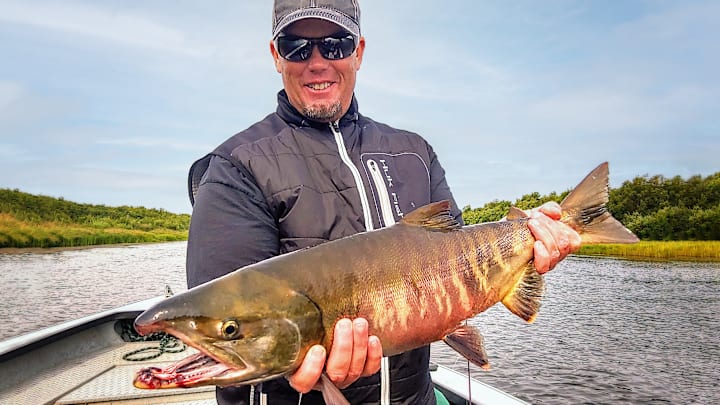
And that’s a big part of why I return to Alaska again and again. Yes, a single bass was caught there a few years ago, but it may have been the work of a backyard biologist. You can’t target them there – and that allows you to keep the main thing, the main thing. While there are also pike and sheefish and a few other game species, you’re going to want to focus on trout and salmon, and that will make you a better bass angler.
Fly Fishing in Alaska: Surprising Lessons for Bass Fishing

I’m not going to insist that the serious bass tournament guys pick up the long stick, but you really should. I know that I look supremely awkward waving it around, but I’ve managed to pick up just enough skills to catch a few every time – and if you’re going to break the ice on this intimidating tackle set, you might as well do it where the fish are ample and occasionally untrained.
But it goes deeper than that. Fly fishing, in my limited experience, is about making natural presentations, using current to your advantage and not allowing any avoidable line drag mess you up. It requires careful but consistent concentration, a deft touch, and constant micro-adjustments. Once you start to develop that muscle memory, you’ll see that it’s not just applicable to dry flies on a remote stream, but also to presenting a Senko under a dock, or moving your Carolina Rig down a ledge. Line control matters. Feel matters. And keeping your adversary unaware while you’re in his living room is tougher than it looks – no matter what you’re chasing.
Fighting Salmon and Trout in Current vs. Battling Bass Back Home

I spend a lot of time casting 50- and 65-pound braided line for bass that average about 2 pounds and rarely top 7. Much of that is in non-moving water. So what happens when I tangle with trout or salmon that weigh more than that on line that’s far lighter, and they have the benefit of heavy current and big laydowns and boulders?
I stay remarkably calm. Part of that is because I can see my quarry throughout the fight. I see when they’re conserving energy and I try to force them to fight. I see when they’re running around like a madman and I try to maintain control. I swear that several times I’ve been convinced that a monster rainbow has hung me up, only to see him holding face-first into the current.
I can apply that when a big largemouth gets me hung up in a brush pile, or a smallmouth bulldogs down into the depths. I now know how to translate what I feel into a visual picture and that puts me in charge of the fight.
No Bass, So Enjoy Alaska’s Trophy Fishery

We all know what a 10-pound largemouth or a 7-pound smallmouth means in our tournament world and when one approaching either size shows up it makes our knees weak. They’re difference-makers and trophies and for most of us a missed chance could be a last chance.
Until, however, they told me that a 30-inch rainbow is considered a trophy in Bristol Bay, I had no idea they grew that big, or that it mattered. I’ve now caught plenty of 20- to 24-inchers up there that my friends in the lower 48 would consider the fish of a lifetime. I am only starting to appreciate what special specimens those are. I’d almost rather not know. It allows me to stay in the experience.
When veteran saltwater anglers in Central America told me that jack crevalle are sometimes considered a nuisance, I was genuinely bummed – they were one of the hardest fighting fish I’d ever encountered. I don’t want someone to yuck-my-yum when it comes to trout, too.
In fact, my favorite fish up there have been grayling – the “sailfish of the north” – which don’t grow big, but eat topwater mouse flies, fight hard and look exquisite.
Alaska Travel Options for Every Angler’s Budget

The world is a big place and there’s plenty to see – from Africa to the Amazon to Australia and beyond. But one of the greatest “safari” experiences you can enjoy doesn’t require a passport. From most places in the US you can be in Alaska in one or two flights (or a long drive, if you have the time and energy).
There are plenty of great lodges that are happy to host you and put on a five-star experience. I’ve been fortunate to partake. At the same time, back in 1995, two friends and I drove around for a month and we caught and ate a lot of fish, met great people and had the low-budget adventure of a lifetime.
Alaska is big enough and remote enough that it can never be fully developed or exploited. Protections have been put in place to keep it wild. At the same time, it’ll never be as wild as it was the day before, so if you need to become a better bass angler, it pays to get there ASAP.
How Alaska Can Make You a Better Bass Angler
- Sharpen presentation skills – Fly fishing teaches line control, natural presentations, and precision that carries over to finesse bass fishing.
- Learn to fight fish in current – Battling salmon and rainbow trout on lighter line builds confidence and understanding in moving and managing bigger fish.
- Fish with focus – With no bass milestones in Alaska, you can become immersed in the experience, not the weigh in at the end of the day. Learning to fish in the moment makes you calmer and more effective back home.
- Expand your perspective – Fishing for grayling, trout, and salmon exposes you to new behaviors and environments, which opens your mind when chasing bass.
- Reignite your passion – Immersing yourself in wild waters with no bass provides a mental reset, reminding you why you love fishing in the first place.
You Might Also Like These Fishing Stories:
 Add us as a preferred source on Google
Pete Robbins is a Senior Writer for Bassmaster Magazine, a prolific blogger and has written for numerous other magazines, websites and outdoor television programs. He is a Board Member of the Bass Fishing Hall of Fame, consults for numerous companies endemic to the fishing industry and hosts trips to destinations including Mexico, Brazil, Guatemala, Panama and Alaska. Pete and his wife Hanna operate Half Past First Cast, a website devoted to fishing travel. They live in Vienna, Virginia, with their Australian Shepherd Rooster and call the Potomac River their home waters.