%22%3E%0A%3Cpath%20fill-rule%3D%22evenodd%22%20clip-rule%3D%22evenodd%22%20d%3D%22M156.868%204.36764C162.691%20-1.45588%20172.132%20-1.45588%20177.956%204.36764C183.779%2010.1912%20183.779%2019.6324%20177.956%2025.4559L167.412%2036L156.868%2025.4559C151.044%2019.6324%20151.044%2010.1912%20156.868%204.36764ZM159.509%207.55761C159.448%207.86849%20159.416%208.39718%20159.416%209.14566V10.4189C159.416%2011.1832%20159.448%2011.7198%20159.513%2012.0267C159.578%2012.3317%20159.778%2012.6168%20160.117%2012.8762C160.456%2013.1376%20160.903%2013.3316%20161.458%2013.4623C162.012%2013.593%20162.6%2013.6584%20163.337%2013.6584C164.073%2013.6584%20164.717%2013.591%20165.269%2013.4524C165.822%2013.3158%20166.261%2013.1178%20166.586%2012.8604C166.911%2012.6029%20167.105%2012.3178%20167.166%2012.0069C167.228%2011.6961%20167.259%2011.1674%20167.259%2010.4189V9.14566C167.259%208.38134%20167.228%207.84473%20167.162%207.53781C167.097%207.23287%20166.897%206.94971%20166.558%206.68834C166.22%206.42696%20165.772%206.23291%20165.218%206.10223C164.663%205.97154%20164.036%205.90619%20163.339%205.90619C162.602%205.90619%20161.959%205.97352%20161.406%206.11213C160.852%206.24875%20160.414%206.44677%20160.089%206.70418C159.765%206.9616%20159.571%207.24673%20159.509%207.55761ZM164.776%2024.8638C168.376%2024.8638%20170.057%2024.2064%20170.057%2021.862V21.858V21.3155C170.057%2019.6581%20169.016%2018.971%20165.752%2018.3136C164.778%2018.1136%20164.408%2017.9136%20164.408%2017.3136V16.9414C164.408%2016.6543%20164.677%2016.5117%20164.913%2016.5117C165.249%2016.5117%20165.418%2016.7137%20165.418%2016.9414V18.1136H169.891V17.3988C169.891%2015.4563%20168.847%2014.4266%20164.677%2014.4266C161.65%2014.4266%20159.396%2015.3414%20159.396%2017.3711V17.7433C159.396%2019.5155%20160.305%2020.3155%20163.701%2021.0303C163.78%2021.0472%20163.855%2021.063%20163.927%2021.0781C164.829%2021.2674%20165.147%2021.3341%20165.147%2021.9174V22.2897C165.147%2022.6619%20165.046%2022.8045%20164.642%2022.8045C164.17%2022.8045%20164.137%2022.5471%20164.137%2022.262V21.2897H159.394V21.7471C159.394%2024.149%20160.976%2024.8638%20164.776%2024.8638ZM170.924%2024.5569H175.425V14.7355H170.924V24.5569ZM172.455%2013.5019H175.425V6.06064H172.592V9.411L170.693%206.06064H167.859V13.5019H170.693V10.1199L172.455%2013.5019ZM163.769%2012.152C163.704%2012.2688%20163.555%2012.3262%20163.325%2012.3262L163.327%2012.3282C163.104%2012.3282%20162.959%2012.2767%20162.898%2012.1758C162.836%2012.0748%20162.805%2011.8074%20162.805%2011.3758V7.90068C162.805%207.51852%20162.852%207.28684%20162.945%207.20962C163.038%207.13239%20163.175%207.09279%20163.351%207.09279C163.559%207.09279%20163.698%207.14031%20163.765%207.23734C163.832%207.33239%20163.866%207.55416%20163.866%207.90068V11.3203C163.866%2011.7579%20163.834%2012.0352%20163.769%2012.152Z%22%20fill%3D%22white%22%2F%3E%0A%3Cpath%20d%3D%22M134.707%2035.9991C129.823%2035.9991%20126.029%2035.0305%20122.478%2033.2547L125.303%2027.7255C127.765%2029.017%20130.227%2029.8242%20133.254%2029.8242C136.684%2029.8242%20138.5%2028.0484%20138.5%2024.9811V24.3354C137.249%2025.7479%20135.191%2027.3623%20132.124%2027.3623C126.433%2027.3623%20122.316%2023.3264%20122.316%2017.2322V17.1515C122.316%2010.9766%20126.514%206.90039%20131.599%206.90039C134.828%206.90039%20136.724%208.11115%20138.339%209.76586V7.42506H147.5V23.8914C147.5%2027.9677%20146.653%2030.7524%20144.635%2032.7704C142.657%2034.748%20139.63%2035.9991%20134.707%2035.9991ZM134.868%2020.6627C137.128%2020.6627%20138.541%2019.1291%20138.541%2017.1919V17.1112C138.541%2015.2143%20137.088%2013.6807%20134.868%2013.6807C132.608%2013.6807%20131.195%2015.2547%20131.195%2017.1919V17.2726C131.195%2019.1695%20132.648%2020.6627%20134.868%2020.6627Z%22%20fill%3D%22white%22%2F%3E%0A%3Cpath%20d%3D%22M96.9492%2029.4629V7.42701H106.111V10.4943C107.523%208.67813%20109.743%206.90234%20112.851%206.90234C117.492%206.90234%20120.398%209.96961%20120.398%2014.9337V29.4629H111.236V17.8799C111.236%2015.9831%20110.106%2014.8934%20108.734%2014.8934C107.362%2014.8934%20106.111%2015.9831%20106.111%2017.8799V29.4629H96.9492Z%22%20fill%3D%22white%22%2F%3E%0A%3Cpath%20d%3D%22M84.8096%205.85202V0H94.2939V5.85202H84.8096ZM84.971%2029.4619V7.42602H94.1324V29.4619H84.971Z%22%20fill%3D%22white%22%2F%3E%0A%3Cpath%20d%3D%22M58.877%2029.4619V0H68.0384V10.3722C69.451%208.55606%2071.6707%206.90135%2074.7783%206.90135C79.4196%206.90135%2082.3254%209.96862%2082.3254%2014.9327V29.4619H73.164V17.8789C73.164%2015.9821%2072.0339%2014.8924%2070.6617%2014.8924C69.2895%2014.8924%2068.0384%2015.9821%2068.0384%2017.8789V29.4619H58.877Z%22%20fill%3D%22white%22%2F%3E%0A%3Cpath%20d%3D%22M47.3991%2029.9876C43.1211%2029.9876%2039.2466%2028.8979%2036.0986%2026.7992L39.2063%2021.5929C41.8699%2023.2477%2044.8565%2024.0548%2047.3587%2024.0548C48.2466%2024.0548%2048.6906%2023.853%2048.6906%2023.3284V23.2477C48.6906%2022.8037%2048.287%2022.5212%2046.0673%2021.9562C40.4977%2020.584%2037.0672%2019.0907%2037.0672%2014.5302V14.4494C37.0672%209.60638%2040.9417%206.90234%2046.6726%206.90234C50.3049%206.90234%2053.8969%207.8306%2056.5605%209.44495L53.6547%2014.8934C51.3139%2013.6019%2048.4888%2012.8351%2046.6323%2012.8351C45.7444%2012.8351%2045.3408%2013.0772%2045.3408%2013.5212V13.6019C45.3408%2014.0458%2045.8251%2014.3284%2048.0448%2014.8934C53.6143%2016.2656%2056.9641%2017.7992%2056.9641%2022.3194V22.4001C56.9641%2027.2028%2053.3722%2029.9876%2047.3991%2029.9876Z%22%20fill%3D%22white%22%2F%3E%0A%3Cpath%20d%3D%22M25.5312%205.85202V0H35.0156V5.85202H25.5312ZM25.6927%2029.4619V7.42602H34.8541V29.4619H25.6927Z%22%20fill%3D%22white%22%2F%3E%0A%3Cpath%20d%3D%22M0%2029.4621V1.21094H23.6503V9.2827H9.44396V12.8746H22.6413V20.2199H9.44396V29.4621H0Z%22%20fill%3D%22white%22%2F%3E%0A%3C%2Fg%3E%0A%3Cdefs%3E%0A%3CclipPath%20id%3D%22clip0_16330_64756%22%3E%0A%3Crect%20width%3D%22182%22%20height%3D%2236%22%20fill%3D%22white%22%2F%3E%0A%3C%2FclipPath%3E%0A%3C%2Fdefs%3E%0A%3C%2Fsvg%3E%0A)
4 Bass Fishing Tips For Finding The Best Lily Pad Beds
The Largemouth Bass and Lily Pad Connection
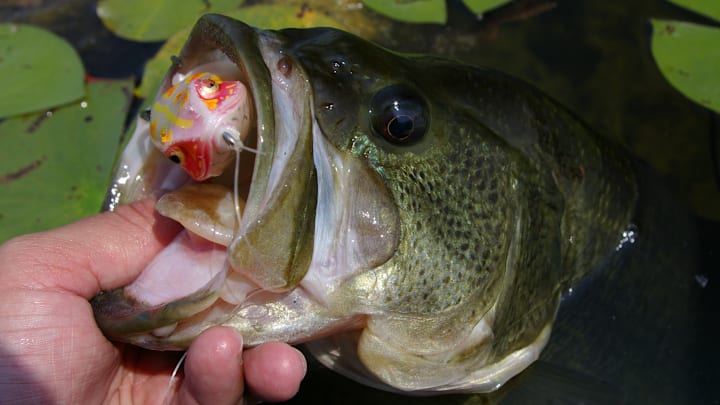
One of the most recognizable aquatic structures to hold largemouth bass is undoubtedly the lily pad. Offering up shade and a cooler water environment, defined and hidden ambush points for picking off prey, and safety and security from larger predators, the lily pad is a perfect spot for bass to hunker down under and thrive.

But not all lily pad beds are created equal, even though they may look like it from the surface. What is found below the beds themselves can often make a big difference on whether they attract and hold largemouth bass or not.
Here's four proven attributes that I seek out when fishing lily pad beds for bass.
1. Target Isolated Lily Pad Beds for Sure-Fire Bassin' Success
Expansive lily pad beds, although they certainly hold fish, are a chore to cover thoroughly. Everything looks similar and the cast-to-catch ratio can often be below average. You have to put in the effort to find fish and that can be time consuming.
A proven tactic is to target those lily pad beds that are 'stand alone' or isolated. Think about it this way: largemouth bass will cruise shallow flats during the early morning hours actively feeding. When the sun starts beating down fish will move deeper and take shelter under the first available overhead cover they can find. Isolated pad beds, far away from any other structure, work like magnets attracting these fish.

Isolated lily pad beds, especially those found on productive flats or set up on the first depth change out from shore, can be gold mines that consistently hold fish day after day.
I have one such pad bed on my favorite river. It's maybe 15 feet in diameter but is adjacent to a channel edge and situated on a productive flat. It has coughed up at least one largemouth bass each time I have fished it this season, all except one day.
Map out a network of isolated lily pad beds on your go-to body of water. Each can be fished quickly and efficiently and most will have a lunker lurking underneath.
2. A Mix of Cover is Much More Inviting to Largemouth Bass
Lily pads on their own will always be inviting to largemouth bass. But lily pads mixed with a secondary cover are that much more attractive to these structure-orientated fish.
There are a myriad of mixed-structure options available on any given lake but the most common would be lily pads and slop, lily pads and cabbage, lily pads and grasses, and lily pads and wood.
Various vegetative and wood structure will support an increased audience of baitfish, drawn to the plankton and micro-organisms these hot spots hold. It only makes sense that largemouth bass would be drawn in as well.

Make it a goal to recognize mixed structure spots and their relation to lily pads. If faced with an expansive pad bed, pay particular attention and concentrate on those spots that hold a lily pad dance partner, so to speak.
3. Largemouth Bass Love Lily Pads Over Deeper Water
Skinny water lily pads definitely hold bass. And I'm a big proponent of the mantra "all a bass needs is enough water to cover its back." But saying that, the more water found underneath a bed of pads the greater the chance fish will congregate and set up shop there.

It basically comes down to safety. Largemouth bass, if dangers presents itself, want a quick and easy escape route to deeper water. Setting up under pad beds already in above-average water depths puts them more at ease and makes jetting out to freedom that much easier.
Lily pad beds set up over deeper water also provide the advantage of a cooler environment, often many degrees colder than pads found in the shallows during the dog days of summer.
4. Look for Irregularities to Find More Largemouth Bass
As mentioned above, 'differences' are more attractive when discussing largemouth bass and lily pads. And in terms of the pad bed makeup itself, I'm a fan of keying-in on irregularities and any changes I stumble across.

Open holes in the pad beds, sharp corners or bends, or cuts through the middle provide secondary ambush points, meaning largemouth bass are more prone to set up shop where these irregularities occur.
Once you recognize these variances, and some may be subtle, you'll have a better understanding of why fish position themselves there and the higher catch rates you'll reap when targeting these differences. This is exactly how you put together a winning pattern and replicate high percentage spots in any lily pad bed you dissect.
Lily Pad Bed Synopsis: Where To Find Largemouth Bass?
- Search out isolated lily pad beds. Small groups of off-shore pads almost always hold largemouth bass.
- Find lily pad beds with other cover mixed in—weeds, wood, or rock.
- Deep water lily pad beds = a high-percentage largemouth bass spot.
- Recognize and target pad bed irregularities, such as holes, cuts, and defined edges.
You Might Also Like These Bass Fishing Stories:
 Add us as a preferred source on Google
Justin Hoffman is an outdoor writer and photographer with 25 years of experience producing media content for a host of North American fishing and hunting publications. With an ardent passion for bass fishing, as well as chasing panfish on the fly, this Ontario-based angler is always seeking out new water to wet a line - and along with that, interesting stories to write and share.
Follow HoffmanOutdoors