%22%3E%0A%3Cpath%20fill-rule%3D%22evenodd%22%20clip-rule%3D%22evenodd%22%20d%3D%22M156.868%204.36764C162.691%20-1.45588%20172.132%20-1.45588%20177.956%204.36764C183.779%2010.1912%20183.779%2019.6324%20177.956%2025.4559L167.412%2036L156.868%2025.4559C151.044%2019.6324%20151.044%2010.1912%20156.868%204.36764ZM159.509%207.55761C159.448%207.86849%20159.416%208.39718%20159.416%209.14566V10.4189C159.416%2011.1832%20159.448%2011.7198%20159.513%2012.0267C159.578%2012.3317%20159.778%2012.6168%20160.117%2012.8762C160.456%2013.1376%20160.903%2013.3316%20161.458%2013.4623C162.012%2013.593%20162.6%2013.6584%20163.337%2013.6584C164.073%2013.6584%20164.717%2013.591%20165.269%2013.4524C165.822%2013.3158%20166.261%2013.1178%20166.586%2012.8604C166.911%2012.6029%20167.105%2012.3178%20167.166%2012.0069C167.228%2011.6961%20167.259%2011.1674%20167.259%2010.4189V9.14566C167.259%208.38134%20167.228%207.84473%20167.162%207.53781C167.097%207.23287%20166.897%206.94971%20166.558%206.68834C166.22%206.42696%20165.772%206.23291%20165.218%206.10223C164.663%205.97154%20164.036%205.90619%20163.339%205.90619C162.602%205.90619%20161.959%205.97352%20161.406%206.11213C160.852%206.24875%20160.414%206.44677%20160.089%206.70418C159.765%206.9616%20159.571%207.24673%20159.509%207.55761ZM164.776%2024.8638C168.376%2024.8638%20170.057%2024.2064%20170.057%2021.862V21.858V21.3155C170.057%2019.6581%20169.016%2018.971%20165.752%2018.3136C164.778%2018.1136%20164.408%2017.9136%20164.408%2017.3136V16.9414C164.408%2016.6543%20164.677%2016.5117%20164.913%2016.5117C165.249%2016.5117%20165.418%2016.7137%20165.418%2016.9414V18.1136H169.891V17.3988C169.891%2015.4563%20168.847%2014.4266%20164.677%2014.4266C161.65%2014.4266%20159.396%2015.3414%20159.396%2017.3711V17.7433C159.396%2019.5155%20160.305%2020.3155%20163.701%2021.0303C163.78%2021.0472%20163.855%2021.063%20163.927%2021.0781C164.829%2021.2674%20165.147%2021.3341%20165.147%2021.9174V22.2897C165.147%2022.6619%20165.046%2022.8045%20164.642%2022.8045C164.17%2022.8045%20164.137%2022.5471%20164.137%2022.262V21.2897H159.394V21.7471C159.394%2024.149%20160.976%2024.8638%20164.776%2024.8638ZM170.924%2024.5569H175.425V14.7355H170.924V24.5569ZM172.455%2013.5019H175.425V6.06064H172.592V9.411L170.693%206.06064H167.859V13.5019H170.693V10.1199L172.455%2013.5019ZM163.769%2012.152C163.704%2012.2688%20163.555%2012.3262%20163.325%2012.3262L163.327%2012.3282C163.104%2012.3282%20162.959%2012.2767%20162.898%2012.1758C162.836%2012.0748%20162.805%2011.8074%20162.805%2011.3758V7.90068C162.805%207.51852%20162.852%207.28684%20162.945%207.20962C163.038%207.13239%20163.175%207.09279%20163.351%207.09279C163.559%207.09279%20163.698%207.14031%20163.765%207.23734C163.832%207.33239%20163.866%207.55416%20163.866%207.90068V11.3203C163.866%2011.7579%20163.834%2012.0352%20163.769%2012.152Z%22%20fill%3D%22white%22%2F%3E%0A%3Cpath%20d%3D%22M134.707%2035.9991C129.823%2035.9991%20126.029%2035.0305%20122.478%2033.2547L125.303%2027.7255C127.765%2029.017%20130.227%2029.8242%20133.254%2029.8242C136.684%2029.8242%20138.5%2028.0484%20138.5%2024.9811V24.3354C137.249%2025.7479%20135.191%2027.3623%20132.124%2027.3623C126.433%2027.3623%20122.316%2023.3264%20122.316%2017.2322V17.1515C122.316%2010.9766%20126.514%206.90039%20131.599%206.90039C134.828%206.90039%20136.724%208.11115%20138.339%209.76586V7.42506H147.5V23.8914C147.5%2027.9677%20146.653%2030.7524%20144.635%2032.7704C142.657%2034.748%20139.63%2035.9991%20134.707%2035.9991ZM134.868%2020.6627C137.128%2020.6627%20138.541%2019.1291%20138.541%2017.1919V17.1112C138.541%2015.2143%20137.088%2013.6807%20134.868%2013.6807C132.608%2013.6807%20131.195%2015.2547%20131.195%2017.1919V17.2726C131.195%2019.1695%20132.648%2020.6627%20134.868%2020.6627Z%22%20fill%3D%22white%22%2F%3E%0A%3Cpath%20d%3D%22M96.9492%2029.4629V7.42701H106.111V10.4943C107.523%208.67813%20109.743%206.90234%20112.851%206.90234C117.492%206.90234%20120.398%209.96961%20120.398%2014.9337V29.4629H111.236V17.8799C111.236%2015.9831%20110.106%2014.8934%20108.734%2014.8934C107.362%2014.8934%20106.111%2015.9831%20106.111%2017.8799V29.4629H96.9492Z%22%20fill%3D%22white%22%2F%3E%0A%3Cpath%20d%3D%22M84.8096%205.85202V0H94.2939V5.85202H84.8096ZM84.971%2029.4619V7.42602H94.1324V29.4619H84.971Z%22%20fill%3D%22white%22%2F%3E%0A%3Cpath%20d%3D%22M58.877%2029.4619V0H68.0384V10.3722C69.451%208.55606%2071.6707%206.90135%2074.7783%206.90135C79.4196%206.90135%2082.3254%209.96862%2082.3254%2014.9327V29.4619H73.164V17.8789C73.164%2015.9821%2072.0339%2014.8924%2070.6617%2014.8924C69.2895%2014.8924%2068.0384%2015.9821%2068.0384%2017.8789V29.4619H58.877Z%22%20fill%3D%22white%22%2F%3E%0A%3Cpath%20d%3D%22M47.3991%2029.9876C43.1211%2029.9876%2039.2466%2028.8979%2036.0986%2026.7992L39.2063%2021.5929C41.8699%2023.2477%2044.8565%2024.0548%2047.3587%2024.0548C48.2466%2024.0548%2048.6906%2023.853%2048.6906%2023.3284V23.2477C48.6906%2022.8037%2048.287%2022.5212%2046.0673%2021.9562C40.4977%2020.584%2037.0672%2019.0907%2037.0672%2014.5302V14.4494C37.0672%209.60638%2040.9417%206.90234%2046.6726%206.90234C50.3049%206.90234%2053.8969%207.8306%2056.5605%209.44495L53.6547%2014.8934C51.3139%2013.6019%2048.4888%2012.8351%2046.6323%2012.8351C45.7444%2012.8351%2045.3408%2013.0772%2045.3408%2013.5212V13.6019C45.3408%2014.0458%2045.8251%2014.3284%2048.0448%2014.8934C53.6143%2016.2656%2056.9641%2017.7992%2056.9641%2022.3194V22.4001C56.9641%2027.2028%2053.3722%2029.9876%2047.3991%2029.9876Z%22%20fill%3D%22white%22%2F%3E%0A%3Cpath%20d%3D%22M25.5312%205.85202V0H35.0156V5.85202H25.5312ZM25.6927%2029.4619V7.42602H34.8541V29.4619H25.6927Z%22%20fill%3D%22white%22%2F%3E%0A%3Cpath%20d%3D%22M0%2029.4621V1.21094H23.6503V9.2827H9.44396V12.8746H22.6413V20.2199H9.44396V29.4621H0Z%22%20fill%3D%22white%22%2F%3E%0A%3C%2Fg%3E%0A%3Cdefs%3E%0A%3CclipPath%20id%3D%22clip0_16330_64756%22%3E%0A%3Crect%20width%3D%22182%22%20height%3D%2236%22%20fill%3D%22white%22%2F%3E%0A%3C%2FclipPath%3E%0A%3C%2Fdefs%3E%0A%3C%2Fsvg%3E%0A)
The Glidebait Mistakes I Finally Stopped Making—and the Fish That Changed Everything
Watching an 8” glidebait articulate back and forth in shallow water can be as mesmerizing to the angler as the bass it’s designed to entice—it just looks “fishy.” But one needs some positive reinforcement to keep at it, and I’d fished for four hours with only a few small followers to show for it.
Deciding to make one last stop at a steep point before heading to the trailer, my cadence for working the big glide was now routine, but I had no anticipation that anything would be different about this stop than the miles of shoreline I’d already covered.
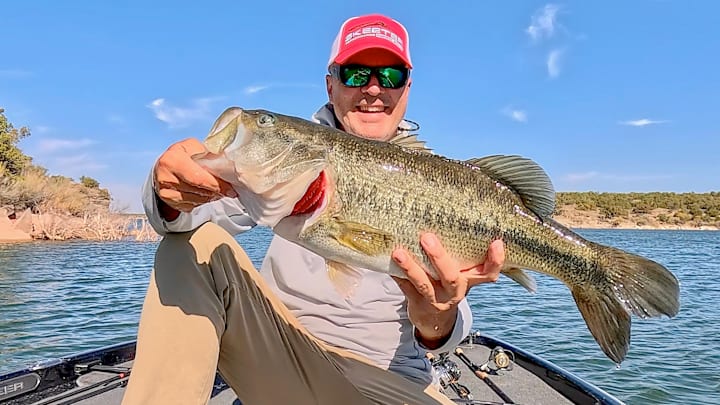
Without warning, the sudden flash of a large, fleshy white side shot out of the depths and engulfed the glidebait in the blink of an eye. My instincts awakened, and the 7’9” rod flexed deeply against the surging bass that I knew was a monster.
This short video clip captures the exact moment everything finally clicked for me and the glidebait bite that changed my view of these big baits.
A little context may help shed light on the importance of this bass. This was one of the few bass I’d ever caught on a glidebait. Though I’d been fishing for decades, glidebaits were an intimidating black hole for me to explore.
Questions such as when to use a glidebait, how to work it, and the myriad combinations of size, styles, sink rates, and actions to choose from kept me at arm's length from what I knew was a big bass technique.
The Confidence Boost That Finally Made Glidebaits Click
Working in fishing media gives me an advantage that other glidebait novices don’t: direct access to the experts. At a recent media event hosted by a large tackle company, I was struck by how many tour pros used glidebaits as part of their tournament strategy. My chance to pick their brains ultimately helped me get started, so I’m passing along their “juice” to you.
Mistake #1: Trying to Work a Glidebait with the Rod Instead of the Reel

The side-to-side action of the glidebait is mostly imparted by quick turns of the reel handles, not by twitching the rod. Overworking the rod tip will pull the bait too far and disrupt the glide's smooth side-to-side action.
The reel handles are turned approximately a quarter-turn (called “chops”) to impart the darting action to the glidebait. The faster the reel handles are “chopped,” the quicker the bait turns in the water.
Mistake #2: Overcomplicating Glidebait Size, Style, and Sink Rate
Given the sheer number of glidebait options, start with a “slow sink” single-joint glidebait as a starting point. Single-joint models can be worked in wide “S” curves in open water when chopping the handles slowly, but can also be worked with a tighter chopping action as they approach isolated cover.
Don't feel the need to start with a massive 10- to 12-inch bait. These require specialized rods to handle the weight of these heavyweight lures. Most pros I observed used baits 6 to 7 inches long, which are large enough to attract bass of all sizes and can be cast with medium-heavy to heavy-action rods.
Mistake #3: Thinking You Need a $300 Glidebait to Get Started

While some of the pros used custom glidebaits costing $300 or more, each confessed that spending this much on a bait is a luxury, not a necessity. There are plenty of quality glidebaits in the $20-$50 range, that will get you acclimated to fishing them and catch plenty of bass. Examples include the Berkley Chop Block, Storm Arashi Glide, and River2Sea S-Waver, all of which are within reach of most any budget.
Where Glidebaits Really Shine
As I picked the brains of various tour pros, I learned they use a glidebait in the same places they’d also use a squarebill crankbait or spinnerbait: shallow flats and points with isolated cover. Think boat docks, isolated bushes, stumps, or rock as prime cover to work the glidebait near.
The ideal conditions for tossing a glidebait are partly cloudy skies with a slight ripple on the water - perfect for putting the bass within the shade of shallow cover. The pros would cast well beyond the target, working the bait with wide side-to-side action as it approached the cover. Once next to the cover, quickly chopping the reel handles imparts a quick darting action that bass can't refuse.
The Biggest Mistake Is Giving Up Too Soon
Like any technique, the best way to learn is to put away every other rod rigged with your favorite lures and dedicate a significant amount of time to learning the glidebait. Experiment with cadence, speed, wide chops, and tight chops. When going hours between bites, it can be discouraging, but stay at it. Had I quit earlier in the day, I would've never experienced one of the most memorable bites of my life.
The Fish That Changed Everything

Back to my opening account, upon landing the bass, I knew she would approach ten pounds, but it had been so long since I’d caught a fish of this caliber that it was hard to tell. Upon filling the livewell, I fumbled for the scales, my hands still shaking with adrenaline, and eventually weighed her at 9 pounds, 7 ounces. Slipping her carefully back into the water, I admired her with satisfaction as she casually swam away.
I knew, however, I was the one who was hooked now, and that's the power of learning to fish a glidebait.
You Might Like These Other Bass Fishing Stories:
 Add us as a preferred source on Google
Shane’s fascination with enticing a bass to eat an artificial lure dates back as far as he can remember. He has previously worked as a bass guide in Texas, enjoys competing in bass tournaments, and loves sharing his passion and expertise through writing and video content. Over the past twenty years, he’s contributed to some of the most recognizable brands in outdoor media and the fishing industry, such as Bassmaster and Game & Fish.