%22%3E%0A%3Cpath%20fill-rule%3D%22evenodd%22%20clip-rule%3D%22evenodd%22%20d%3D%22M156.868%204.36764C162.691%20-1.45588%20172.132%20-1.45588%20177.956%204.36764C183.779%2010.1912%20183.779%2019.6324%20177.956%2025.4559L167.412%2036L156.868%2025.4559C151.044%2019.6324%20151.044%2010.1912%20156.868%204.36764ZM159.509%207.55761C159.448%207.86849%20159.416%208.39718%20159.416%209.14566V10.4189C159.416%2011.1832%20159.448%2011.7198%20159.513%2012.0267C159.578%2012.3317%20159.778%2012.6168%20160.117%2012.8762C160.456%2013.1376%20160.903%2013.3316%20161.458%2013.4623C162.012%2013.593%20162.6%2013.6584%20163.337%2013.6584C164.073%2013.6584%20164.717%2013.591%20165.269%2013.4524C165.822%2013.3158%20166.261%2013.1178%20166.586%2012.8604C166.911%2012.6029%20167.105%2012.3178%20167.166%2012.0069C167.228%2011.6961%20167.259%2011.1674%20167.259%2010.4189V9.14566C167.259%208.38134%20167.228%207.84473%20167.162%207.53781C167.097%207.23287%20166.897%206.94971%20166.558%206.68834C166.22%206.42696%20165.772%206.23291%20165.218%206.10223C164.663%205.97154%20164.036%205.90619%20163.339%205.90619C162.602%205.90619%20161.959%205.97352%20161.406%206.11213C160.852%206.24875%20160.414%206.44677%20160.089%206.70418C159.765%206.9616%20159.571%207.24673%20159.509%207.55761ZM164.776%2024.8638C168.376%2024.8638%20170.057%2024.2064%20170.057%2021.862V21.858V21.3155C170.057%2019.6581%20169.016%2018.971%20165.752%2018.3136C164.778%2018.1136%20164.408%2017.9136%20164.408%2017.3136V16.9414C164.408%2016.6543%20164.677%2016.5117%20164.913%2016.5117C165.249%2016.5117%20165.418%2016.7137%20165.418%2016.9414V18.1136H169.891V17.3988C169.891%2015.4563%20168.847%2014.4266%20164.677%2014.4266C161.65%2014.4266%20159.396%2015.3414%20159.396%2017.3711V17.7433C159.396%2019.5155%20160.305%2020.3155%20163.701%2021.0303C163.78%2021.0472%20163.855%2021.063%20163.927%2021.0781C164.829%2021.2674%20165.147%2021.3341%20165.147%2021.9174V22.2897C165.147%2022.6619%20165.046%2022.8045%20164.642%2022.8045C164.17%2022.8045%20164.137%2022.5471%20164.137%2022.262V21.2897H159.394V21.7471C159.394%2024.149%20160.976%2024.8638%20164.776%2024.8638ZM170.924%2024.5569H175.425V14.7355H170.924V24.5569ZM172.455%2013.5019H175.425V6.06064H172.592V9.411L170.693%206.06064H167.859V13.5019H170.693V10.1199L172.455%2013.5019ZM163.769%2012.152C163.704%2012.2688%20163.555%2012.3262%20163.325%2012.3262L163.327%2012.3282C163.104%2012.3282%20162.959%2012.2767%20162.898%2012.1758C162.836%2012.0748%20162.805%2011.8074%20162.805%2011.3758V7.90068C162.805%207.51852%20162.852%207.28684%20162.945%207.20962C163.038%207.13239%20163.175%207.09279%20163.351%207.09279C163.559%207.09279%20163.698%207.14031%20163.765%207.23734C163.832%207.33239%20163.866%207.55416%20163.866%207.90068V11.3203C163.866%2011.7579%20163.834%2012.0352%20163.769%2012.152Z%22%20fill%3D%22white%22%2F%3E%0A%3Cpath%20d%3D%22M134.707%2035.9991C129.823%2035.9991%20126.029%2035.0305%20122.478%2033.2547L125.303%2027.7255C127.765%2029.017%20130.227%2029.8242%20133.254%2029.8242C136.684%2029.8242%20138.5%2028.0484%20138.5%2024.9811V24.3354C137.249%2025.7479%20135.191%2027.3623%20132.124%2027.3623C126.433%2027.3623%20122.316%2023.3264%20122.316%2017.2322V17.1515C122.316%2010.9766%20126.514%206.90039%20131.599%206.90039C134.828%206.90039%20136.724%208.11115%20138.339%209.76586V7.42506H147.5V23.8914C147.5%2027.9677%20146.653%2030.7524%20144.635%2032.7704C142.657%2034.748%20139.63%2035.9991%20134.707%2035.9991ZM134.868%2020.6627C137.128%2020.6627%20138.541%2019.1291%20138.541%2017.1919V17.1112C138.541%2015.2143%20137.088%2013.6807%20134.868%2013.6807C132.608%2013.6807%20131.195%2015.2547%20131.195%2017.1919V17.2726C131.195%2019.1695%20132.648%2020.6627%20134.868%2020.6627Z%22%20fill%3D%22white%22%2F%3E%0A%3Cpath%20d%3D%22M96.9492%2029.4629V7.42701H106.111V10.4943C107.523%208.67813%20109.743%206.90234%20112.851%206.90234C117.492%206.90234%20120.398%209.96961%20120.398%2014.9337V29.4629H111.236V17.8799C111.236%2015.9831%20110.106%2014.8934%20108.734%2014.8934C107.362%2014.8934%20106.111%2015.9831%20106.111%2017.8799V29.4629H96.9492Z%22%20fill%3D%22white%22%2F%3E%0A%3Cpath%20d%3D%22M84.8096%205.85202V0H94.2939V5.85202H84.8096ZM84.971%2029.4619V7.42602H94.1324V29.4619H84.971Z%22%20fill%3D%22white%22%2F%3E%0A%3Cpath%20d%3D%22M58.877%2029.4619V0H68.0384V10.3722C69.451%208.55606%2071.6707%206.90135%2074.7783%206.90135C79.4196%206.90135%2082.3254%209.96862%2082.3254%2014.9327V29.4619H73.164V17.8789C73.164%2015.9821%2072.0339%2014.8924%2070.6617%2014.8924C69.2895%2014.8924%2068.0384%2015.9821%2068.0384%2017.8789V29.4619H58.877Z%22%20fill%3D%22white%22%2F%3E%0A%3Cpath%20d%3D%22M47.3991%2029.9876C43.1211%2029.9876%2039.2466%2028.8979%2036.0986%2026.7992L39.2063%2021.5929C41.8699%2023.2477%2044.8565%2024.0548%2047.3587%2024.0548C48.2466%2024.0548%2048.6906%2023.853%2048.6906%2023.3284V23.2477C48.6906%2022.8037%2048.287%2022.5212%2046.0673%2021.9562C40.4977%2020.584%2037.0672%2019.0907%2037.0672%2014.5302V14.4494C37.0672%209.60638%2040.9417%206.90234%2046.6726%206.90234C50.3049%206.90234%2053.8969%207.8306%2056.5605%209.44495L53.6547%2014.8934C51.3139%2013.6019%2048.4888%2012.8351%2046.6323%2012.8351C45.7444%2012.8351%2045.3408%2013.0772%2045.3408%2013.5212V13.6019C45.3408%2014.0458%2045.8251%2014.3284%2048.0448%2014.8934C53.6143%2016.2656%2056.9641%2017.7992%2056.9641%2022.3194V22.4001C56.9641%2027.2028%2053.3722%2029.9876%2047.3991%2029.9876Z%22%20fill%3D%22white%22%2F%3E%0A%3Cpath%20d%3D%22M25.5312%205.85202V0H35.0156V5.85202H25.5312ZM25.6927%2029.4619V7.42602H34.8541V29.4619H25.6927Z%22%20fill%3D%22white%22%2F%3E%0A%3Cpath%20d%3D%22M0%2029.4621V1.21094H23.6503V9.2827H9.44396V12.8746H22.6413V20.2199H9.44396V29.4621H0Z%22%20fill%3D%22white%22%2F%3E%0A%3C%2Fg%3E%0A%3Cdefs%3E%0A%3CclipPath%20id%3D%22clip0_16330_64756%22%3E%0A%3Crect%20width%3D%22182%22%20height%3D%2236%22%20fill%3D%22white%22%2F%3E%0A%3C%2FclipPath%3E%0A%3C%2Fdefs%3E%0A%3C%2Fsvg%3E%0A)
The Strange Spiny Lure Taking Over Bass Fishing in 2026
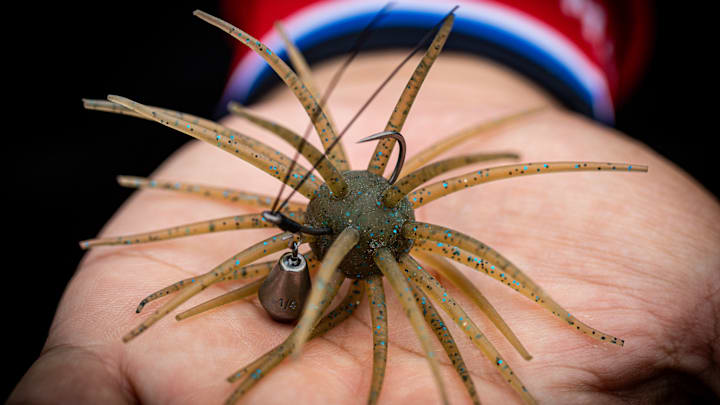
The Coike, a dense elastomer ball covered in soft spines, looks more like a sea urchin than a bass lure. Over the past year it has become one of the most talked-about baits in professional bass fishing.
A little over a year ago, I attended a writer’s conference at Lake Hartwell, South Carolina. Among the various fishing brands present was a Japanese company called Hideup, which offered an assortment of odd-looking, spiny soft plastic baits called the Coike. They’d been popular in Japan for some time, but were just entering the US market.
While intrigued, I assumed the unusual baits were likely a passing novelty, stuffed them in my bag, and mostly forgot about them. But the following weekend I, and lots of other curious bass anglers, watched a professional from Japan hammering monster largemouth bass with a similar urchin-style bait during a BASSMASTER event on Lake Fork, Texas. Had I known the increased demand would make them so scarce in early 2026, I would’ve ordered a lot more when I had the chance.

What Makes the Coike Different?

There have been many urchin-style baits emerging onto the bass scene over the past few months. The Yamamoto Uni and the Hag’s Prickly Pear are similar to the Coike and are just two examples of tackle companies scrambling to supply the feeding frenzy surrounding this genre of unique baits.
The Coike comes in three sizes from 13mm to 17mm, and like its counterparts mentioned above, consists of a very dense elastomer sphere with multiple soft spines protruding all around it. These baits could easily be mistaken for a sea urchin, but sea urchins, of course, don’t live in freshwater. So what do the bass think the Coike represents?
Speculations abound, but my opinion is that bass really don’t care what it is. As predators, they see lifelike movement of something that will fit in their mouth and eat it. Because they’ve never seen anything like it before, they show little hesitation to chase down the spiny little ball.
How to Rig the Coike
1. Drop Shot Rig

My first trip with the Coike was to a nearby lake with clear water and loaded with spotted bass. Needing to break the ice and build some confidence, I cautiously pulled out the 13 mm-sized ball of tentacles and rigged it on a drop shot.
Due to the thickness of the dense elastomer core, a traditional finesse drop shot hook wouldn’t work. Upsizing to a light wire, wide-gap 2/0 hook helped, but it was also immediately evident that the elastomer's density would interfere with the hookset. The remedy was to push the hook deeper into the bait, well past the bend of the hook.

If I recall, it was about the third pitch to a group of spotted bass that one swam over to eat the little Coike. My confidence meter went up a tick with that first bass in the boat.
After boating the 5th fish only a few minutes later, I realized I had a new drop shot bait that no bass had ever seen before. Coike, you had my interest; now you have my attention!
2. Neko-Rigging for Suspended Bass
After spending some time experimenting with ways to use the bait, another favorite for me is to Neko-rig it on a wide-gap hook when casting to suspended fish seen on FFS. Some anglers insert nail weights into the Coike's dense elastomer center to help it descend through the water column, but the smaller models don't accommodate them well; therefore, I prefer a different rigging method.

After tying the hook to the line, I leave a 3” tag end on the knot. I then secure a drop-shot weight to the tag end with a few overhand knots to keep it from coming off the rig while battling a bass. There are specialized hooks with small clips that hold the drop shot weight, which look pretty clean (see opening pic), though I've yet to try them.
As the bait descends toward the bass, twitching it like a jerkbait causes the soft spines to quiver and pulse just above the fish as they rise to investigate it. The dangling drop-shot weight also acts as a counterbalance, giving the Coike added action when twitched.

3. Treble Hook Rig Variation
A variation on this rigging method is to thread a split ring onto a treble hook. Next, thread a closed-loop drop shot weight onto the split ring to make the bait sink. Insert one of the three treble hooks deep into the elastomer center, leaving the other two hooks exposed.

While this isn't a totally weedless rig, it does help when working the bait near wood cover.
When the Coike Works Best
The Coike seems to excel in clear water with visibility of at least 2’. I’ve not used it in muddy water, but my gut tells me more traditional power-fishing tactics would be a better option here.
This bait really shines when targeting suspended bass, especially when targeting fish using forward-facing sonar. In popular lakes where bass have seen the more common profile baits again and again, the unusual look and pulsing spines can be enough to make otherwise hesitant fish bite.
Seasonally, there’s no limit to the Coike’s effectiveness. As the spawning season approaches, there’s no question I’ll be using it for bedding bass, either on a Neko rig or drop shot.
Will the Trend Last?
Lure trends come and go. Will the Coike and similar lure options follow the Alabama Rig's fade from popularity? Possibly so, but right now, it’s proven to be the most peculiar lure ever to dominate professional bass fishing. The Coike and competitive offerings are so popular that they remain backordered on most online fishing sites.
The 13mm Coike has an MSRP of $20.49, while the 17mm and Fullcast Coike retail for $21.99. If you happen to find one available online, order an extra one for me!
 Add us as a preferred source on Google
Shane’s fascination with enticing a bass to eat an artificial lure dates back as far as he can remember. He has previously worked as a bass guide in Texas, enjoys competing in bass tournaments, and loves sharing his passion and expertise through writing and video content. Over the past twenty years, he’s contributed to some of the most recognizable brands in outdoor media and the fishing industry, such as Bassmaster and Game & Fish.