%22%3E%0A%3Cpath%20fill-rule%3D%22evenodd%22%20clip-rule%3D%22evenodd%22%20d%3D%22M156.868%204.36764C162.691%20-1.45588%20172.132%20-1.45588%20177.956%204.36764C183.779%2010.1912%20183.779%2019.6324%20177.956%2025.4559L167.412%2036L156.868%2025.4559C151.044%2019.6324%20151.044%2010.1912%20156.868%204.36764ZM159.509%207.55761C159.448%207.86849%20159.416%208.39718%20159.416%209.14566V10.4189C159.416%2011.1832%20159.448%2011.7198%20159.513%2012.0267C159.578%2012.3317%20159.778%2012.6168%20160.117%2012.8762C160.456%2013.1376%20160.903%2013.3316%20161.458%2013.4623C162.012%2013.593%20162.6%2013.6584%20163.337%2013.6584C164.073%2013.6584%20164.717%2013.591%20165.269%2013.4524C165.822%2013.3158%20166.261%2013.1178%20166.586%2012.8604C166.911%2012.6029%20167.105%2012.3178%20167.166%2012.0069C167.228%2011.6961%20167.259%2011.1674%20167.259%2010.4189V9.14566C167.259%208.38134%20167.228%207.84473%20167.162%207.53781C167.097%207.23287%20166.897%206.94971%20166.558%206.68834C166.22%206.42696%20165.772%206.23291%20165.218%206.10223C164.663%205.97154%20164.036%205.90619%20163.339%205.90619C162.602%205.90619%20161.959%205.97352%20161.406%206.11213C160.852%206.24875%20160.414%206.44677%20160.089%206.70418C159.765%206.9616%20159.571%207.24673%20159.509%207.55761ZM164.776%2024.8638C168.376%2024.8638%20170.057%2024.2064%20170.057%2021.862V21.858V21.3155C170.057%2019.6581%20169.016%2018.971%20165.752%2018.3136C164.778%2018.1136%20164.408%2017.9136%20164.408%2017.3136V16.9414C164.408%2016.6543%20164.677%2016.5117%20164.913%2016.5117C165.249%2016.5117%20165.418%2016.7137%20165.418%2016.9414V18.1136H169.891V17.3988C169.891%2015.4563%20168.847%2014.4266%20164.677%2014.4266C161.65%2014.4266%20159.396%2015.3414%20159.396%2017.3711V17.7433C159.396%2019.5155%20160.305%2020.3155%20163.701%2021.0303C163.78%2021.0472%20163.855%2021.063%20163.927%2021.0781C164.829%2021.2674%20165.147%2021.3341%20165.147%2021.9174V22.2897C165.147%2022.6619%20165.046%2022.8045%20164.642%2022.8045C164.17%2022.8045%20164.137%2022.5471%20164.137%2022.262V21.2897H159.394V21.7471C159.394%2024.149%20160.976%2024.8638%20164.776%2024.8638ZM170.924%2024.5569H175.425V14.7355H170.924V24.5569ZM172.455%2013.5019H175.425V6.06064H172.592V9.411L170.693%206.06064H167.859V13.5019H170.693V10.1199L172.455%2013.5019ZM163.769%2012.152C163.704%2012.2688%20163.555%2012.3262%20163.325%2012.3262L163.327%2012.3282C163.104%2012.3282%20162.959%2012.2767%20162.898%2012.1758C162.836%2012.0748%20162.805%2011.8074%20162.805%2011.3758V7.90068C162.805%207.51852%20162.852%207.28684%20162.945%207.20962C163.038%207.13239%20163.175%207.09279%20163.351%207.09279C163.559%207.09279%20163.698%207.14031%20163.765%207.23734C163.832%207.33239%20163.866%207.55416%20163.866%207.90068V11.3203C163.866%2011.7579%20163.834%2012.0352%20163.769%2012.152Z%22%20fill%3D%22white%22%2F%3E%0A%3Cpath%20d%3D%22M134.707%2035.9991C129.823%2035.9991%20126.029%2035.0305%20122.478%2033.2547L125.303%2027.7255C127.765%2029.017%20130.227%2029.8242%20133.254%2029.8242C136.684%2029.8242%20138.5%2028.0484%20138.5%2024.9811V24.3354C137.249%2025.7479%20135.191%2027.3623%20132.124%2027.3623C126.433%2027.3623%20122.316%2023.3264%20122.316%2017.2322V17.1515C122.316%2010.9766%20126.514%206.90039%20131.599%206.90039C134.828%206.90039%20136.724%208.11115%20138.339%209.76586V7.42506H147.5V23.8914C147.5%2027.9677%20146.653%2030.7524%20144.635%2032.7704C142.657%2034.748%20139.63%2035.9991%20134.707%2035.9991ZM134.868%2020.6627C137.128%2020.6627%20138.541%2019.1291%20138.541%2017.1919V17.1112C138.541%2015.2143%20137.088%2013.6807%20134.868%2013.6807C132.608%2013.6807%20131.195%2015.2547%20131.195%2017.1919V17.2726C131.195%2019.1695%20132.648%2020.6627%20134.868%2020.6627Z%22%20fill%3D%22white%22%2F%3E%0A%3Cpath%20d%3D%22M96.9492%2029.4629V7.42701H106.111V10.4943C107.523%208.67813%20109.743%206.90234%20112.851%206.90234C117.492%206.90234%20120.398%209.96961%20120.398%2014.9337V29.4629H111.236V17.8799C111.236%2015.9831%20110.106%2014.8934%20108.734%2014.8934C107.362%2014.8934%20106.111%2015.9831%20106.111%2017.8799V29.4629H96.9492Z%22%20fill%3D%22white%22%2F%3E%0A%3Cpath%20d%3D%22M84.8096%205.85202V0H94.2939V5.85202H84.8096ZM84.971%2029.4619V7.42602H94.1324V29.4619H84.971Z%22%20fill%3D%22white%22%2F%3E%0A%3Cpath%20d%3D%22M58.877%2029.4619V0H68.0384V10.3722C69.451%208.55606%2071.6707%206.90135%2074.7783%206.90135C79.4196%206.90135%2082.3254%209.96862%2082.3254%2014.9327V29.4619H73.164V17.8789C73.164%2015.9821%2072.0339%2014.8924%2070.6617%2014.8924C69.2895%2014.8924%2068.0384%2015.9821%2068.0384%2017.8789V29.4619H58.877Z%22%20fill%3D%22white%22%2F%3E%0A%3Cpath%20d%3D%22M47.3991%2029.9876C43.1211%2029.9876%2039.2466%2028.8979%2036.0986%2026.7992L39.2063%2021.5929C41.8699%2023.2477%2044.8565%2024.0548%2047.3587%2024.0548C48.2466%2024.0548%2048.6906%2023.853%2048.6906%2023.3284V23.2477C48.6906%2022.8037%2048.287%2022.5212%2046.0673%2021.9562C40.4977%2020.584%2037.0672%2019.0907%2037.0672%2014.5302V14.4494C37.0672%209.60638%2040.9417%206.90234%2046.6726%206.90234C50.3049%206.90234%2053.8969%207.8306%2056.5605%209.44495L53.6547%2014.8934C51.3139%2013.6019%2048.4888%2012.8351%2046.6323%2012.8351C45.7444%2012.8351%2045.3408%2013.0772%2045.3408%2013.5212V13.6019C45.3408%2014.0458%2045.8251%2014.3284%2048.0448%2014.8934C53.6143%2016.2656%2056.9641%2017.7992%2056.9641%2022.3194V22.4001C56.9641%2027.2028%2053.3722%2029.9876%2047.3991%2029.9876Z%22%20fill%3D%22white%22%2F%3E%0A%3Cpath%20d%3D%22M25.5312%205.85202V0H35.0156V5.85202H25.5312ZM25.6927%2029.4619V7.42602H34.8541V29.4619H25.6927Z%22%20fill%3D%22white%22%2F%3E%0A%3Cpath%20d%3D%22M0%2029.4621V1.21094H23.6503V9.2827H9.44396V12.8746H22.6413V20.2199H9.44396V29.4621H0Z%22%20fill%3D%22white%22%2F%3E%0A%3C%2Fg%3E%0A%3Cdefs%3E%0A%3CclipPath%20id%3D%22clip0_16330_64756%22%3E%0A%3Crect%20width%3D%22182%22%20height%3D%2236%22%20fill%3D%22white%22%2F%3E%0A%3C%2FclipPath%3E%0A%3C%2Fdefs%3E%0A%3C%2Fsvg%3E%0A)
3 Jighead Minnow Mistakes That Cost You Bass (and How to Fix Them)
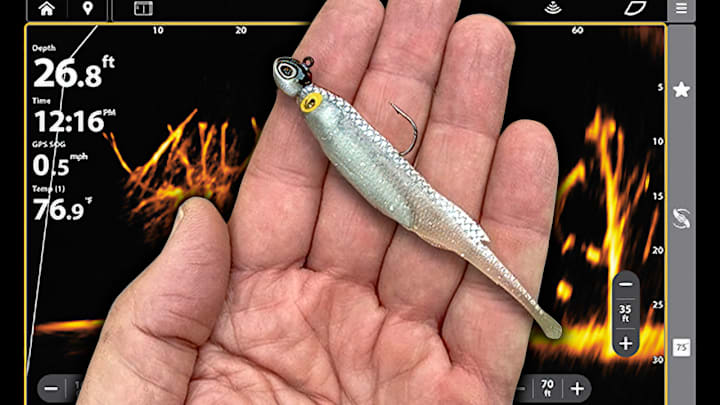
Less than a decade ago, who would've thought that bass fishing would be dominated by such an inconspicuous little lure as the jig head minnow, yet here we are in 2026, in the era of forward-facing sonar (FFS), light tackle, and a jig head minnow designed to imitate a shad.

The jig head minnow's effectiveness lies in its simplicity, typically consisting of a 3-4" soft plastic grub-style bait threaded onto a tungsten or lead jig head. Jighead weights will vary from 1/8 to 3/8 of an ounce, based on the depth of the bass.
One would think the open-hook design of the jig head would lead to sticking and landing most every bass that eats the diminutive minnow. But that simply wasn't my experience. I would estimate I lost close to 30-40% of the bass I hooked on certain days.
Since the school of hard knocks is the best teacher, here are the adjustments I made to get more bass in the boat.
Remedy 1: Shorten the Casting Distance

Like most anglers looking for bass in open water, I keep the forward range set at around 100 feet from the boat. That gives me a sizable search window in which to look for bass suspended high in the water column. However, I too often bombed a long cast toward the fish as soon as I saw them at the far edge of my screen. The result? A bass that pulled loose shortly after eating the lure.
When attempting to drive the hook home, say 90 to 100 feet from the boat, it becomes more difficult to get the hook past the barb with a spinning rod and a thin-diameter line. It's certainly not impossible, but it often results in a low landing percentage at that distance. By "holding my fire" with the minnow for just a few extra seconds, allowing the bass to get within 60 to 70 feet of the boat, the landing percentage increases significantly.
Shorter casting distances also increased casting accuracy. Remember, the sonar array widens as it moves from the transducer. If the bass you see at 100 feet away are on one side of the sonar beam, your lure could still land within the width of the sonar beam, but be 20-30 feet away from the bass. They may never even see the lure you presented to them at that distance.
At 60 feet from the boat, the width of the same sonar beam isn't as wide, dramatically upping your odds of making an accurate presentation with the minnow on the very first, and most important, cast.
Remedy 2: Shorten the Fluorocarbon Leader

Like most anglers, I had adopted the standard setup with finesse gear: a thin-diameter braid as the main line and a 10-15-foot fluorocarbon leader. While a long leader can be useful with a drop shot, it adds too much stretch to the line when using a jig head minnow. Yes, fluorocarbon has less stretch than monofilament, but long lengths of fluoro still stretch from the impact of the hookset. This became evident to me with numerous fish pulling free as I brought them to the boat.
Only after spending time on the water with longtime BASS Pro John Crews did I course-correct. We were working on a feature story idea when he mentioned that he had observed multiple Japanese anglers on tour using only 2-foot leader lengths with a jig head minnow. By shortening the leader, they were able to get considerably more "pop" on their hookset, thereby dramatically increasing their landing percentages. Crews found better success with a shorter leader, and so have I.
Pro tip from Crews: With a shortened fluorocarbon leader, choose a muted color, such as green or camo, for the braided line to disguise the braid from bass in clearer water.
Remedy 3: Use a Softer Rod

I love a good hookset, and with roots as a "power fisherman," I grew up with thick line and heavy-action broomstick rods that could drive a flipping hook through a 2x4. Naturally, I initially chose a medium-heavy spinning rod to pair with the jig head minnow to "drive the hookpoint" home. As you might guess, it led to a lot of missed fish from the stiff rod jerking the lure away too quickly.
Instead, most pros now use softer-tipped rods that allow the bass to take the lure deeper into their mouths before setting the hook. To be clear, these rods aren't rubbery noodles. The soft tip of a proper rod transitions into a firm mid-section about 1/3 to 1/2 way down the blank. Since rod actions and powers aren't universal, consider a 7- to 7'4" rod with a medium action and a fast tip. There's room to accommodate your own personal preferences in the rod's action, but the fact remains that softer-tipped rods land more bass when using a jighead minnow.
Subtle Beats Aggressive
No matter how much you might wish it to be, the jighead minnow isn’t a power fishing technique. The more aggressive I tried to be with longer casts, longer leaders, and heavier rods, the worse my landing percentage became. By finally embracing the finesse of shorter casts, shorter leaders, and a softer rod, the difference was immediate. When fish are eating small bait in open water, surgical precision and control matter more than force.
You Might Also Like These Bass Fishing Articles:
 Add us as a preferred source on Google
Shane’s fascination with enticing a bass to eat an artificial lure dates back as far as he can remember. He has previously worked as a bass guide in Texas, enjoys competing in bass tournaments, and loves sharing his passion and expertise through writing and video content. Over the past twenty years, he’s contributed to some of the most recognizable brands in outdoor media and the fishing industry, such as Bassmaster and Game & Fish.