
The Champions Promised to Settle Bass Fishing's Biggest Debate. Did It?
Nine months ago, I covered the announcement of a new bass fishing tournament called The Champions. This competition promised to bring together fishing’s best-of-the-best from both the Bassmaster Elite Series and Major League Fishing (MLF) Bass Pro Tour (BPT) on the same water, with neutral rules, and let the scales decide who is the true 2026 champion of professional bass fishing. Read the original story here.
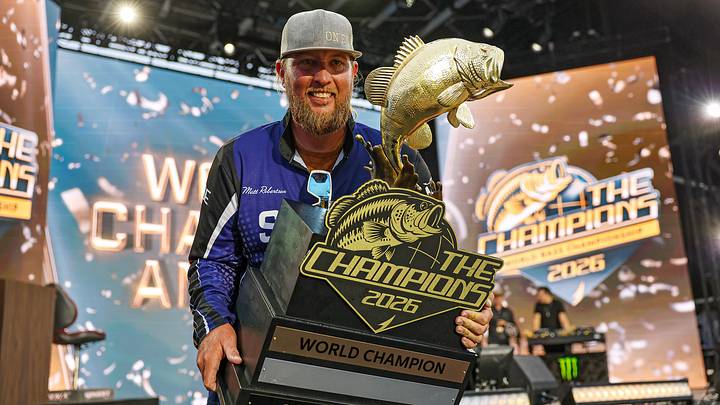
This past weekend, Kentucky’s Matt Robertson made fishing history by collecting the sport’s largest ever tournament prize of $1.25 million. And his 20-pound, 2-ounce Championship Saturday bag was over 6-pounds more than second place.
Understandably, in a professional sport where the competitors have historically earned well under the average of other sports’ top performers, the dollar amount got most of the headlines. But overall, the event was created to answer a question about this sport, and it’s worth asking whether it did.

The Tour Question Got an Answer, at Least for One Week
Which Pro Tour has the more competitive anglers? The Champions event hosted 30 anglers from the Bassmaster Elite Series (Team Stars) and 30 from the MLF Bass Pro Tour (Team Stripes). Whichever group advanced more anglers into the third and final day of competition would take The Champions Cup.
In this inaugural event, it wasn’t close. Team Stars filled 10 of the 15 Championship Round spots. Plus, Elite anglers finished in first place (Robertson), second (Pake South) and fourth (Trey McKinney).
That’s a pretty decisive result that earns Bassmaster fans some bragging rights for this year. That said, it’s just one lake on one week, fishing under rules that neither group uses. The results can tip the debate for now, but they can’t end it.
Did the Kids Outshine the Legends?
A trend we should probably all get used to seeing, and something I’ve written about in past articles, is that the anglers bunched near the top of the leaderboard were some of the youngest in the field.
Elite Series rookie, Pake South from Texas, who just turned 22 in July, took home $500,000 for his second place finish. And again, worth noting, that’s way more than the winners of the Bassmaster Classic or REDCREST earned this year. Trey McKinney, who just a few months ago became the youngest Bassmaster Angler of the Year ever, finished fourth. At just 20 years old, Bassmaster Elite rookie Fisher Anaya finished in seventh place.
Meanwhile, a couple of the hottest names in the 2026 regular season did not make the Day 3 cut. Jacob Wheeler, always a threat to win, four-time BPT Angler of the Year, and the reigning REDCREST Champion, put together a total of just 16-pounds, 11-ounces at the end of the two days of qualifying and fell well short of the cut. Zack Birge, after a rock solid 2026 season earning him BPT’s Angler of the Year and Team Stripes captain, missed with 18-09.
Again, there isn’t anything definitive about one event. But on this historically big stage, the young guys seemed very comfortable.
Grading the Format
In my earlier article, I liked that the rules didn’t seem to hand any style of angler an obvious advantage. Here is how the actual competition played out.
Forward-facing sonar limits: Good…I guess. In a world where the FFS debate has been the unavoidable, number one issue dividing bass fishermen, The Champions tournament created what seems to be a reasonable compromise—anglers were allowed to use FFS on only one of their two qualifying days and for any three consecutive hours on the final day of competition. Based on the fact that I haven’t seen anyone saying anything negative about it, even those who have been beating the issue to death over the past couple years, the format was generally accepted by fans and anglers alike.
The Saturday zero-out: Fair, but harsh. Starting with weights zeroed on the final day has come and gone in lots of different tournament formats over the years. On the good side, it means it’s still any qualifier’s tournament on the last day. On the bad side, it’s possible that the guy who caught the most weight over the event might not win. In this case, Robertson crushed all three days. The winner won by any measure.

Old Hickory: Tougher than expected. Based on past tournament history, I described Old Hickory as a lake that rewards multiple approaches. Maybe it did to some extent, but overall I heard anglers describe it as stingy more than anything else. Robertson was the only competitor who topped 14 pounds on Championship Saturday, with eight of the 15 finalists unable to fill a five-fish limit. But a generally good lake in a tough stretch isn’t a flaw in a championship. It just means a 20-pound bag made a big impact.
The Real Test Is Year Two
As for now, World Bass Enterprises is describing The Champions as an annual event. Based on the buzz and general positivity from the fans and anglers, that would be great. But setting the standard with a $3.25 million prize purse without entry fees is remarkable to accomplish even one time. Making it happen every year will require the support of high-level partners who saw a return this time, or at least can now see the potential in additional events.
But most of all, for one week, the best anglers from both of the top tours competed on the same water, replacing hypothetical arguments with pounds and ounces. This time, the scales settled the score. And for one week, we were reminded what it looks like when a common passion for this sport brings us all together. Here’s to hoping it’s not the last time.
 Add us as a preferred source on Google

Kurt Mazurek writes about all things fishing and the outdoor lifestyle for Fishing On SI -a division of Sports Illustrated. Before writing On SI he enjoyed a successful career in the fishing industry, developing marketing campaigns and creative content for many of the sport’s most recognizable brands. He is a dedicated husband and father, an enthusiastic bass tournament competitor, YouTuber, photographer, musician, and author of the novel "Personal Best: fishing and life”.