%22%3E%0A%3Cpath%20fill-rule%3D%22evenodd%22%20clip-rule%3D%22evenodd%22%20d%3D%22M156.868%204.36764C162.691%20-1.45588%20172.132%20-1.45588%20177.956%204.36764C183.779%2010.1912%20183.779%2019.6324%20177.956%2025.4559L167.412%2036L156.868%2025.4559C151.044%2019.6324%20151.044%2010.1912%20156.868%204.36764ZM159.509%207.55761C159.448%207.86849%20159.416%208.39718%20159.416%209.14566V10.4189C159.416%2011.1832%20159.448%2011.7198%20159.513%2012.0267C159.578%2012.3317%20159.778%2012.6168%20160.117%2012.8762C160.456%2013.1376%20160.903%2013.3316%20161.458%2013.4623C162.012%2013.593%20162.6%2013.6584%20163.337%2013.6584C164.073%2013.6584%20164.717%2013.591%20165.269%2013.4524C165.822%2013.3158%20166.261%2013.1178%20166.586%2012.8604C166.911%2012.6029%20167.105%2012.3178%20167.166%2012.0069C167.228%2011.6961%20167.259%2011.1674%20167.259%2010.4189V9.14566C167.259%208.38134%20167.228%207.84473%20167.162%207.53781C167.097%207.23287%20166.897%206.94971%20166.558%206.68834C166.22%206.42696%20165.772%206.23291%20165.218%206.10223C164.663%205.97154%20164.036%205.90619%20163.339%205.90619C162.602%205.90619%20161.959%205.97352%20161.406%206.11213C160.852%206.24875%20160.414%206.44677%20160.089%206.70418C159.765%206.9616%20159.571%207.24673%20159.509%207.55761ZM164.776%2024.8638C168.376%2024.8638%20170.057%2024.2064%20170.057%2021.862V21.858V21.3155C170.057%2019.6581%20169.016%2018.971%20165.752%2018.3136C164.778%2018.1136%20164.408%2017.9136%20164.408%2017.3136V16.9414C164.408%2016.6543%20164.677%2016.5117%20164.913%2016.5117C165.249%2016.5117%20165.418%2016.7137%20165.418%2016.9414V18.1136H169.891V17.3988C169.891%2015.4563%20168.847%2014.4266%20164.677%2014.4266C161.65%2014.4266%20159.396%2015.3414%20159.396%2017.3711V17.7433C159.396%2019.5155%20160.305%2020.3155%20163.701%2021.0303C163.78%2021.0472%20163.855%2021.063%20163.927%2021.0781C164.829%2021.2674%20165.147%2021.3341%20165.147%2021.9174V22.2897C165.147%2022.6619%20165.046%2022.8045%20164.642%2022.8045C164.17%2022.8045%20164.137%2022.5471%20164.137%2022.262V21.2897H159.394V21.7471C159.394%2024.149%20160.976%2024.8638%20164.776%2024.8638ZM170.924%2024.5569H175.425V14.7355H170.924V24.5569ZM172.455%2013.5019H175.425V6.06064H172.592V9.411L170.693%206.06064H167.859V13.5019H170.693V10.1199L172.455%2013.5019ZM163.769%2012.152C163.704%2012.2688%20163.555%2012.3262%20163.325%2012.3262L163.327%2012.3282C163.104%2012.3282%20162.959%2012.2767%20162.898%2012.1758C162.836%2012.0748%20162.805%2011.8074%20162.805%2011.3758V7.90068C162.805%207.51852%20162.852%207.28684%20162.945%207.20962C163.038%207.13239%20163.175%207.09279%20163.351%207.09279C163.559%207.09279%20163.698%207.14031%20163.765%207.23734C163.832%207.33239%20163.866%207.55416%20163.866%207.90068V11.3203C163.866%2011.7579%20163.834%2012.0352%20163.769%2012.152Z%22%20fill%3D%22white%22%2F%3E%0A%3Cpath%20d%3D%22M134.707%2035.9991C129.823%2035.9991%20126.029%2035.0305%20122.478%2033.2547L125.303%2027.7255C127.765%2029.017%20130.227%2029.8242%20133.254%2029.8242C136.684%2029.8242%20138.5%2028.0484%20138.5%2024.9811V24.3354C137.249%2025.7479%20135.191%2027.3623%20132.124%2027.3623C126.433%2027.3623%20122.316%2023.3264%20122.316%2017.2322V17.1515C122.316%2010.9766%20126.514%206.90039%20131.599%206.90039C134.828%206.90039%20136.724%208.11115%20138.339%209.76586V7.42506H147.5V23.8914C147.5%2027.9677%20146.653%2030.7524%20144.635%2032.7704C142.657%2034.748%20139.63%2035.9991%20134.707%2035.9991ZM134.868%2020.6627C137.128%2020.6627%20138.541%2019.1291%20138.541%2017.1919V17.1112C138.541%2015.2143%20137.088%2013.6807%20134.868%2013.6807C132.608%2013.6807%20131.195%2015.2547%20131.195%2017.1919V17.2726C131.195%2019.1695%20132.648%2020.6627%20134.868%2020.6627Z%22%20fill%3D%22white%22%2F%3E%0A%3Cpath%20d%3D%22M96.9492%2029.4629V7.42701H106.111V10.4943C107.523%208.67813%20109.743%206.90234%20112.851%206.90234C117.492%206.90234%20120.398%209.96961%20120.398%2014.9337V29.4629H111.236V17.8799C111.236%2015.9831%20110.106%2014.8934%20108.734%2014.8934C107.362%2014.8934%20106.111%2015.9831%20106.111%2017.8799V29.4629H96.9492Z%22%20fill%3D%22white%22%2F%3E%0A%3Cpath%20d%3D%22M84.8096%205.85202V0H94.2939V5.85202H84.8096ZM84.971%2029.4619V7.42602H94.1324V29.4619H84.971Z%22%20fill%3D%22white%22%2F%3E%0A%3Cpath%20d%3D%22M58.877%2029.4619V0H68.0384V10.3722C69.451%208.55606%2071.6707%206.90135%2074.7783%206.90135C79.4196%206.90135%2082.3254%209.96862%2082.3254%2014.9327V29.4619H73.164V17.8789C73.164%2015.9821%2072.0339%2014.8924%2070.6617%2014.8924C69.2895%2014.8924%2068.0384%2015.9821%2068.0384%2017.8789V29.4619H58.877Z%22%20fill%3D%22white%22%2F%3E%0A%3Cpath%20d%3D%22M47.3991%2029.9876C43.1211%2029.9876%2039.2466%2028.8979%2036.0986%2026.7992L39.2063%2021.5929C41.8699%2023.2477%2044.8565%2024.0548%2047.3587%2024.0548C48.2466%2024.0548%2048.6906%2023.853%2048.6906%2023.3284V23.2477C48.6906%2022.8037%2048.287%2022.5212%2046.0673%2021.9562C40.4977%2020.584%2037.0672%2019.0907%2037.0672%2014.5302V14.4494C37.0672%209.60638%2040.9417%206.90234%2046.6726%206.90234C50.3049%206.90234%2053.8969%207.8306%2056.5605%209.44495L53.6547%2014.8934C51.3139%2013.6019%2048.4888%2012.8351%2046.6323%2012.8351C45.7444%2012.8351%2045.3408%2013.0772%2045.3408%2013.5212V13.6019C45.3408%2014.0458%2045.8251%2014.3284%2048.0448%2014.8934C53.6143%2016.2656%2056.9641%2017.7992%2056.9641%2022.3194V22.4001C56.9641%2027.2028%2053.3722%2029.9876%2047.3991%2029.9876Z%22%20fill%3D%22white%22%2F%3E%0A%3Cpath%20d%3D%22M25.5312%205.85202V0H35.0156V5.85202H25.5312ZM25.6927%2029.4619V7.42602H34.8541V29.4619H25.6927Z%22%20fill%3D%22white%22%2F%3E%0A%3Cpath%20d%3D%22M0%2029.4621V1.21094H23.6503V9.2827H9.44396V12.8746H22.6413V20.2199H9.44396V29.4621H0Z%22%20fill%3D%22white%22%2F%3E%0A%3C%2Fg%3E%0A%3Cdefs%3E%0A%3CclipPath%20id%3D%22clip0_16330_64756%22%3E%0A%3Crect%20width%3D%22182%22%20height%3D%2236%22%20fill%3D%22white%22%2F%3E%0A%3C%2FclipPath%3E%0A%3C%2Fdefs%3E%0A%3C%2Fsvg%3E%0A)
Ultimate Guide to Fishing Alaska’s Kenai River for Salmon and Trout
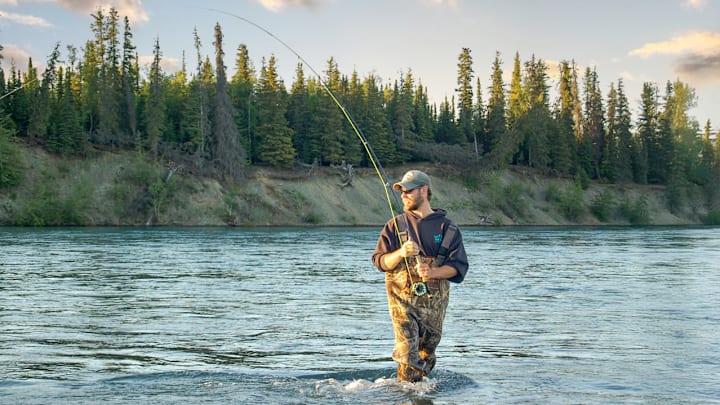
For many anglers, an Alaskan fishing adventure is a dream come true. But where do you start?
The Kenai River in Alaska is famous for its epic salmon runs, incredible rainbow trout and dolly varden fishing, and stunning glacial waters running through surreal mountainous scenery. Did you know the Kenai River is home to the world record king salmon: a fish weighing 97 pounds, 4 ounces?
Whether you’re a first-timer or an accomplished angler planning a bucket list fishing adventure on a budget, this guide shares how you can fish the Kenai like a local, without needing a guide or a boat. Here’s everything you need to know.
How to Get to the Kenai River from Anchorage
Although the little berg of Cooper Landing is only about 30 air miles from Anchorage, it's a 100-mile drive by the time you skirt around Turnagain Arm and weave through the Chugach Mountains. Cooper Landing is where it all begins as the Kenai River starts here, exiting sprawling Kenai Lake and flowing 82 miles before dumping into Cook Inlet near the town of Kenai.

Where to Stay: RV Camping vs. River Lodges
Fish the Kenai from an RV
Renting an RV is a fun and practical option for visiting the Kenai Peninsula. You'll need both lodging and transportation, so why not get both for the price of one? A quick search on outdoorsy.com reveals a selection of 362 RVs available to rent near Anchorage. There are plenty of campgrounds available, plus, you can camp at any highway pull-off in Alaska unless there's a sign there specifically prohibiting camping. So you can camp for free a couple nights and then use a campground when you need to dump wastewater.
Alaskan River Resort Options
If RV-life isn't your style, there are dozens of comfortable resorts, many of them right on the river. If you plan to fish the Kenai River, there are lodges and amenities in Cooper Landing, Sterling, Soldotna and Kenai.
And if you want to take a break from river fishing and chase halibut, Seward is a pretty little coastal town to the east. Going farther west, you'll find halibut fishing in Ninilchik, Anchor Point and Homer.

Fishing for King Salmon on the Kenai (When In Season)
The river gets several salmon runs each year including two runs of king salmon: a smaller early run that goes from mid-May through June and a larger late run that runs approximately through the month of July. The Kenai is renowned for its giant kings. Unfortunately, due to a declining population, king salmon fishing has been closed on the Kenai River in recent years.
However, anglers can still fish for big kings on the nearby Kasilof River. Like the Kenai, the Kasilof gets an early and late run of kings. Much king salmon fishing is done from drift boats, pulling Luhr-Jensen Kwikfish or using salmon eggs. You will need a king salmon stamp to fish kings, and there are special regulations that are subject to change. Alaskan fishing regulations are strict and somewhat complicated. Pick up a copy of the Southcentral Alaska fishing regulations and study it thoroughly prior to fishing.
Where, When and How to “Floss” Red (Sockeye) Salmon on the Kenai River

If king salmon are the trophy fish of the Kenai Peninsula, red salmon are the "meat" fish. Like kings, there are two runs of reds that come up the river, although they pretty much blend into one. The first smaller run starts coming up in early June. These fish muscle their way up the Kenai River, through Skilak Lake and back into the river. Many of them will then split off the Kenai and venture up the Russian River to spawn. The confluence of the Russian and Kenai Rivers is an extremely popular place among anglers. Reds generally hug the shoreline as they swim upstream, so outside bends are preferred fishing destinations.
The Russian River Ferry takes anglers across the Kenai River to the outside bend and is one of the most popular places to fish. Here, anglers stand shoulder to shoulder in knee-deep water and engage in what is known as "combat fishing." They flip lines with flies and heavy sinkers, which could potentially hook nearby anglers. Thus, the term combat fishing. It's wise to wear sunglasses and a life jacket to protect yourself.

No motors are allowed on the Upper Kenai River, and only artificial flies with a hook gap of 3/8-inch or less are allowed. Further downstream, 4-stroke motors are allowed and the hook gap restriction is removed. Check regulations.
To catch reds, anglers engage in a technique known as "flossing." Reds are naturally plankton eaters, so they're not interested in hitting lures. So you use a 3- or 4-foot length of 25-pound mono between a sinker and a Russian River fly, and that length of line acts as your hook. As fish run up the river, you make a short flip upstream and swing this presentation downstream with the current, hoping to run the line in a fish's mouth. When you do so, you set the hook and the fight is on! Most anglers fish this rig on an 8 or 10 weight fly rod, but you can use a stout spinning or baitcasting rod as well.
Sockeye salmon season opens June 11 every year. You can log on to the Alaska Department of Fish and Game website and look at the daily fish count for the Kenai and other rivers. A high-tech sonar counts the fish by species as they enter the river. When a big push moves up, it's time to hit the water!
Generally, the third week in July is considered the peak. Also, for eating purposes, you want to catch the fish when they're still chrome-colored. As salmon get closer to spawning, the males grow hooked jaws and humped backs and all species will change colors. Reds are aptly named, as they turn a bright red color. They are also sometimes called tomatoes because they have green heads in contrast to their red bodies.
By the time August hits, most of the reds in the river will have turned red. There are still plenty of fish around, but few "chromers" to eat.
Techniques for Catching Silver (Coho) Salmon in Fall

Silver salmon also make two runs up the Kenai. They begin entering the river as the red run starts to wind down. Peak fishing for silvers runs from August through October. An added benefit of fishing silvers is many of the summer tourists depart when school is back in session, so a fall trip can be a little less touristy.
Unlike reds, silvers will hit lures and you can fish them a variety of ways: spinners, spoons, plugs, eggs or flies. Vibrax spinners, Pixee spoons and Kwikfish plugs will take silvers, as will egg-sucking leeches in the fly department. Because you don't need to floss silvers, you fish them a little differently. You can cast to them in slack eddies where they pool up to rest. Or you can backtroll for them or fish a Kwikfish in place from an anchored position. Or you can just chill on shore pitching eggs suspended below a bobber. The variety is part of the appeal of chasing silvers.
The limit starts out at 2 silvers but bumps up to 3 later in the season. Check current regulations and always be aware of possible emergency orders.
Fishing for Pink Salmon (Humpies) and the Truth About Eating Them

If kings are trophies and reds and silvers are prized for their meat, pink salmon are the booby prize of the Kenai River. Most anglers look down their noses at pinks, which make large runs up the Kenai in even-numbered years. As their nickname implies, male humpies go through a spectacular transformation as they prepare to spawn, growing grotesque humps on their backs. Although rather unsightly, this broadened shape helps them put up an incredible fight. You ever catch a big bluegill on a light fly rod? It's sort of like that, but on steroids.
As crazy as they look, the big hump-backed fish aren't the ones you want to eat. If you ever want to start an argument in a bar, ask a guy with a few beers in him how pinks taste. Most anglers despise them. But, if you get them fresh from the ocean when they're still silver and before they go through their transformation, many claim they taste just fine. So if you plan to target pinks to eat, make it a point to fish the lower river within a few miles of the mouth to get them when they're still fresh from the sea.
Pinks are aggressive and will hit a variety of lures. That's one appeal of fishing for them: you can catch a lot of them, and to their credit, they do fight like crazy. Any of the lures mentioned above for silvers should work for humpies.
Targeting Rainbow Trout and Dolly Varden

Rainbow trout and dolly varden (a kind of char) are found in the river year round. Although you can catch them any time of year (except for May 1 to June 10 when the season is closed), the best fishing is when salmon are spawning. These fish go on a feeding binge eating salmon eggs. There are a couple primary options for bait: plastic beads resembling salmon eggs or flesh flies, which are strips of yarn meant to imitate salmon flesh. These two varieties are both fished under a strike indicator. At other times of the year, nymphs, streamers and even dry flies may be productive.
Although the regulations do permit some limited trout harvest, there is a very strong catch-and-release ethic among Kenai trout anglers, and seldom are trout killed to eat. As a result of this, coupled with the abundance of food in the form of salmon eggs and flesh, the Kenai's trout grow large. Rainbows in the 12- to 15-inch range are quite common. The ultimate goal of many anglers is to land one of the Kenai's mythical 30-inch rainbows. Although the fish are there, it's a feat not easily achieved, due to their relative scarcity, their uncanny ability to avoid an angler's fly and their ability to throw the hook.

A Bucket-List Destination Within the Reach of Most Anglers
Fishing in Alaska is a dream trip for many anglers and the Kenai River won't disappoint. The river teems with salmon in the summer and trout year round. Plus, you may see moose drinking along the banks (particularly early in the season before the salmon come and lure in the bears) or brown or black bears trying their luck for fish. Snow-capped mountains surround you even in summer. All the while, you're on an impossibly blue river that looks like something out of a dream world. And if done right, this amazing, bucket-list fishing destination doesn’t have to break the bank.
You Might Also Like These Fishing Stories:
 Add us as a preferred source on Google
Joe Shead is an accomplished outdoor writer, hunter, fishing guide and multi-species angler from Minnesota who will fish for anything, even if it won’t bite. Check out more of his work at goshedhunting.com and superiorexperiencecharters.com.