%22%3E%0A%3Cpath%20fill-rule%3D%22evenodd%22%20clip-rule%3D%22evenodd%22%20d%3D%22M156.868%204.36764C162.691%20-1.45588%20172.132%20-1.45588%20177.956%204.36764C183.779%2010.1912%20183.779%2019.6324%20177.956%2025.4559L167.412%2036L156.868%2025.4559C151.044%2019.6324%20151.044%2010.1912%20156.868%204.36764ZM159.509%207.55761C159.448%207.86849%20159.416%208.39718%20159.416%209.14566V10.4189C159.416%2011.1832%20159.448%2011.7198%20159.513%2012.0267C159.578%2012.3317%20159.778%2012.6168%20160.117%2012.8762C160.456%2013.1376%20160.903%2013.3316%20161.458%2013.4623C162.012%2013.593%20162.6%2013.6584%20163.337%2013.6584C164.073%2013.6584%20164.717%2013.591%20165.269%2013.4524C165.822%2013.3158%20166.261%2013.1178%20166.586%2012.8604C166.911%2012.6029%20167.105%2012.3178%20167.166%2012.0069C167.228%2011.6961%20167.259%2011.1674%20167.259%2010.4189V9.14566C167.259%208.38134%20167.228%207.84473%20167.162%207.53781C167.097%207.23287%20166.897%206.94971%20166.558%206.68834C166.22%206.42696%20165.772%206.23291%20165.218%206.10223C164.663%205.97154%20164.036%205.90619%20163.339%205.90619C162.602%205.90619%20161.959%205.97352%20161.406%206.11213C160.852%206.24875%20160.414%206.44677%20160.089%206.70418C159.765%206.9616%20159.571%207.24673%20159.509%207.55761ZM164.776%2024.8638C168.376%2024.8638%20170.057%2024.2064%20170.057%2021.862V21.858V21.3155C170.057%2019.6581%20169.016%2018.971%20165.752%2018.3136C164.778%2018.1136%20164.408%2017.9136%20164.408%2017.3136V16.9414C164.408%2016.6543%20164.677%2016.5117%20164.913%2016.5117C165.249%2016.5117%20165.418%2016.7137%20165.418%2016.9414V18.1136H169.891V17.3988C169.891%2015.4563%20168.847%2014.4266%20164.677%2014.4266C161.65%2014.4266%20159.396%2015.3414%20159.396%2017.3711V17.7433C159.396%2019.5155%20160.305%2020.3155%20163.701%2021.0303C163.78%2021.0472%20163.855%2021.063%20163.927%2021.0781C164.829%2021.2674%20165.147%2021.3341%20165.147%2021.9174V22.2897C165.147%2022.6619%20165.046%2022.8045%20164.642%2022.8045C164.17%2022.8045%20164.137%2022.5471%20164.137%2022.262V21.2897H159.394V21.7471C159.394%2024.149%20160.976%2024.8638%20164.776%2024.8638ZM170.924%2024.5569H175.425V14.7355H170.924V24.5569ZM172.455%2013.5019H175.425V6.06064H172.592V9.411L170.693%206.06064H167.859V13.5019H170.693V10.1199L172.455%2013.5019ZM163.769%2012.152C163.704%2012.2688%20163.555%2012.3262%20163.325%2012.3262L163.327%2012.3282C163.104%2012.3282%20162.959%2012.2767%20162.898%2012.1758C162.836%2012.0748%20162.805%2011.8074%20162.805%2011.3758V7.90068C162.805%207.51852%20162.852%207.28684%20162.945%207.20962C163.038%207.13239%20163.175%207.09279%20163.351%207.09279C163.559%207.09279%20163.698%207.14031%20163.765%207.23734C163.832%207.33239%20163.866%207.55416%20163.866%207.90068V11.3203C163.866%2011.7579%20163.834%2012.0352%20163.769%2012.152Z%22%20fill%3D%22white%22%2F%3E%0A%3Cpath%20d%3D%22M134.707%2035.9991C129.823%2035.9991%20126.029%2035.0305%20122.478%2033.2547L125.303%2027.7255C127.765%2029.017%20130.227%2029.8242%20133.254%2029.8242C136.684%2029.8242%20138.5%2028.0484%20138.5%2024.9811V24.3354C137.249%2025.7479%20135.191%2027.3623%20132.124%2027.3623C126.433%2027.3623%20122.316%2023.3264%20122.316%2017.2322V17.1515C122.316%2010.9766%20126.514%206.90039%20131.599%206.90039C134.828%206.90039%20136.724%208.11115%20138.339%209.76586V7.42506H147.5V23.8914C147.5%2027.9677%20146.653%2030.7524%20144.635%2032.7704C142.657%2034.748%20139.63%2035.9991%20134.707%2035.9991ZM134.868%2020.6627C137.128%2020.6627%20138.541%2019.1291%20138.541%2017.1919V17.1112C138.541%2015.2143%20137.088%2013.6807%20134.868%2013.6807C132.608%2013.6807%20131.195%2015.2547%20131.195%2017.1919V17.2726C131.195%2019.1695%20132.648%2020.6627%20134.868%2020.6627Z%22%20fill%3D%22white%22%2F%3E%0A%3Cpath%20d%3D%22M96.9492%2029.4629V7.42701H106.111V10.4943C107.523%208.67813%20109.743%206.90234%20112.851%206.90234C117.492%206.90234%20120.398%209.96961%20120.398%2014.9337V29.4629H111.236V17.8799C111.236%2015.9831%20110.106%2014.8934%20108.734%2014.8934C107.362%2014.8934%20106.111%2015.9831%20106.111%2017.8799V29.4629H96.9492Z%22%20fill%3D%22white%22%2F%3E%0A%3Cpath%20d%3D%22M84.8096%205.85202V0H94.2939V5.85202H84.8096ZM84.971%2029.4619V7.42602H94.1324V29.4619H84.971Z%22%20fill%3D%22white%22%2F%3E%0A%3Cpath%20d%3D%22M58.877%2029.4619V0H68.0384V10.3722C69.451%208.55606%2071.6707%206.90135%2074.7783%206.90135C79.4196%206.90135%2082.3254%209.96862%2082.3254%2014.9327V29.4619H73.164V17.8789C73.164%2015.9821%2072.0339%2014.8924%2070.6617%2014.8924C69.2895%2014.8924%2068.0384%2015.9821%2068.0384%2017.8789V29.4619H58.877Z%22%20fill%3D%22white%22%2F%3E%0A%3Cpath%20d%3D%22M47.3991%2029.9876C43.1211%2029.9876%2039.2466%2028.8979%2036.0986%2026.7992L39.2063%2021.5929C41.8699%2023.2477%2044.8565%2024.0548%2047.3587%2024.0548C48.2466%2024.0548%2048.6906%2023.853%2048.6906%2023.3284V23.2477C48.6906%2022.8037%2048.287%2022.5212%2046.0673%2021.9562C40.4977%2020.584%2037.0672%2019.0907%2037.0672%2014.5302V14.4494C37.0672%209.60638%2040.9417%206.90234%2046.6726%206.90234C50.3049%206.90234%2053.8969%207.8306%2056.5605%209.44495L53.6547%2014.8934C51.3139%2013.6019%2048.4888%2012.8351%2046.6323%2012.8351C45.7444%2012.8351%2045.3408%2013.0772%2045.3408%2013.5212V13.6019C45.3408%2014.0458%2045.8251%2014.3284%2048.0448%2014.8934C53.6143%2016.2656%2056.9641%2017.7992%2056.9641%2022.3194V22.4001C56.9641%2027.2028%2053.3722%2029.9876%2047.3991%2029.9876Z%22%20fill%3D%22white%22%2F%3E%0A%3Cpath%20d%3D%22M25.5312%205.85202V0H35.0156V5.85202H25.5312ZM25.6927%2029.4619V7.42602H34.8541V29.4619H25.6927Z%22%20fill%3D%22white%22%2F%3E%0A%3Cpath%20d%3D%22M0%2029.4621V1.21094H23.6503V9.2827H9.44396V12.8746H22.6413V20.2199H9.44396V29.4621H0Z%22%20fill%3D%22white%22%2F%3E%0A%3C%2Fg%3E%0A%3Cdefs%3E%0A%3CclipPath%20id%3D%22clip0_16330_64756%22%3E%0A%3Crect%20width%3D%22182%22%20height%3D%2236%22%20fill%3D%22white%22%2F%3E%0A%3C%2FclipPath%3E%0A%3C%2Fdefs%3E%0A%3C%2Fsvg%3E%0A)
Catch More Bluegill Through the Ice: Why Big Bluegills Charge Your Jig…Then Swim Away
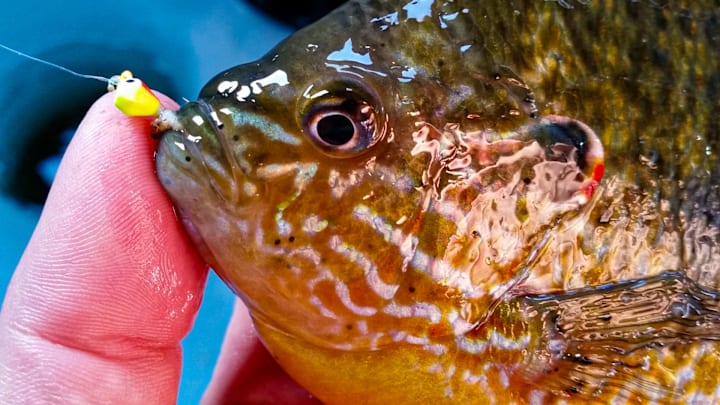
You might think of bluegills as something kids catch from docks in the summertime. But in winter, they are serious sport. They can be willing biters ... or they can be challenging, depending on their mood. And while walleye or pike anglers might smirk at the idea of targeting fish that measure just a few inches, ice fishing panfish anglers know that ounce for ounce, nothing fights quite like a big 'gill.
1. Where to Find Ice Fishing Bluegills in Winter

Bluegills are usually never far from weeds, particularly green weeds. In early winter, look for them in relatively shallow weeds; from 3 feet out to 15 feet, depending on water clarity and how deep weeds grow. Fish cribs and docks are also good bets. If oxygen levels sag in winter, 'gills may slide deeper, retreating to deep weed edges or even onto mud flats where they feed on aquatic invertebrates. With good oxygen levels, you can find slabs in the weeds all winter long. Rule of thumb: start shallow and if you're not marking fish, move deeper.
2. Best Ice Fishing Baits for Bluegills: Turn Lookers Into Biters

Catching 'gills isn't usually rocket science. A 1/32- or 1/64-ounce ice jig does the trick, tipped with either live bait or soft plastics. Waxworms, spikes (maggots), Eurolarvae (colored spikes) or mousies all work well. They put out scent that attracts fish. Squeeze the bait, which squirts out more scent and undulates attractively in the water. A waxworm simply impaled on your jig that curves around in the shape of the hook produces less scent and tends to spin in the water, which often repels fish.
Soft-plastic baits work as well. Skinny plastic strands move attractively in the water like aquatic insects, prompting strikes. Plus, you don't have to worry about re-baiting as often if the bite is fast and furious.
Consider lure size and shape as well. Tungsten is denser than lead, so it sinks faster than a comparatively sized lead lure. So you can get down faster and keep a tighter line, which helps you detect subtle bites. The smaller size of a corresponding-sized tungsten lure is better when fish are reluctant to bite. When the bite is on, however, you might consider using a tiny spoon, which gets down fast and may deter smaller fish from biting.
3. Why Big Bluegills Won’t Bite: Line, Lure Spin, and Stealth Mistakes
Big bluegills can be fussy and wary. I've sight-fished for 'gills in shallow water and watched them motor right up to my bait, pause and then turn away. They didn't like something. Bluegills can be line shy. Never use anything larger than 4-pound-test. One- or 2-pound is even better. Fluorocarbon line works well in clear water.
Make sure your jig doesn't spin in the water, but keeping it constantly quivering helps. So does attaching a ball-bearing swivel a foot above your lure. That's one reason fly reels have become so popular for ice fishing: they don't twist line like spinning reels, which eliminates jig spin.
4. How to Detect Ultra-Light Bluegill Bites Through the Ice

Be prepared for subtle bites, too. If you have any curly cues in your line, replace it. You need your line to hang straight so you can detect light bites.
A big 'gill can suck in and spit out your offering surprisingly fast. Use a spring bobber to detect light bites. Sometimes you'll actually see the spring bobber rise. That's because the weight of the lure bends the spring bobber slightly and when a bluegill takes the bait, the weight of the jig is gone, prompting the spring bobber to rise. If it does, set the hook.
Sometimes you'll just see your line move subtly. Other times you can watch your lure (or just your live bait) disappear while watching down the hole.
5. The Perfect Jigging Cadence for Triggering Slab Bluegills

Fast jigging often works well. Except when it doesn't! Start out keeping your jig constantly quivering, like an aquatic insect. When a fish appears, either visually or on your electronics, slowly raise the offering while keeping it quivering. Often that will trigger a strike. But sometimes it doesn't. Slow it down. Make a few quick jigs, then pause, giving the fish time to catch the bait.
Watch the fish's reaction. If the fish is disinterested, try raising it to make the fish think the bait is getting away. No matter what you do, pay attention to how a fish reacts. I've seen bitterly cold days where the jigging motion attracted a fish, but any sort of movement once it approached sent the fish packing. You had to keep the lure absolutely still to get bit.
Ice Fishing Bluegill Checklist
Gear & Tackle
- Ultralight ice rod with sensitive tip
- Add a spring bobber to your rod tip (to detect light bites)
- Fly-style ice reel (reduces line twist)
- 1 to 4 lb fluorocarbon line (the lighter, the better)
- Tungsten jigs (1/32, 1/64 oz) in multiple colors
- Small lead jigs for a slower fall
- Tiny spoons for aggressive fish
- Ball-bearing swivel 12 inches above jig (reduces line twist)
Baits
- Waxworms
- Spikes / maggots
- Eurolarvae (colored spikes)
- Mousies
- Soft-plastic micro worms (when the bite is on)
Location Strategy
- Check green weeds (start shallow and move deeper until you find fish)
- Check fish cribs and docks
- If oxygen levels drop midwinter, move deeper to outside weed edges or even mudflats
Presentation Tips
- Keep the jig quivering constantly
- Raise slowly, still quivering, when a fish appears
- Watch reaction and adjust accordingly (try pauses, tiny hops, or dead-sticking)
Bite Detection
- Watch for spring bobber rise bites
- Look for subtle line movements
- Sight-fish when possible (watch your lure “disappear”)
- Use electronics to read fish reaction
You Might Also Like These Fishing Articles:
 Add us as a preferred source on Google
Joe Shead is an accomplished outdoor writer, hunter, fishing guide and multi-species angler from Minnesota who will fish for anything, even if it won’t bite. Check out more of his work at goshedhunting.com and superiorexperiencecharters.com.