%22%3E%0A%3Cpath%20fill-rule%3D%22evenodd%22%20clip-rule%3D%22evenodd%22%20d%3D%22M156.868%204.36764C162.691%20-1.45588%20172.132%20-1.45588%20177.956%204.36764C183.779%2010.1912%20183.779%2019.6324%20177.956%2025.4559L167.412%2036L156.868%2025.4559C151.044%2019.6324%20151.044%2010.1912%20156.868%204.36764ZM159.509%207.55761C159.448%207.86849%20159.416%208.39718%20159.416%209.14566V10.4189C159.416%2011.1832%20159.448%2011.7198%20159.513%2012.0267C159.578%2012.3317%20159.778%2012.6168%20160.117%2012.8762C160.456%2013.1376%20160.903%2013.3316%20161.458%2013.4623C162.012%2013.593%20162.6%2013.6584%20163.337%2013.6584C164.073%2013.6584%20164.717%2013.591%20165.269%2013.4524C165.822%2013.3158%20166.261%2013.1178%20166.586%2012.8604C166.911%2012.6029%20167.105%2012.3178%20167.166%2012.0069C167.228%2011.6961%20167.259%2011.1674%20167.259%2010.4189V9.14566C167.259%208.38134%20167.228%207.84473%20167.162%207.53781C167.097%207.23287%20166.897%206.94971%20166.558%206.68834C166.22%206.42696%20165.772%206.23291%20165.218%206.10223C164.663%205.97154%20164.036%205.90619%20163.339%205.90619C162.602%205.90619%20161.959%205.97352%20161.406%206.11213C160.852%206.24875%20160.414%206.44677%20160.089%206.70418C159.765%206.9616%20159.571%207.24673%20159.509%207.55761ZM164.776%2024.8638C168.376%2024.8638%20170.057%2024.2064%20170.057%2021.862V21.858V21.3155C170.057%2019.6581%20169.016%2018.971%20165.752%2018.3136C164.778%2018.1136%20164.408%2017.9136%20164.408%2017.3136V16.9414C164.408%2016.6543%20164.677%2016.5117%20164.913%2016.5117C165.249%2016.5117%20165.418%2016.7137%20165.418%2016.9414V18.1136H169.891V17.3988C169.891%2015.4563%20168.847%2014.4266%20164.677%2014.4266C161.65%2014.4266%20159.396%2015.3414%20159.396%2017.3711V17.7433C159.396%2019.5155%20160.305%2020.3155%20163.701%2021.0303C163.78%2021.0472%20163.855%2021.063%20163.927%2021.0781C164.829%2021.2674%20165.147%2021.3341%20165.147%2021.9174V22.2897C165.147%2022.6619%20165.046%2022.8045%20164.642%2022.8045C164.17%2022.8045%20164.137%2022.5471%20164.137%2022.262V21.2897H159.394V21.7471C159.394%2024.149%20160.976%2024.8638%20164.776%2024.8638ZM170.924%2024.5569H175.425V14.7355H170.924V24.5569ZM172.455%2013.5019H175.425V6.06064H172.592V9.411L170.693%206.06064H167.859V13.5019H170.693V10.1199L172.455%2013.5019ZM163.769%2012.152C163.704%2012.2688%20163.555%2012.3262%20163.325%2012.3262L163.327%2012.3282C163.104%2012.3282%20162.959%2012.2767%20162.898%2012.1758C162.836%2012.0748%20162.805%2011.8074%20162.805%2011.3758V7.90068C162.805%207.51852%20162.852%207.28684%20162.945%207.20962C163.038%207.13239%20163.175%207.09279%20163.351%207.09279C163.559%207.09279%20163.698%207.14031%20163.765%207.23734C163.832%207.33239%20163.866%207.55416%20163.866%207.90068V11.3203C163.866%2011.7579%20163.834%2012.0352%20163.769%2012.152Z%22%20fill%3D%22white%22%2F%3E%0A%3Cpath%20d%3D%22M134.707%2035.9991C129.823%2035.9991%20126.029%2035.0305%20122.478%2033.2547L125.303%2027.7255C127.765%2029.017%20130.227%2029.8242%20133.254%2029.8242C136.684%2029.8242%20138.5%2028.0484%20138.5%2024.9811V24.3354C137.249%2025.7479%20135.191%2027.3623%20132.124%2027.3623C126.433%2027.3623%20122.316%2023.3264%20122.316%2017.2322V17.1515C122.316%2010.9766%20126.514%206.90039%20131.599%206.90039C134.828%206.90039%20136.724%208.11115%20138.339%209.76586V7.42506H147.5V23.8914C147.5%2027.9677%20146.653%2030.7524%20144.635%2032.7704C142.657%2034.748%20139.63%2035.9991%20134.707%2035.9991ZM134.868%2020.6627C137.128%2020.6627%20138.541%2019.1291%20138.541%2017.1919V17.1112C138.541%2015.2143%20137.088%2013.6807%20134.868%2013.6807C132.608%2013.6807%20131.195%2015.2547%20131.195%2017.1919V17.2726C131.195%2019.1695%20132.648%2020.6627%20134.868%2020.6627Z%22%20fill%3D%22white%22%2F%3E%0A%3Cpath%20d%3D%22M96.9492%2029.4629V7.42701H106.111V10.4943C107.523%208.67813%20109.743%206.90234%20112.851%206.90234C117.492%206.90234%20120.398%209.96961%20120.398%2014.9337V29.4629H111.236V17.8799C111.236%2015.9831%20110.106%2014.8934%20108.734%2014.8934C107.362%2014.8934%20106.111%2015.9831%20106.111%2017.8799V29.4629H96.9492Z%22%20fill%3D%22white%22%2F%3E%0A%3Cpath%20d%3D%22M84.8096%205.85202V0H94.2939V5.85202H84.8096ZM84.971%2029.4619V7.42602H94.1324V29.4619H84.971Z%22%20fill%3D%22white%22%2F%3E%0A%3Cpath%20d%3D%22M58.877%2029.4619V0H68.0384V10.3722C69.451%208.55606%2071.6707%206.90135%2074.7783%206.90135C79.4196%206.90135%2082.3254%209.96862%2082.3254%2014.9327V29.4619H73.164V17.8789C73.164%2015.9821%2072.0339%2014.8924%2070.6617%2014.8924C69.2895%2014.8924%2068.0384%2015.9821%2068.0384%2017.8789V29.4619H58.877Z%22%20fill%3D%22white%22%2F%3E%0A%3Cpath%20d%3D%22M47.3991%2029.9876C43.1211%2029.9876%2039.2466%2028.8979%2036.0986%2026.7992L39.2063%2021.5929C41.8699%2023.2477%2044.8565%2024.0548%2047.3587%2024.0548C48.2466%2024.0548%2048.6906%2023.853%2048.6906%2023.3284V23.2477C48.6906%2022.8037%2048.287%2022.5212%2046.0673%2021.9562C40.4977%2020.584%2037.0672%2019.0907%2037.0672%2014.5302V14.4494C37.0672%209.60638%2040.9417%206.90234%2046.6726%206.90234C50.3049%206.90234%2053.8969%207.8306%2056.5605%209.44495L53.6547%2014.8934C51.3139%2013.6019%2048.4888%2012.8351%2046.6323%2012.8351C45.7444%2012.8351%2045.3408%2013.0772%2045.3408%2013.5212V13.6019C45.3408%2014.0458%2045.8251%2014.3284%2048.0448%2014.8934C53.6143%2016.2656%2056.9641%2017.7992%2056.9641%2022.3194V22.4001C56.9641%2027.2028%2053.3722%2029.9876%2047.3991%2029.9876Z%22%20fill%3D%22white%22%2F%3E%0A%3Cpath%20d%3D%22M25.5312%205.85202V0H35.0156V5.85202H25.5312ZM25.6927%2029.4619V7.42602H34.8541V29.4619H25.6927Z%22%20fill%3D%22white%22%2F%3E%0A%3Cpath%20d%3D%22M0%2029.4621V1.21094H23.6503V9.2827H9.44396V12.8746H22.6413V20.2199H9.44396V29.4621H0Z%22%20fill%3D%22white%22%2F%3E%0A%3C%2Fg%3E%0A%3Cdefs%3E%0A%3CclipPath%20id%3D%22clip0_16330_64756%22%3E%0A%3Crect%20width%3D%22182%22%20height%3D%2236%22%20fill%3D%22white%22%2F%3E%0A%3C%2FclipPath%3E%0A%3C%2Fdefs%3E%0A%3C%2Fsvg%3E%0A)
Fish Bucktail Jigs This Fall to Catch More Walleye and Bass in the Weeds
What Makes a Bucktail Jig So Effective for Catching Bass and Walleye?
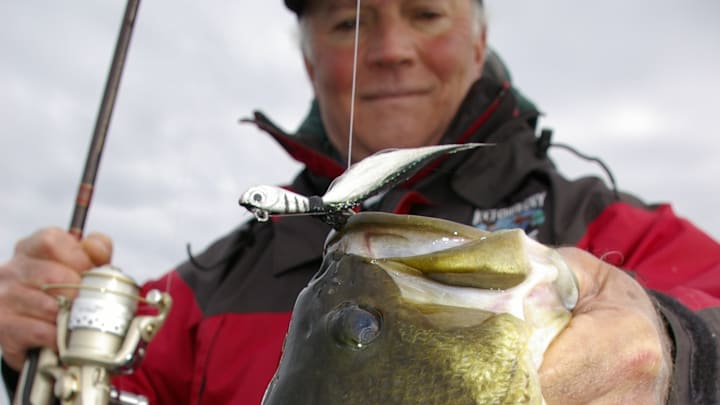
Simplistic in design but lethal in execution, the bucktail jig works magic when fished amongst weeds in the fall. Comprised of a lead or Tungsten head and hook with a 'skirt' of bucktail attached, this minnow or leech imitator looks natural and real when jerked and jigged through the water.

When ripped through weeds a bucktail jig springs forward and up - before falling back down in a controlled manner. It is this tantalizing swimming and darting motion, paired with the flash, that convinces gamefish, such as largemouth bass and walleye, to take a reactionary swipe.
A bucktail jig is also relatively weedless, allowing it to break free of vegetation with a quick snap of the rod tip. This makes it the perfect bait for pitching to the thick weeds walleye and largemouth bass seek out during the fall.
What Makes Weeds So Attractive to Bass and Walleye in the Fall?
The arrival of cooler weather and a drop in water temperature, especially in northern regions where seasonal change is more pronounced, signals a shift in game fish behavior. Shallow flats, once home to largemouth bass and walleye, are now mostly devoid of fish as vegetation dies off, driving fish to deeper water and greener weeds.

Healthy green weeds give off oxygen, attracting a myriad of prey items, and with them, larger predators. In addition to the food source they provide, they also offer largemouth bass and walleye cover and safety, two important aspects that will help both species survive the coming winter.
Look for lush green weeds when you hit the water in the fall. You will often find these at the first break when working out from the shoreline. Weedlines and thick clumps both excel at this time of year and are generally found in 6 to 10 feet of water.
Cabbage, millfoil and coontail vegetation all hold largemouth bass and walleye in the fall. If you can find a mixture of multiple varieties, the attractiveness to gamefish definitely rises.
My favorite fall lake for largemouth bass and walleye, which I stumbled upon some 15 years ago, has a long weedline that zig-zags its way across water that is between 5 and 8 feet deep. Fish hunker down in this green vegetation like clockwork each season and I've enjoyed some banner days on the water slowly working along the edge and rip jigging bucktail jigs into and through the weeds.
How to Fish a Bucktail Jig for Weed Walleye and Bass in the Fall
Working a bucktail jig in the weeds for fall walleye and bass requires a specialized technique called 'rip jigging.' Although it's not hard to do, becoming proficient will up your odds at connecting with more fish. Here is rip jigging broken down into four easy steps:
How to Rip Jig a Bucktail Jig for Walleye and Bass
- With an underhand pitch or cast, send your bucktail jig into the weedline or amongst clumps. Keep your casts short (no more than 20 feet.)
- Let the bucktail jig drop vertically on a semi-slack line.
- Once your bucktail jig connects with weeds or bottom, quickly take up the slack in your line and aggressively 'rip' up with your rod tip. Add variety by doubling up on your rip from time to time.
- Let your bucktail jig drop vertically again and repeat the same ripping pattern until your lure is back to the boat.
How Do Walleye and Bass Hit a Bucktail Jig When Rip Jigged?
Walleye and largemouth bass, during the fall, will both hit a bucktail jig in one of two ways. The first is during the ripping action, as the bucktail jig breaks free of the vegetation and springs forward and up. The second is as the bucktail jig freefalls vertically.
A bucktail jig is a reactionary bait and bass and walleye often smash them with reckless abandon.

It's important to watch your line closely when rip jigging. Any jumps or movement in the line, especially when the bucktail jig freefalls after a rip, can signify a largemouth bass or walleye has sucked in the jig. If they are moving up or towards the boat, the strike itself might not be felt through the rod. If you notice any movement in the line, set the hook immediately.
The Best Bucktail Jigs for Weed Walleye and Bass in the Fall
Bucktail jigs come in a myriad of sizes and styles. And although I carry a bunch with me when I head out in the fall, I do have my favorites.
A banana-style head works its way through the weeds with ease. The same goes for bucktail jigs with line ties positioned towards the front of the head. That's not to say a round headed bucktail jig doesn't work, but they seem to get the edge when vegetation is sparse.

As for bucktail jig weight, a 3/8 oz. size gets the brunt of work when I rip jig for bass and walleye in the fall. You can certainly go heavier or lighter, depending on conditions, depth of water, and denseness of weed, but you can't go wrong with this standard size for the majority of your fishing.
Color is always a hot topic but I like to stick with proven hues—usually something natural. Black, white, brown, orange, red and yellow can't be beat. The addition of tinsel strands produces some added flash which can help trigger strikes. Experiment with the colors that work best on your home lake to gain confidence in your choices.

Either braid and flurocarbon fishing line can be used when rip jigging bucktail jigs. Braid will slice through vegetation more easily but fluoro will stand up to toothy critters more effectively.
Many anglers prefer spinning gear for jigs, but baitcast equipment works equally well. It really comes down to personal preference.
Catch More Bass and Walleye This Fall
When the leaves begin to fall and the water temperatures drop, the fish get hungry. Find the greenest vegetation and rip jig your way to more largemouth bass and walleye on bucktail jigs.
You Might Also Like These Fishing Stories:
 Add us as a preferred source on Google
Justin Hoffman is an outdoor writer and photographer with 25 years of experience producing media content for a host of North American fishing and hunting publications. With an ardent passion for bass fishing, as well as chasing panfish on the fly, this Ontario-based angler is always seeking out new water to wet a line - and along with that, interesting stories to write and share.
Follow HoffmanOutdoors