
Christmas Gifts for the Angler Addicted to Fly Fishing Streamers
I would be hard-pressed to pick one style of fly fishing as my favorite. Each style has its own pleasures.
The Thrill of the Take
That being said, I have a weakness for throwing streamers. I’m drawn to the violence of an aggressive brown trout in hunt mode trying to rip the line from my hand, or the satisfying feeling of coming tight to a big smallmouth bass with a solid strip set.
A Purpose-Built Outfit
I enjoy streamer fishing enough that I have a rod, reel, and fly line that make up a dedicated streamer fly-fishing outfit. It’s a setup I use when I know I’ll be throwing 3- to 6-inch streamers most of the day, especially on lakes and big rivers where I’m fishing deeper.
Why?
Like I said, I love streamer fishing, and I do it a lot. Experience has taught me that certain streamer-specific techniques make you more productive at catching fish, and that certain rods, reels, and fly lines are better suited to those tasks than your general setup. They are small differences, but they can make a big difference.
I’ve found three pieces of gear that, because of their design, are particularly well-suited for streamer fishing.

Fly Rod - A 9’ 6” Hardy Marksman
I’m a fan of the Hardy Marksman Z fly rod. I’ve used it for striped bass and redfish, and even landed a 90-pound sailfish on one. The rod excelled in every situation I put it through. When I saw that they offered a 7-weight in a freshwater 9'6" configuration, I knew this would make for a good streamer rod.

Why a 9’ 6” Fly Rod
I mostly use a sinking line when fishing a streamer. The extra rod length makes it easier to lift the denser line out of the water when setting up for my next cast. I will also plunge the rod tip down into the water on the retrieve to get the fly down a little deeper. Fishing can be a game of inches, and I look for advantages where I can find them.
I also like the extra length of the rod for the increased casting distance it gives me. Some of my favorite streamer fishing takes place in lakes and big rivers. More distance means more time in the water, which means more fish-catching opportunities.
Sinking Fly Line - More Important Than You Realize
Before I go on about sinking fly lines, I highly recommend that fly anglers learn and become comfortable with fishing them. It will help you catch more fish because it expands the real estate you can cover while fishing. Most fish don't hang out near the surface for long periods of time, but they do stay deeper.
You will find that casting a sinking line isn't that difficult. It doesn't kill the joy of casting; at least for me, and it's another arrow for your quiver.

Scientific Anglers SONAR Titan 3D Fly Line
This is my favorite sinking fly line because its design makes it easier to cast, gives me better control of my streamer when it is down deep, and lets me feel what’s happening at the other end of the line.
Here’s a quick explanation of what the 3D designation means and why it improves the line's fishability.
What the 3D Means
The line uses three different sinking densities. My I/3/5 version has a fast-sinking tip that sinks at 5 inches per second, a middle section that sinks at 3 inches per second, and then an intermediate section at the back that sinks at 1.5 inches per second.
What 3D Does
The idea is to have the front of the line sink faster than the sections behind it, helping maintain a straighter connection to the fly. Think of a line on a graph that slopes gradually downward, rather than one that curves sharply and then flattens out.

More Hook Ups
Why does that matter? A straighter connection means less slack to take up, better sensitivity when a fish strikes, and a more direct hook set. All ways of increasing your hookups. Add to that how a sinking line gets your fly down to where fish spend most of their lives, which will definitely improve your catch rate.
A Dedicated Streamer Reel
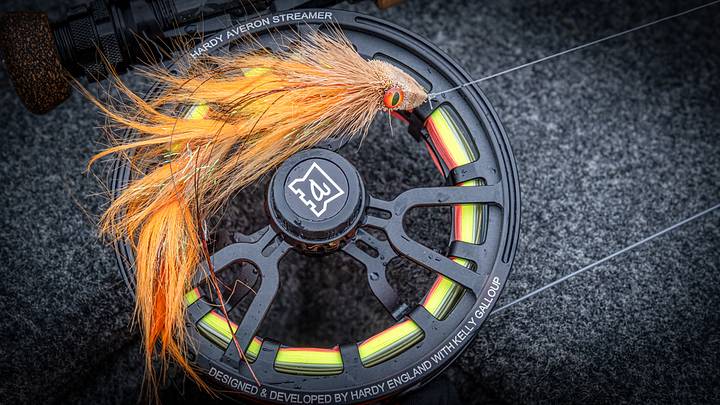
Now, the piece of equipment I get the most excited about: the Hardy Averon “Galloup” Streamer fly reel. I love fly reels. Everything about them. I feel the same way about fly reels as I do knives and watches. When one is well-made and functions at a high level, it gets my attention.
There are different schools of thought about what a fly reel should do. Some anglers believe its primary purpose is to hold line. Others value when craftsmanship and intention are built in.

Do we really need a reel dedicated to streamer fishing?
Yes and no. Can I catch fish on streamers with a basic Pflueger reel? Of course. I’ve done it.
Does the fishing experience improve when the tools I’m using are better? Better design, better materials, tighter tolerances, and improved functionality? For me, it does.
A Purposeful Reel
The Galloup Streamer has become one of my favorite reels to fish. I like its size, weight, large arbor, and overall performance.
But there’s one feature that separates it from other reels I’ve used.
Free-spool Retrieve
The Streamer Averon spool spins freely in the retrieve direction, so all it takes is a quick slap of your hand to get it spinning and picking up line. Combined with the large arbor, this lets you pick up a lot of line in a hurry.
When I first read about this feature, something rang true, but I also thought it leaned a little toward the gimmicky.
A 25-Pound Catfish Changed My Mind
I was fishing the Red River in Winnipeg, Manitoba, specifically targeting big channel catfish. That’s what they do on this river. It’s famous for its channel cat fishery, where you can realistically hook into a 30-pound catfish with a fly rod.
These fish aren’t just an occasional encounter. During the fishing season, from late spring through fall, the catfish are there, feeding on schools of baitfish. When the action gets going, it’s like a striper feed, with fish breaking the surface and birds all around.
More Than I Had Expected
I was standing in knee-deep water, fishing a Clouser. It was my first time on this river, and my first time targeting channel catfish. I cast upriver and let the sinking line carry my streamer down to about 10 feet before I started stripping it back. I didn't know how long it would take to hook a fish, but I didn't expect it to happen within the first 20 minutes. The take was light and subtle, just a tap, but when I set the hook, it wasn't so light and subtle. Right away, the fish took off.

After the first run, I had a mess of fly line on and around me. The fish took off and quickly got on the reel, then turned and headed straight back toward me. I had to strip line in fast, piling it up at my knees. This isn't the cleanest river. Sticks, vegetation, and straws float past you.
Avoiding a Disaster
The line was all around me, and I could see the potential for a disaster if a twig got caught in it. I had the fish under temporary control; my index finger held the line tight by squeezing it between the first joint, this served as my drag.
I usually fight a fish this way, off the reel, with my index finger as my drag. Exceptions to this rule are large saltwater fish that take off on long, blistering runs.
A Big Fish
And now I was hooked into a large freshwater fish that could take off on a long, blistering run. The smart bet was to get it on the reel’s drag.
I needed to pick up the loose fly line off the water as fast as I could.

Where I Lose Fish
When I get distracted, and take focus off the fight of the fish, off the amount of pressure I’m giving and releasing with my drag finger, this is where I usually lose fish.
But I had to clear the coiled line and get it on the reel. Then I remembered Hardy’s marketing hype. All you need to do is slap the spool, and it will pick up your line. I can do that without taking my focus off the fight.
A Simple Solution
I started hitting the spool like I’m trying to spin a basketball on my finger. I didn't look down or take my brain off the fish. The reel did exactly what Hardy said it would do.
I got the line off the water and onto the reel, fast. Fifteen minutes later, I had the fish in the net, and I was a convert to fly fishing for channel catfish in Winnipeg's Red River.
I was also a convert to this reel.

Now the Christmas Part
Two kinds of people are reading this article. Fly anglers looking for Christmas gifts they can casually “suggest” to someone else, and non-anglers trying to find the right gift for the fly angler on their list.
The Latter
If you have a fly angler on your Christmas list, here’s how to tell whether they are into streamer fishing.
The simplest way is to ask them about fishing a streamer with a fly rod. Make them think you are genuinely interested. You should be able to tell by their reaction whether streamer fishing is their thing. If they light up, shocked that you would ask, and suddenly have a whole lot to say about it, you’re probably onto something.
Or ask them who Kelly Galloup is. If they say, “Wait right here, I’ve got one of his streamers,” they’re probably a perfect candidate for this outfit.
The best gifts are the ones someone puts a lot of thought into, and the ones you pick for yourself. It’s time to start thinking about who’s getting what this year. ~ KB
Follow me on Instagram @KenBaldwin7. I share the stories behind my articles, photos from my fly-fishing adventures, lots of Alaskan Brown Bear photography, gear I’m testing, and the outdoor places that inspire them.
"Slow down...listen to the hoppers...be patient with yer wife...eat sardines with hot sauce... catch “Gagger” trout!!!" –Flip Pallot
Some of the equipment reviewed in this article was provided to me at no cost for evaluation. All opinions and assessments are my own.
 Add us as a preferred source on Google

Ken Baldwin is a writer and editor for Fishing On SI, covering fly fishing gear, travel, and all other aspects of a life well fished. His writing and photography have appeared in Men’s Journal, Catch Magazine, Fish Alaska, and American Angler. Ken also created and hosts Season on the Edge, a television series exploring travel, adventure, and culture through fishing that aired on NBC Sports and in seven countries. For twenty years, Ken guided fly anglers in Alaska, keeping him in close proximity to brown bears and launching his path into wildlife photography. That field experience led to his work as a bear guard and consultant on the Netflix documentary Our Planet II, narrated by David Attenborough. His photography was also featured in the series promotion. His career has taken a few memorable turns – professionally dancing and teaching salsa, bartending at the House of Blues on the Sunset Strip, and played the terrorist “Mulkey” in the film Die Hard 2. Ken graduated from the University of Washington with a degree that had absolutely nothing to do with any of the above.
Follow KenBaldwinOnSI