%22%3E%0A%3Cpath%20d%3D%22M-0.00012207%2027.4428L4.82746%2021.6883C7.76264%2023.9283%2011.1226%2024.8552%2014.2702%2024.8552C15.8923%2024.8552%2016.5875%2024.4303%2016.5875%2023.6965V23.6193C16.5875%2022.8469%2015.7378%2022.4221%2012.8413%2021.8428C6.77781%2020.6069%201.46746%2018.869%201.46746%2013.1724V13.0952C1.46746%207.95862%205.48401%204%2012.9185%204C18.1323%204%2021.975%205.23586%2025.1033%207.70759L20.7006%2013.8097C18.1516%2011.9559%2015.1006%2011.1448%2012.6095%2011.1448C11.2578%2011.1448%2010.6399%2011.6083%2010.6399%2012.2648V12.3421C10.6399%2013.0759%2011.3737%2013.5393%2014.2316%2014.08C21.1447%2015.3545%2025.7599%2017.3628%2025.7599%2022.789V22.8662C25.7599%2028.5434%2021.0868%2032%2013.8454%2032C8.36126%2032%203.43712%2030.4552%20-0.00012207%2027.4428Z%22%20fill%3D%22white%22%2F%3E%0A%3Cpath%20d%3D%22M26.9569%2021.0702V20.9929C26.9569%2014.6978%2031.4755%209.9281%2037.79%209.9281C45.2824%209.9281%2048.739%2015.1419%2048.739%2021.5336C48.739%2021.9971%2048.739%2022.5378%2048.7004%2023.0012H35.1638C35.7817%2024.855%2037.2493%2025.8205%2039.1417%2025.8205C40.7252%2025.8205%2042.0383%2025.0867%2043.4286%2023.6578L48.1404%2027.404C46.0548%2030.1074%2043.081%2031.9998%2038.5431%2031.9998C31.63%2031.9998%2026.9762%2027.6357%2026.9762%2021.0895L26.9569%2021.0702ZM40.7638%2019.1391C40.5707%2017.1309%2039.3735%2015.9722%2037.8286%2015.9722C36.2838%2015.9722%2035.3183%2017.2081%2035.0479%2019.1391H40.7638Z%22%20fill%3D%22white%22%2F%3E%0A%3Cpath%20d%3D%22M50.6707%2010.4298H59.4182V14.678C60.6155%2011.8201%2062.5465%209.9663%2066.0224%2010.1208V19.4091H65.0955C61.3879%2019.4091%2059.4182%2021.456%2059.4182%2026.1291V31.4973H50.6707V10.4298Z%22%20fill%3D%22white%22%2F%3E%0A%3Cpath%20d%3D%22M66.2151%2010.4296H75.3875L78.7861%2020.9923L82.2234%2010.4296H91.2799L82.7447%2031.6516H74.7309L66.2151%2010.4296Z%22%20fill%3D%22white%22%2F%3E%0A%3Cpath%20d%3D%22M90.5847%2021.0702V20.9929C90.5847%2014.6978%2095.1033%209.9281%20101.418%209.9281C108.91%209.9281%20112.367%2015.1419%20112.367%2021.5336C112.367%2021.9971%20112.367%2022.5378%20112.328%2023.0012H98.7916C99.4095%2024.855%20100.877%2025.8205%20102.77%2025.8205C104.353%2025.8205%20105.666%2025.0867%20107.056%2023.6578L111.768%2027.404C109.683%2030.1074%20106.709%2031.9998%20102.171%2031.9998C95.2578%2031.9998%2090.604%2027.6357%2090.604%2021.0895L90.5847%2021.0702ZM104.392%2019.1391C104.199%2017.1309%20103.001%2015.9722%20101.456%2015.9722C99.9116%2015.9722%2098.9461%2017.2081%2098.6757%2019.1391H104.392Z%22%20fill%3D%22white%22%2F%3E%0A%3Cpath%20fill-rule%3D%22evenodd%22%20clip-rule%3D%22evenodd%22%20d%3D%22M122.368%204.36764C128.191%20-1.45588%20137.632%20-1.45588%20143.456%204.36764C149.279%2010.1912%20149.279%2019.6324%20143.456%2025.4559L132.912%2036L122.368%2025.4559C116.544%2019.6324%20116.544%2010.1912%20122.368%204.36764ZM125.009%207.55761C124.948%207.86849%20124.916%208.39718%20124.916%209.14566V10.4189C124.916%2011.1832%20124.948%2011.7198%20125.013%2012.0267C125.078%2012.3317%20125.278%2012.6168%20125.617%2012.8762C125.956%2013.1376%20126.403%2013.3316%20126.958%2013.4623C127.512%2013.593%20128.1%2013.6584%20128.837%2013.6584C129.573%2013.6584%20130.217%2013.591%20130.769%2013.4524C131.322%2013.3158%20131.761%2013.1178%20132.086%2012.8604C132.411%2012.6029%20132.605%2012.3178%20132.666%2012.0069C132.728%2011.6961%20132.759%2011.1674%20132.759%2010.4189V9.14566C132.759%208.38134%20132.728%207.84473%20132.662%207.53781C132.597%207.23287%20132.397%206.94971%20132.058%206.68834C131.72%206.42696%20131.272%206.23291%20130.718%206.10223C130.163%205.97154%20129.536%205.90619%20128.839%205.90619C128.102%205.90619%20127.459%205.97352%20126.906%206.11213C126.352%206.24875%20125.914%206.44677%20125.589%206.70418C125.265%206.9616%20125.071%207.24673%20125.009%207.55761ZM130.276%2024.8638C133.876%2024.8638%20135.557%2024.2064%20135.557%2021.862V21.858V21.3155C135.557%2019.6581%20134.516%2018.971%20131.252%2018.3136C130.278%2018.1136%20129.908%2017.9136%20129.908%2017.3136V16.9414C129.908%2016.6543%20130.177%2016.5117%20130.413%2016.5117C130.749%2016.5117%20130.918%2016.7137%20130.918%2016.9414V18.1136H135.391V17.3988C135.391%2015.4563%20134.347%2014.4266%20130.177%2014.4266C127.15%2014.4266%20124.896%2015.3414%20124.896%2017.3711V17.7433C124.896%2019.5155%20125.805%2020.3155%20129.201%2021.0303C129.28%2021.0472%20129.355%2021.063%20129.427%2021.0781C130.329%2021.2674%20130.647%2021.3341%20130.647%2021.9174V22.2897C130.647%2022.6619%20130.546%2022.8045%20130.142%2022.8045C129.67%2022.8045%20129.637%2022.5471%20129.637%2022.262V21.2897H124.894V21.7471C124.894%2024.149%20126.476%2024.8638%20130.276%2024.8638ZM136.424%2024.5569H140.925V14.7355H136.424V24.5569ZM137.955%2013.5019H140.925V6.06064H138.092V9.411L136.193%206.06064H133.359V13.5019H136.193V10.1199L137.955%2013.5019ZM129.269%2012.152C129.204%2012.2688%20129.055%2012.3262%20128.825%2012.3262L128.827%2012.3282C128.604%2012.3282%20128.459%2012.2767%20128.398%2012.1758C128.336%2012.0748%20128.305%2011.8074%20128.305%2011.3758V7.90068C128.305%207.51852%20128.352%207.28684%20128.445%207.20962C128.538%207.13239%20128.675%207.09279%20128.851%207.09279C129.059%207.09279%20129.198%207.14031%20129.265%207.23734C129.332%207.33239%20129.366%207.55416%20129.366%207.90068V11.3203C129.366%2011.7579%20129.334%2012.0352%20129.269%2012.152Z%22%20fill%3D%22white%22%2F%3E%0A%3C%2Fg%3E%0A%3Cdefs%3E%0A%3CclipPath%20id%3D%22clip0_15160_920%22%3E%0A%3Crect%20width%3D%22148%22%20height%3D%2236%22%20fill%3D%22white%22%2F%3E%0A%3C%2FclipPath%3E%0A%3C%2Fdefs%3E%0A%3C%2Fsvg%3E%0A)
Off-Court Revenue: How Much Do Players Make Beyond Their Winnings?
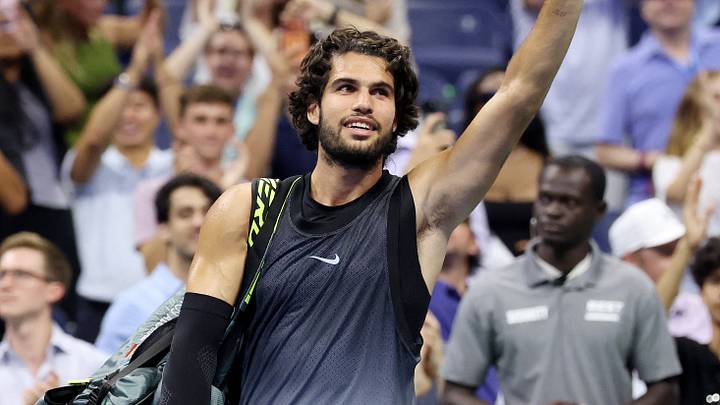
Forbes' 2026 ranking of the sport's highest earners shows just how much money the top-ranked players can make throughout the season. Jannik Sinner topped the list with $58 million in total earnings, but $35 million of that came from outside the lines of the court. Across professional tennis, endorsements, appearances, and business ventures have become just as important to a top player's income as on-court performance.
How Players Earn Money Off-Court
Tennis has undoubtedly become more commercial in recent years, giving professional players various opportunities to earn money off the court. These primarily include endorsement deals, paid appearances, and even their own business ventures.
Sponsorship deals make up the largest portion of this, with companies in apparel, technology, car manufacturing, and consumer goods frequently pairing with athletes to represent their brands. These deals can run anywhere from six to eight figures for the tour’s top players.
Appearance fees and exhibitions add another significant revenue stream for athletes too, whether that’s playing in exhibition matches or meeting with fans. Licensing, memorabilia, and equity investments also generate income for those who have moved beyond traditional sponsorships into actual ownership stakes.
Finally, content and social media deals have become their own category entirely. Players who’ve amassed sizable social media followings can monetize their posting and work with brands to promote paid initiatives. For the sport’s top earners, these off-court opportunities combined can match or exceed the prize money earned on-court, which is a dynamic that’s changing how players think about their careers altogether.
Let’s explore how much each of the sport’s top earners makes on and off-court.
Carlos Alcaraz
Alcaraz brought in an estimated $38 million in off-court income over the past 12 months, the highest off-court total of any player in the sport. In comparison, he won just $15.7 million in prize money during this span.
His portfolio includes Nike, Rolex, Louis Vuitton, Calvin Klein, BMW, and Infosys, among other brands Alcaraz has worked with on a smaller scale. Even finishing second to Sinner in total earnings, Alcaraz’s off-court number alone illustrates how his commercial appeal has even outpaced his on-court dominance.
Jannik Sinner
Sinner’s $58 million made him the highest-earning tennis player in 2026, split between $23 million in prize money and $35 million in endorsements from brands including Nike, Rolex, Gucci, Head, and Allianz. His deals maintained a steady stream of income for Sinner despite missing the US Open with a knee injury.
He also earned $6 million for each of his last two Six Kings Slam exhibition wins in Riyadh, income that Forbes split between prize money and endorsements, given the event's appearance-fee structure.
Novak Djokovic
Djokovic earned an estimated $30.2 million in total earnings in 2026, with $25 million of that coming from off-court business. This gives him the sixth-highest total in the sport despite no longer being its top-ranked player.
His endorsement portfolio includes some of the longest-running partnerships in tennis, such as deals with Head (since 2001) and Lacoste, alongside newer deals with Hublot, Qatar Airways, and Aman Resorts. He’s also built a substantial business portfolio beyond endorsements, holding ownership stakes in ventures like the biotech firm QuantBioRes.
At 39, with his career prize money already the highest in tennis history at nearly $193 million, Djokovic’s off-court earnings show that a player’s commercial value can remain high even years after their on-court dominance has started to fade.
Coco Gauff
Gauff earned an estimated $35.5 million in 2026, giving her the second-highest total among women in the sport. Her off-court income primarily comes from endorsement deals with New Balance, Rolex, and Mercedes-Benz. She’s even topped Forbes’ list of the world’s highest-paid female athletes in past years.
Beyond traditional endorsements, she’s also invested in the women’s basketball league Unrivaled, secured an equity share in Naked Juice, and partnered with a production studio called Religion of Sports. Gauff’s portfolio is an example of how players are moving beyond sponsorship checks into ownership stakes and business ventures of their own.
Aryna Sabalenka
Sabalenka brought in an estimated $36.1 million in total earnings in 2026, with $23 million of that coming from off-court deals with brands. Sabalenka has most notably worked with Nike, Wilson, Sephora, Gucci, and Audemars Piguet, on top of $13.1 million in prize money.
She also became the first-ever Jewelry Ambassador for Material Good, a partnership that created some of the most talked-about looks of the season, including a custom 127-carat gemstone piece she wore at this year’s US Open. Even with a strong season on the court, her $23 million in off-court income illustrates how the sport’s biggest stars can earn much more beyond just prize money.
Iga Swiatek
Swiatek’s $20.5 million in total earnings was skewed heavily towards off-court endeavors in 2026, with endorsement deals accounting for a much larger share of her income than prize money (~$3.6 million). Her portfolio includes On (the Roger Federer-backed apparel brand she joined in 2023), Rolex, Porsche, Infosys, and a new multi-year deal with Coach signed in June 2026.
As a six-time Grand Slam champion, she remains one of the most commercially valuable players in the sport even during seasons where her on-court results dip slightly. Swiatek shows that a strong portfolio of off-court partnerships can protect top players from year-to-year swings in tournament results.
Players Are Earning More Off-Court
Off-court income isn’t a supplemental revenue stream for the top players in professional tennis anymore; it’s now become the larger portion of their income. Zheng Qinwen is a prime example of this, who earned just $600,000 in prize money in 2026 but still finished with $22.6 million in total earnings, almost entirely from endorsements.
As tennis’ audience and commercial reach keep growing globally, fans should expect the gap between what players win and what they actually earn to keep widening, especially for the sport’s most prominent stars.
Note: All earnings cited in this article are estimates based on publicly available information. They are not official confirmations of any player’s income or net worth.
 Add us as a preferred source on Google
Jayson Staiger is a Content Manager at Point Curve with years of experience in journalism, sports writing, and digital content. He has written and edited thousands of articles covering a wide range of sports, with work published by outlets including Tennis Library. Jayson graduated from Syracuse University with a bachelor’s degree in Sport Management and continues to bring his passion for sports and media to his work. Outside of work, he enjoys spending time with family and friends, trying new restaurants, and collecting retro video games.