
Tsitsipas Aims For Return To Tennis' Top Table As Renaissance Continues
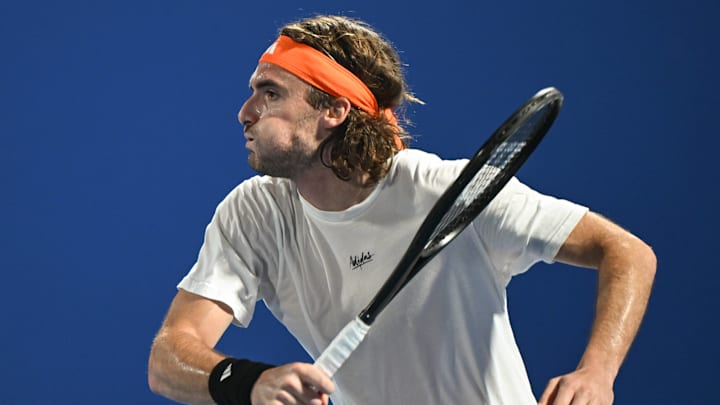
It is worth reminding oneself every now and again that Stefanos Tsitsipas was, in the not too distant past, one of the finest tennis players on the planet.
Over the tumultuous course of the previous two years of the Greek's career, though, that has not always been self-evident. Somewhere around the grass-court swing in the summer of 2025, Tsitsipas' already creaking form collapsed entirely. Grappling with a lower back injury and a persistent struggle for results, the former World No. 3 has spent much of the 16 months since in a downward spiral.
However, a significant coaching change in June of this year, coupled with some positive developments regarding his troublesome back, have arrested that slump and dramatically reversed the trajectory of his plummeting ranking. As he enters the home straight of his 2026 campaign, Tsitsipas opens up about how things have clicked for him again this year, a new chapter for his relationship with his father and former coach, Apostolos, and his ambitions for returning to the summit of the sport in 2027.
A Year Of Two Halves For Tsitsipas
The latter half of the Greek's 2026 season has been a vast improvement on the first. Early exits - comparable to his former elite standards - in tournaments across the opening three months of the year preceded a clay-court swing in which he posted six losses to just five wins. It was a deeply concerning return for a player whose renowned proficiency on the surface had previously led him to a maiden Grand Slam final in Paris and yielded all three of his Masters 1000 crowns (each coming at the prestigious Monte-Carlo Country Club).
The watershed moment came in June of this year, when Tsitsipas finally came to terms with a fundamental change required in his set-up. He ended his career-long coaching partnership with his father, turning instead to Frenchman Thomas Perrin, whom the Greek knows from his time at the Mouratoglou Academy, with Patrick Mouratoglou himself also providing additional assistance as an adviser at key tournaments.
The impact was rapid. After a second-round finish at Wimbledon, Tsitsipas ended a 17-month title drought by lifting the trophy in Gstaad, a little over a month before his excellent and unexpected run to the fourth round of the US Open.
Thomas Perrin's Impact
Prior to Perrin taking charge, the 2019 ATP Finals champion had fallen to as low as 88th in the world rankings, a position that - long-term injury notwithstanding - had seemed inconceivable when the Greek first emerged as one of the leading names of the future, hustling his way to two Grand Slam finals and establishing himself as a regular fixture inside the top 10.
Just four months into Perrin's tenure, and Tsitsipas has more than halved his ranking, currently sitting at 39th in the world. So what is it about this new partnership that was so effective so remarkably quickly?
"He brings calmness into the table and into the team spirit" Tsitsipas explains from this week's ATP 250 tournament in Almaty, Kazakhstan, where he is competing.
"That's what I need, I need someone that understands me, understands my decision making, we can also analyse and process certain things together in a calm manner. It's difficult, it's not an easy thing working with a parent, so having someone like him is a breath of fresh air.
"He's a very collaborative person, and I enjoy very much this collaboration with him, because he's open-minded and he sees things exactly how I see them. He has his own ideas, we exchange those, we're able to form a common ground."
Tsitsipas Parts Ways With His Father As Coach
Deciding to end his coaching relationship with his father, Apostolos, for the second time in his career was a defining moment for Tsitsipas. The pair had split once before in 2024, only to reunite last season. This time around, however, the key difference is that the parting of ways looks set to be permanent.
"I love my father, and I love him as a father," is Stefanos' heartfelt assertion, who is clearly determined this be the headline message of this topic. He goes on to explain that the pair's relationship is now much better for keeping their professional and personal lives separate.
"I want to keep the coaching part out of my relationship with my father, because my relationship now has never been better with my father, now that he's actually only a father, than when he was combined with a coach. It was very difficult for me to separate the coach and the father, and it led to a lot of tension for me.
"I'm a person who's calm, generally speaking, I don't get triggered very easily, and it reached a point where I felt like I could not avoid being triggered. The dynamic really changed in a bad way for me, I really couldn't handle it myself. So for me it's a great thing that we've separated those two roles, we still are in touch every single few days, we do talk and chat and everything, and I really like the way things are right now, I wouldn't change anything."

Physical Fitness Key To Recent Renaissance
While the turning point in Tsitsipas' recent renaissance can be identified primarily as this integral coaching change, the Greek is keen to stress that injury also played a big role in his struggles. Welcome breakthroughs in managing his lower back pain have been a vital ingredient in his revival.
"A healthy body," is his first response when asked what has made the key difference for him between the first and latter halves of this year.
"Last year I didn't have a healthy body and it affected my ranking, it affected my confidence, it affected having to play more than two matches in a tournament, and now suddenly I can play long tournaments, have long runs without my back being affected by it. So that is a big relief for me, that is a big, massive strength that just spreads all over the place, because it allows me to really play my game without too many concerns waking up in the morning.
"And I'm confident, I know I can be back to the top, I genuinely believe that, and to see myself healthy again, that's already a big confidence of its own, because now I know if I want to play every single week, I can play every single week without any concerns."
Tsitsipas Aiming Once More To Be "Hunted", Rather Than "Hunter"
Having surged nearly 50 rankings places in the past four months alone, Tsitsipas is now within striking distance of a significant ranking milestone. Should he be able to rise a further seven places from his current position of 39, the former No. 3 would be back within the cut-off for seeded players at the Grand Slams. This, he explains, is the immediate goal keeping him motivated between now and the close of the season.
"I'm trying to accumulate as many points to end the season with," he replies - with instant clarity - when asked about his plans between now and November.
"Normally I wouldn't be playing that many tournaments, but I really want to maximise on getting as many points and closing the season strongly in order to be seeded at the Grand Slams. That's the goal right now, ending the season within the top 32, getting a good head start to the season and starting a new season fresh with a good rest over the off-season."
Tsitsipas makes it clear that this recent uptick is just the first step in his eventual return to the summit of the sport. Something made evident in his memorable final line of this interview. "This year, I felt like I was just genuinely hunting to get my way back into the place I belong to. I feel like next season is more of me being hunted than me hunting."
Emotional Maturity Opens Page On Next Chapter Of Career
After a somewhat torrid period defined by patchy form and physical setbacks, Tsitsipas has now drawn a line under his recent struggles with an impressive display of emotional maturity. Restructuring his coaching set-up in such a way was a brave move, and it reflects a level of growth in his character that will stand him in good stead for the next chapter of his career.
When he first emerged as a dynamic, long-haired young talent, unafraid of a serve-and-volley, and with an eye-catching, one-handed backhand evoking a certain 80s nostalgia, many observers had Tsitsipas pegged as a 21st century Bjorn Borg.
Such unhelpful comparisons, unsurprisingly, failed to come entirely to fruition. But hey, Borg was finished by the time he was 26. At 28 years young, and with the best part of a decade of experience now under his belt, the Greek remains as hungry as ever. A new era of Tsitsipas' career is under way, and the early signs are highly promising.
 Add us as a preferred source on Google

Jamie Malachy is a freelance tennis journalist, aiming to provide a unique, nuanced and informative analysis of the sport he loves. He has been documenting tennis since 2019, and writing professionally since 2023. Working in collaboration with Tennis Majors and numerous other sports news outlets, personal highlights include covering six Grand Slam singles finals and the 2024 Paris Olympic Games. You can reach him at: jamiemalachy@gmail.com
Follow JamieMalachy