%22%3E%0A%3Cpath%20d%3D%22M-0.00012207%2027.4428L4.82746%2021.6883C7.76264%2023.9283%2011.1226%2024.8552%2014.2702%2024.8552C15.8923%2024.8552%2016.5875%2024.4303%2016.5875%2023.6965V23.6193C16.5875%2022.8469%2015.7378%2022.4221%2012.8413%2021.8428C6.77781%2020.6069%201.46746%2018.869%201.46746%2013.1724V13.0952C1.46746%207.95862%205.48401%204%2012.9185%204C18.1323%204%2021.975%205.23586%2025.1033%207.70759L20.7006%2013.8097C18.1516%2011.9559%2015.1006%2011.1448%2012.6095%2011.1448C11.2578%2011.1448%2010.6399%2011.6083%2010.6399%2012.2648V12.3421C10.6399%2013.0759%2011.3737%2013.5393%2014.2316%2014.08C21.1447%2015.3545%2025.7599%2017.3628%2025.7599%2022.789V22.8662C25.7599%2028.5434%2021.0868%2032%2013.8454%2032C8.36126%2032%203.43712%2030.4552%20-0.00012207%2027.4428Z%22%20fill%3D%22white%22%2F%3E%0A%3Cpath%20d%3D%22M26.9569%2021.0702V20.9929C26.9569%2014.6978%2031.4755%209.9281%2037.79%209.9281C45.2824%209.9281%2048.739%2015.1419%2048.739%2021.5336C48.739%2021.9971%2048.739%2022.5378%2048.7004%2023.0012H35.1638C35.7817%2024.855%2037.2493%2025.8205%2039.1417%2025.8205C40.7252%2025.8205%2042.0383%2025.0867%2043.4286%2023.6578L48.1404%2027.404C46.0548%2030.1074%2043.081%2031.9998%2038.5431%2031.9998C31.63%2031.9998%2026.9762%2027.6357%2026.9762%2021.0895L26.9569%2021.0702ZM40.7638%2019.1391C40.5707%2017.1309%2039.3735%2015.9722%2037.8286%2015.9722C36.2838%2015.9722%2035.3183%2017.2081%2035.0479%2019.1391H40.7638Z%22%20fill%3D%22white%22%2F%3E%0A%3Cpath%20d%3D%22M50.6707%2010.4298H59.4182V14.678C60.6155%2011.8201%2062.5465%209.9663%2066.0224%2010.1208V19.4091H65.0955C61.3879%2019.4091%2059.4182%2021.456%2059.4182%2026.1291V31.4973H50.6707V10.4298Z%22%20fill%3D%22white%22%2F%3E%0A%3Cpath%20d%3D%22M66.2151%2010.4296H75.3875L78.7861%2020.9923L82.2234%2010.4296H91.2799L82.7447%2031.6516H74.7309L66.2151%2010.4296Z%22%20fill%3D%22white%22%2F%3E%0A%3Cpath%20d%3D%22M90.5847%2021.0702V20.9929C90.5847%2014.6978%2095.1033%209.9281%20101.418%209.9281C108.91%209.9281%20112.367%2015.1419%20112.367%2021.5336C112.367%2021.9971%20112.367%2022.5378%20112.328%2023.0012H98.7916C99.4095%2024.855%20100.877%2025.8205%20102.77%2025.8205C104.353%2025.8205%20105.666%2025.0867%20107.056%2023.6578L111.768%2027.404C109.683%2030.1074%20106.709%2031.9998%20102.171%2031.9998C95.2578%2031.9998%2090.604%2027.6357%2090.604%2021.0895L90.5847%2021.0702ZM104.392%2019.1391C104.199%2017.1309%20103.001%2015.9722%20101.456%2015.9722C99.9116%2015.9722%2098.9461%2017.2081%2098.6757%2019.1391H104.392Z%22%20fill%3D%22white%22%2F%3E%0A%3Cpath%20fill-rule%3D%22evenodd%22%20clip-rule%3D%22evenodd%22%20d%3D%22M122.368%204.36764C128.191%20-1.45588%20137.632%20-1.45588%20143.456%204.36764C149.279%2010.1912%20149.279%2019.6324%20143.456%2025.4559L132.912%2036L122.368%2025.4559C116.544%2019.6324%20116.544%2010.1912%20122.368%204.36764ZM125.009%207.55761C124.948%207.86849%20124.916%208.39718%20124.916%209.14566V10.4189C124.916%2011.1832%20124.948%2011.7198%20125.013%2012.0267C125.078%2012.3317%20125.278%2012.6168%20125.617%2012.8762C125.956%2013.1376%20126.403%2013.3316%20126.958%2013.4623C127.512%2013.593%20128.1%2013.6584%20128.837%2013.6584C129.573%2013.6584%20130.217%2013.591%20130.769%2013.4524C131.322%2013.3158%20131.761%2013.1178%20132.086%2012.8604C132.411%2012.6029%20132.605%2012.3178%20132.666%2012.0069C132.728%2011.6961%20132.759%2011.1674%20132.759%2010.4189V9.14566C132.759%208.38134%20132.728%207.84473%20132.662%207.53781C132.597%207.23287%20132.397%206.94971%20132.058%206.68834C131.72%206.42696%20131.272%206.23291%20130.718%206.10223C130.163%205.97154%20129.536%205.90619%20128.839%205.90619C128.102%205.90619%20127.459%205.97352%20126.906%206.11213C126.352%206.24875%20125.914%206.44677%20125.589%206.70418C125.265%206.9616%20125.071%207.24673%20125.009%207.55761ZM130.276%2024.8638C133.876%2024.8638%20135.557%2024.2064%20135.557%2021.862V21.858V21.3155C135.557%2019.6581%20134.516%2018.971%20131.252%2018.3136C130.278%2018.1136%20129.908%2017.9136%20129.908%2017.3136V16.9414C129.908%2016.6543%20130.177%2016.5117%20130.413%2016.5117C130.749%2016.5117%20130.918%2016.7137%20130.918%2016.9414V18.1136H135.391V17.3988C135.391%2015.4563%20134.347%2014.4266%20130.177%2014.4266C127.15%2014.4266%20124.896%2015.3414%20124.896%2017.3711V17.7433C124.896%2019.5155%20125.805%2020.3155%20129.201%2021.0303C129.28%2021.0472%20129.355%2021.063%20129.427%2021.0781C130.329%2021.2674%20130.647%2021.3341%20130.647%2021.9174V22.2897C130.647%2022.6619%20130.546%2022.8045%20130.142%2022.8045C129.67%2022.8045%20129.637%2022.5471%20129.637%2022.262V21.2897H124.894V21.7471C124.894%2024.149%20126.476%2024.8638%20130.276%2024.8638ZM136.424%2024.5569H140.925V14.7355H136.424V24.5569ZM137.955%2013.5019H140.925V6.06064H138.092V9.411L136.193%206.06064H133.359V13.5019H136.193V10.1199L137.955%2013.5019ZM129.269%2012.152C129.204%2012.2688%20129.055%2012.3262%20128.825%2012.3262L128.827%2012.3282C128.604%2012.3282%20128.459%2012.2767%20128.398%2012.1758C128.336%2012.0748%20128.305%2011.8074%20128.305%2011.3758V7.90068C128.305%207.51852%20128.352%207.28684%20128.445%207.20962C128.538%207.13239%20128.675%207.09279%20128.851%207.09279C129.059%207.09279%20129.198%207.14031%20129.265%207.23734C129.332%207.33239%20129.366%207.55416%20129.366%207.90068V11.3203C129.366%2011.7579%20129.334%2012.0352%20129.269%2012.152Z%22%20fill%3D%22white%22%2F%3E%0A%3C%2Fg%3E%0A%3Cdefs%3E%0A%3CclipPath%20id%3D%22clip0_15160_920%22%3E%0A%3Crect%20width%3D%22148%22%20height%3D%2236%22%20fill%3D%22white%22%2F%3E%0A%3C%2FclipPath%3E%0A%3C%2Fdefs%3E%0A%3C%2Fsvg%3E%0A)
Maja Chwalinska's Most Remarkable Roland Garros Story
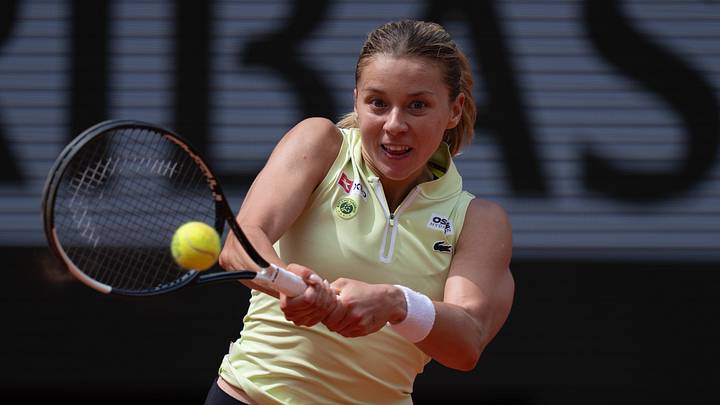
If canvassing the opinion of tennis followers prior to this year's Roland-Garros, few - if any - observers would have predicted that the last Pole standing at the clay-court Grand Slam would have been a little-known qualifier named Maja Chwalińska.
At a tournament that is now synonymous with the dominance of four-time champion and 'Queen of Clay' Iga Swiatek, it would have seemed inconceivable that her relatively obscure young compatriot would be the one to carry the Polish flag into the semi-finals in Paris.
And yet, as we enter the climax of a French Open tournament unlike any other Grand Slam in recent memory, it is 24-year-old Chwalińska who stands on the brink of sporting history.
Chwalińska Setting Records and Rewriting Expectations
Indeed, the rarest of records have already been matched across the course of this fortnight by the young Pole. Her quarter-final victory over experienced Russian shot-maker Anna Kalinskaya means Chwalińska has become just the sixth women's qualifier in the Open Era to reach the last four of a major. Of the previous five, only Emma Raducanu at the 2021 US Open went on to lift the trophy.
Coming into this year's tournament, Chwalińska was ranked at No. 113 in the world, with only one Grand Slam victory to her name in a mere two main-draw appearances. She had won just two WTA Tour-level matches and spent the bulk of her young career thus far competing on the Challenger circuit.
Chwalińska's two big aims heading into Roland-Garros? Firstly, to qualify. Secondly, initially deemed a more long-term project, to crack the top 100.
The Pole has since stormed into the main draw, sweeping qualifying without dropping a set, and now surged superbly into the semi-finals, still having only dropped one set of tennis along the way. Few could argue that Chwalińska has benefited from a kind draw either, having dispatched Olympic champion and Grand Slam finalist Zheng Qinwen in the first round, before recovering from that single dropped set to power past Maria Sakkari in the third.
It would seem, then, that the first of those two aims has more than been met. As for the second, regardless of Thursday's result in the last four, Chwalińska is now projected to break into the top 30 when the new WTA rankings are published on Monday. She has also more than doubled her total career earnings, with a £647,700 pay check for reaching the semis eclipsing the £642,400 she had thus far accumulated across the course of her career.
It appears the Pole may need to re-evaluate her targets for the remainder of the season.
Mental Fortitude and Excellent Clay-Court Style
What has been particularly delightful to witness in Chwalińska's breakthrough this fortnight is the manner in which she has taken apart her opponents. Her game style contains a wonderful array of variety, which helps explain her success in Paris this year. Clay-court tennis rewards ingenuity, with the slower-playing surface and higher-bouncing conditions lending themselves to those players who can best construct points across extended rallies.
Chwalińska's game is full of craft and guile. Not only does she make excellent use of her well-honed drop shots and deft touch in the forecourt, but her looping left-handed style - injected with wonderful amounts of topspin - plays to devastating effect on the clay courts of Paris.
While Kalinskaya, her opponent in Wednesday's quarter-final victory, was out of sorts on unusually blustery conditions inside Court Phillipe-Chatrier, Chwalińska still needed to conquer the mental challenge of staying calm, composed and focused throughout yet another career-best win.
And she did so quite beautifully, regrouping impressively after squandering a 5-1 lead in the first set to clinch the tiebreak, before recovering from a missed opportunity to serve out the match to break her opponent in the next game.
It is a strength of character that has also helped Chwalińska to return to the sport after grappling with depression in 2021, which led to her taking a break from tennis. Having believed she had lost her passion for the game, the Pole was unsure whether she would return to the professional circuit.
Yet, as a greater spotlight was shone on the importance of mental health - especially in an environment as grueling as the tennis tour - Chwalińska found the inner strength and mental fortitude to return to a sport at which she is so evidently uniquely gifted. Even if she is still finding it difficult to process in real time exactly what she is achieving right now.
"I honestly don't know what is going on," were Chwalińska's first words to the crowd after sealing safe passage to the semi-finals.
"I know I repeat myself, but every single match here is kind of crazy for me. I am very grateful. I was definitely nervous. It is normal and I care. I am stressed, of course, but I try to focus on my job and my games. I am happy that I did that.
"I just try to win every match that I am playing, but I am not focusing on confidence. I am playing against the best players in the world, so I will not compare myself to them."
History Beckons in a Roland-Garros Like No Other
But comparing herself to the best players in the world is now something that this player will have to get used to. She is not only playing them in the latter stages of Grand Slams and on the biggest stages in tennis, but she is beating them. Now, all that stands between her and sporting immortality are two matches - both of which, based on the evidence of the previous 10 days, are eminently winnable.
Chwalińska's next opponent will be a fellow left-hander when she takes on Diana Shnaider in the last four after the Russian stunningly dispatched World No. 1 Aryna Sabalenka. A challenging prospect without doubt, but an obstacle the Pole will surely feel capable of overcoming.
In a Roland-Garros that will be remembered for years to come by the litany of extraordinary upsets and unlikeliest of storylines, Maja Chwalińska's narrative is arguably the most remarkable of them all. It has been emblematic of the tournament as a whole, and gives fresh credence to the defining slogan of the French Open - 'Victory belongs to the most tenacious'.
This young Pole has tenacity in abundance, with a devilish lefty game to match. At this year's tournament, predictions are simply a fool's errand. Instead, let us all just bask in at least one more joyous outing for this resplendently refreshing player, as we move into the final throes of this most gloriously chaotic of Roland-Garros tournaments.
 Add us as a preferred source on Google
Jamie Malachy is a freelance tennis journalist, aiming to provide a unique, nuanced and informative analysis of the sport he loves. He has been documenting tennis since 2019, and writing professionally since 2023. Working in collaboration with Tennis Majors and numerous other sports news outlets, personal highlights include covering six Grand Slam singles finals and the 2024 Paris Olympic Games. You can reach him at: jamiemalachy@gmail.com
Follow JamieMalachy