%20%20--%3E%0A%3Csvg%20version%3D%221.1%22%20id%3D%22Layer_1%22%20xmlns%3D%22http%3A%2F%2Fwww.w3.org%2F2000%2Fsvg%22%20xmlns%3Axlink%3D%22http%3A%2F%2Fwww.w3.org%2F1999%2Fxlink%22%20x%3D%220px%22%20y%3D%220px%22%0A%09%20width%3D%2239px%22%20height%3D%2240px%22%20viewBox%3D%220%200%2039%2040%22%20enable-background%3D%22new%200%200%2039%2040%22%20xml%3Aspace%3D%22preserve%22%3E%0A%3Cpath%20fill%3D%22%23FFFFFF%22%20d%3D%22M38.5%2C7H28.2v26h10.3V7z%22%2F%3E%0A%3Cpath%20fill-rule%3D%22evenodd%22%20clip-rule%3D%22evenodd%22%20fill%3D%22%23FFFFFF%22%20d%3D%22M26.1%2C25.5c0%2C5.8-4.1%2C7.5-12.9%2C7.5C3.9%2C33%2C0%2C31.2%2C0%2C25.2v-1.1h11.6%0A%09v2.4c0%2C0.7%2C0.1%2C1.4%2C1.2%2C1.4c1%2C0%2C1.2-0.4%2C1.2-1.3v-0.9c0-1.6-0.9-1.6-3.5-2.2C2.2%2C21.7%2C0%2C19.7%2C0%2C15.3v-0.9C0%2C9.3%2C5.5%2C7%2C12.9%2C7%0A%09c10.2%2C0%2C12.8%2C2.6%2C12.8%2C7.4v1.8h-11v-2.9c0-0.6-0.4-1.1-1.2-1.1c-0.6%2C0-1.2%2C0.4-1.2%2C1.1v0.9c0%2C1.5%2C0.9%2C2%2C3.3%2C2.5%0A%09c8%2C1.6%2C10.5%2C3.3%2C10.5%2C7.5V25.5z%22%2F%3E%0A%3C%2Fsvg%3E%0A)
Antics aside, Serena Williams' majesty on display at U.S. Open
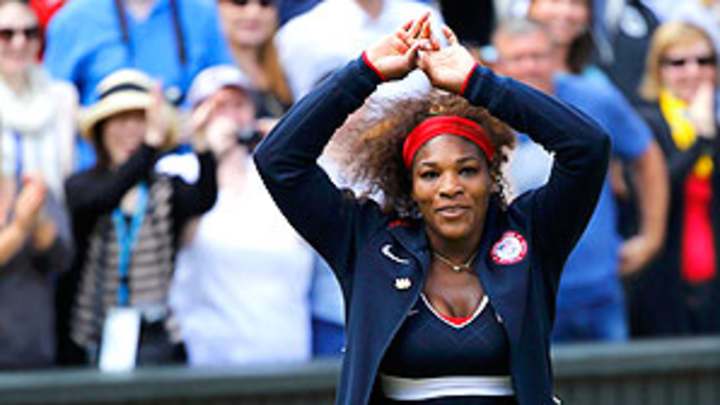
For the first time in a long time there is actually more than a modicum of interest in the woman's side of a Grand Slam tournament. And of course, it's all strictly due to a party of one: Serena Williams.
She's not only being seriously mentioned now as potentially one of the greatest players ever, but more to the immediate point, after the way she whipped through Wimbledon and the Olympics, there is the sense right now that Serena is better than all her competitors by a margin we haven't seen in almost a century -- since Suzanne Lenglen was such a dominant marvel that her popularity forced Wimbledon to move to a huge new grounds.
But, of course, it isn't just that Venus' kid sister is rampant upon the court now, with the most powerful serve ever seen in the women's game. Serena is also always, well, compelling. I don't think we should call her a "soap opera" anymore since soap operas are disappearing, but certainly she is, in 21st century terms, a credible one-woman reality show.
To my taste, Serena's attire on the court is tacky. When she broke out into an exuberant little jig after she annihilated Maria Sharapova to win her Olympic gold medal, Serena was immediately castigated by students of street-gang culture -- which probably has very little overlap with tennis culture -- or doing the so-called "Crip dance," the terpsichorean signature of the murderous gang that competes with the Bloods.
Who knew?
Why can't Serena be more like tennis players are supposed to be: Understated and well behaved, not disappearing from the tour for alleged lack of interest, not cursing out linespeople and chair umpires, not being dismissive in defeat?
Serena's most infamous moments have occurred at the U.S. Open. The undercurrent of race has forever been a constant, and to many fans, she's always teetered on the edge of the outrageous -- starting when she and Venus first appeared on the scene, home-schooled in their studies and tennis-schooled in his own very original fashion by her very outspoken father, Richard. In fact, maybe it still stings the purists that Richard's contrarian ways worked; the proof is in the pudding.
Perhaps because tennis is founded in graciousness, those few more volatile stars stand out all the more, from Lenglen herself and Big Bill Tilden, to Pancho Gonzales; Connors, McEnroe and Nastase; Billie Jean King in her way, Martina Navratilova in hers. Serena Williams is in that crowd, but as this U.S. Open approaches, it is not her persona, but her majesty that is front and center court.
 Add us as a preferred source on Google
Frank Deford is among the most versatile of American writers. His work has appeared in virtually every medium, including print, where he has written eloquently for Sports Illustrated since 1962. Deford is currently the magazine's Senior Contributing Writer and contributes a weekly column to SI.com. Deford can be heard as a commentator each week on Morning Edition. On television he is a regular correspondent on the HBO show Real Sports With Bryant Gumbel. He is the author of 15 books, and his latest,The Enitled, a novel about celebrity, sex and baseball, was published in 2007 to exceptional reviews. He and Red Smith are the only writers with multiple features in The Best American Sports Writing of the Century. Editor David Halberstam selected Deford's 1981 Sports Illustrated profile on Bobby Knight (The Rabbit Hunter) and his 1985 SI profile of boxer Billy Conn (The Boxer and the Blonde) for that prestigious anthology. For Deford the comparison is meaningful. "Red Smith was the finest columnist, and I mean not just sports columnist," Deford told Powell's Books in 2007. "I've always said that Red is like Vermeer, with those tiny, priceless pieces. Five hundred words, perfectly chosen, crafted. Best literary columnist, in any newspaper, that I've ever seen." Deford was elected to the National Association of Sportscasters and Sportswriters Hall of Fame. Six times at Sports Illustrated Deford was voted by his peers as U.S. Sportswriter of The Year. The American Journalism Review has likewise cited him as the nation's finest sportswriter, and twice he was voted Magazine Writer of The Year by the Washington Journalism Review. Deford has also been presented with the National Magazine Award for profiles; a Christopher Award; and journalism honor awards from the University of Missouri and Northeastern University; and he has received many honorary degrees. The Sporting News has described Deford as "the most influential sports voice among members of the print media," and the magazine GQ has called him, simply, "The world's greatest sportswriter." In broadcast, Deford has won a Cable Ace award, an Emmy and a George Foster Peabody Award for his television work. In 2005 ESPN presented a television biography of Deford's life and work, You Write Better Than You Play. Deford has spoken at well over a hundred colleges, as well as at forums, conventions and on cruise ships around the world. He served as the editor-in-chief of The National Sports Daily in its brief but celebrated existence. Deford also wrote Sports Illustrated's first Point After column, in 1986. Two of Deford's books, the novel, Everybody's All-American, and Alex: The Life Of A Child, his memoir about his daughter who died of cystic fibrosis, have been made into movies. Two of his original screenplays have also been filmed. For 16 years Deford served as national chairman of the Cystic Fibrosis Foundation, and he remains chairman emeritus. He resides in Westport, CT, with his wife, Carol. They have two grown children – a son, Christian, and a daughter, Scarlet. A native of Baltimore, Deford is a graduate of Princeton University, where he has taught American Studies.