
Buyer Beware with Online Purchases
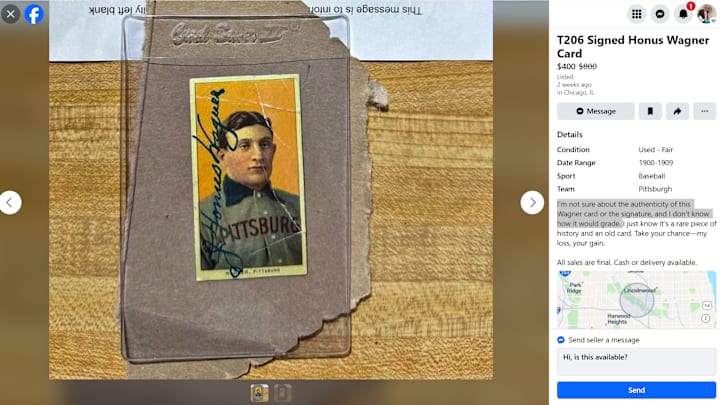
The first rule of buying sports cards online has always been Buyer Beware! However, the rule now comes with a high-tech twist. In the old days, cards didn't always arrive as advertised. In some cases, such cards were accidentally misrepresented by the seller. In other cases, the misrepresentation might have been intentional. For example, a seller might knowingly sell fake Michael Jordan rookie cards as real, though thankfully eBay has various authentication and buyer protection measures in place to mitigate the harm to buyers of such cards.
Now, however, there is a brand new way your card may not arrive as advertised: AI. Just as artificial intelligence has expanded its footprint in nearly all other aspects of our lives, such is the case with card collecting as well.
RELATED: The Ten Essential Topps Baseball Cards of the 1970s
I first became aware of the trend when a Dwight Gooden card I'd wanted for years finally turned up in an eBay search: Doc's tough 1999 Topps MVP Promotion. As the price was only $1.79, I bought the card without a moment's hesitation. Unfortunately, there was a problem.

Upon closer inspection, I realized the card shown was simply the standard and widely available Doc Gooden card from 1999 Topps. The seller, who acknowledged the listing was AI-generated, provided an immediate refund, so no harm done. However, the experience definitely put me on high alert, knowing listings were no longer just prone to errors by human sellers but by bots as well.
Fast forward to a few days ago when I decided it was time to add the 1978 Topps Zest Manny Mota to my collection. I was initially pleased to see several of these in my search, many at very low prices. However, once again, there was a problem. Most of these "Zest" listings were simply the standard Topps card #228 of Mota. Once again, AI was the culprit.

Finally, I was working on an article yesterday evening regarding some of the toughest Topps cards of the 1970s. As one issue I covered was the 1970 Topps Cloth Stickers set, I was shocked to see the set's Ron Perranoski card listed on eBay for $2. After all, this is a card that should go for thousands of dollars! (Somewhere between 1 and 3 total are believed to exist.)

RELATED: The Impossible Cards of the 1970s
Could this just be an innocent mistake--human error--you might wonder? Well, seeing as the card is listed as #NNO (no number), reflecting the fact that the 1970 Topps Stickers were blank backed, it was easy enough to see this card very much had a back numbered 226.

The good news for card buyers is that even buying all three of the above cards by accident would amount to less than a $10 error. Not only that, but I'm confident all three sellers would happily issue prompt refunds. The bad news is that these same sort of erroneous listings can just as easily occur with cards listed as much higher prices. Where buyers lack the Hobby knowledge to identify such errors and request refunds, they may well find themselves permanently on the wrong end of some very bad deals.
A wrinkle I'll add to the topic is that in each case I've covered, the actual cards were incredibly common. They all came from standard Topps flagship sets. Yet in each case, the AI tools didn't default to the most likely option. They went with the least likely (and most expensive) option. In other words, it's unlikely the good deals and bad deals will balance out.
So once again, as always really, the lesson remains Buyer Beware. Only now the person behind a problematic listing may not be a person at all. Over time, it's very likely AI will improve at identifying cards. Until then, just remember to be careful out there.
 Add us as a preferred source on Google
Jason A. Schwartz is a collectibles expert whose work can be found regularly at SABR Baseball Cards, Hobby News Daily, and 1939Bruins.com. His collection of Hank Aaron baseball cards and memorabilia is currently on exhibit at the Atlanta History Center, and his collectibles-themed artwork is on display at the Honus Wagner Museum and PNC Park.