
Why Are Vintage Baseball Card Checklists So Expensive?
In this story:
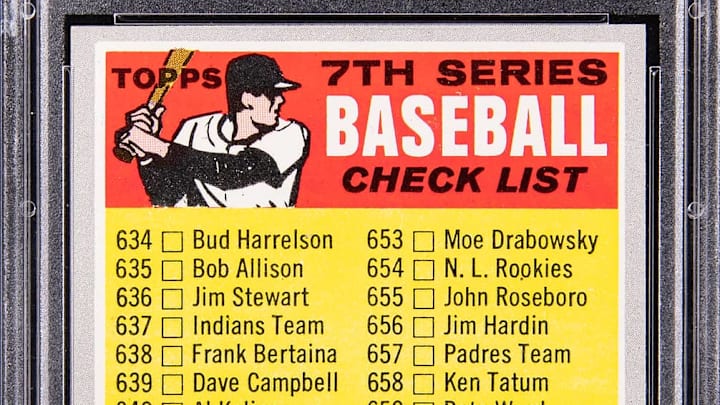
For decades, checklists were the most overlooked cards in a set. Checklists weren’t fun and they weren’t aesthetically pleasing. Most collectors didn’t even treat them like real cards. They were simply tools meant to be scribbled on, creased, and eventually thrown into the trash.
Fast forward to today, and the once-ignored pieces of cardboard are now some of the most expensive cards in each vintage set. When you look at recent sales, the numbers are eye-opening. A 1971 Topps baseball Checklist in a PSA 10 sold for $23,400. Even a 1969 Topps vintage basketball checklist in a PSA 10 also for more than $20,000.

For the price of a single high-end checklist, vintage collectors could instead secure a 1951 Bowman Mickey Mantle rookie (PSA 3, $13,200) or a 1954 Topps Hank Aaron rookie (PSA 7, $14,300). So why do collectors spend hard-earned hobby dollars on a checklist when for the same price you could own the most iconic cards in history? The baseball card market doesn’t always make sense, but we will examine the factors that explain crazy-high checklist prices.
The PSA Set Registry Drives Up the Price of Checklists

In many ways PSA has taken over the baseball card hobby, and its set registry is one driver of that influence. The PSA Set Registry allows collectors to showcase their graded collections online. This creates an intense competition within the PSA Set Registry rankings and there becomes competition for the title of the “best” set in existence.
If someone is building a 1956 Topps set in PSA 8 or better, they need the checklist in PSA 8 or better. When only a few PSA 8 checklists exist at that level, bidding wars happen between set builders. The value of the checklist is in no way attached to the image of the actual card. The checklist has value because of its impact on leaderboard positioning and set completion. This is why checklists often demand higher prices than Hall of Famer’s cards from the same set.
People Used to “Check” Checklists, Creating Scarcity

Many vintage checklists were written on in pen or pencil as collectors tracked their sets. Kids checked off names, circled star players, or scribbled across them. Unlike a Mickey Mantle or Willie Mays card, a checklist wasn’t protected. Many were thrown away after they served their purpose.
As a result, clean, unmarked examples of checklists from key sets are legitimately scarce. 1,349 of the 1956 Topps Checklist “1/3s” have been graded by PSA, but only ten copies have ever received a PSA 9 (with none higher). 191 checklists from 1968 Topps have been graded by PSA, with only one PSA 10 in existence.
Checklists are Not the Only Oddly Expensive Vintage Baseball Cards

A Bill Miller 1952 Topps #403 PSA 9 card sold for $24,400 on February 21st, 2026. This high sale has almost nothing to do with the player and has everything to do with set collectors. Bill "Lefty" Miller was a journeyman pitcher who finished his career with a 6-9 record and a 4.24 ERA. He pitched 41 games in the major leagues.
The value of Bill Miller’s 1952 Topps #403 mirrors that of vintage checklists. As a "high number" card, it was printed in significantly lower quantities than the rest of the set. This scarcity is reflected in its grading history.
Of the 513 copies submitted to PSA, only four have achieved a PSA 9 grade, with none higher. Consequently, prices are driven upward by a niche but dedicated segment of the hobby (high-end vintage set collectors) who view this card as a critical hurdle to completing their collection.
 Add us as a preferred source on Google
David is a collector based in Georgia and a lifelong fan of the New York Yankees, New York Giants, and New York Knicks. He is an avid sports card collector with a strong passion for vintage baseball cards and vintage on-card autographs. David enjoys obtaining autographs through the mail and loves connecting with other knowledgeable collectors to discuss the history and evolution of the hobby. He also previously wrote about the New York Giants for GMENHQ.com