
Arkansas Basketball's Inside Offense Could Become a Major Weapon
In this story:
FAYETTEVILLE, Ark. — Arkansas basketball does not need to rely exclusively on perimeter shooting to overwhelm opponents. With its combination of athletic guards, versatile forwards and developing frontcourt players, the Razorbacks have another potential advantage that could become increasingly important as the season progresses.
They can attack the basket.
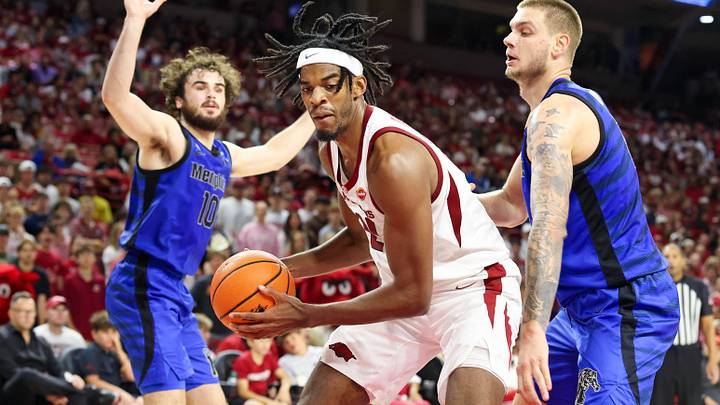
Arkansas offered a glimpse of that potential in its 93-81 exhibition victory over Memphis on Wednesday, scoring 54 points in the paint and throwing down 13 dunks. The Razorbacks finished with 18 assists and shot 53.7% from the field, according to the official box score and game recap.
The performance represented a significant improvement from Arkansas' exhibition against Gonzaga four days earlier. The Razorbacks struggled to convert around the basket in that 76-72 victory, making just five of 16 layup attempts, according to the Gonzaga game recap.
Arkansas has the second-most talented bench in college basketball behind Duke.
— Jon Rothstein (@JonRothstein) October 29, 2026
Thompson, Toure, Andrews, Maker, and Ourigou are all talented and capable.
Tremendous depth and long-term potential with this team.
The difference was not simply the number of points Arkansas scored. It was the team's ability to turn its athleticism into efficient offense near the rim.
If the Razorbacks can maintain that approach against regular-season competition, interior scoring could become one of the most dependable parts of their offense.
Arkansas has multiple ways to score inside
One of the most encouraging aspects of Arkansas' performance against Memphis was that its interior production did not depend on a single player.
Billy Richmond III and Jordan Smith Jr. each scored 17 points, while Miikka Muurinen finished with 10 points and 12 rebounds. Davion Thompson added 13 points, giving Arkansas another productive option as the Razorbacks spread the scoring across the lineup.
The guards' ability to get downhill is especially important. When Richmond and Smith put pressure on the defense, opposing players must decide whether to stay attached to their assignments or help protect the basket.
Arkansas freshman guard Jordan Smith Jr. in an exhibition win against Memphis:
— B/R Hoops (@brhoops) October 29, 2026
17 PTS | 7-11 FG | 3 REB | 2 AST | 2 BLK | 18 MIN pic.twitter.com/jAT5AZgfv7
That decision creates opportunities for teammates.
A defender who steps toward a driving guard can leave space for a cutter, a lob or a rebounder attacking the basket. When the defense stays home, the ballhandler has a better chance to finish at the rim.
Arkansas has the personnel to exploit both choices. Richmond brings athleticism and finishing ability, while Smith showed against Memphis that he can create offense after a difficult shooting performance against Gonzaga.
The Razorbacks do not need every possession to end in a dunk. They need to make the defense account for the possibility of one.
The frontcourt can turn pressure into easy points
Arkansas' frontcourt provides another important part of the equation.
Cooper Bowser, who transferred from Furman, gives the Razorbacks an experienced college player who can finish around the basket and compete for rebounds. Muurinen offers size, mobility and the ability to move quickly into scoring positions. Freshman Maper Maker also showed his offensive potential against Memphis, scoring seven points in the first half.
Bowser had nine points and 10 rebounds against Gonzaga before recording eight rebounds and three blocks against Memphis. Muurinen followed his 10-point performance against Gonzaga with a double-double against the Tigers.
SHOWTIME MUURINEN 🤯 pic.twitter.com/7bP4iWc30o
— Arkansas Men’s Basketball 🐗 (@RazorbackMBB) October 29, 2026
Their contributions give Arkansas options beyond asking guards to create every scoring opportunity.
Bowser can provide a target near the rim, while Muurinen's movement and athleticism can create opportunities when defenders lose track of him. Maker gives the coaching staff another young player to develop as the rotation takes shape.
The challenge is turning those individual tools into consistent possessions. Arkansas must make good entry passes, establish position before the defense is set and avoid forcing difficult attempts against multiple defenders.
When the pieces work together, the frontcourt can make life easier for the entire offense.
Rim pressure can open up the perimeter
Interior scoring also affects what happens outside the paint.
If Arkansas consistently attacks the basket, opponents may be forced to send additional defenders toward the lane. That can create open perimeter shots for players who are ready to catch and shoot.
The reverse is also true. If Arkansas begins making outside shots, defenders may become more reluctant to help off the perimeter, creating additional room for drives and cuts.
That relationship could be important for a team still establishing its offensive identity.
Nearly done at Bud Walton with Arkansas leading 85-70 at the final media timeout. Billy Richmond III and Jordan Smith with 17 points each, Jeremiah Wilkinson with 11 and Miikka with a double-double (10pts, 12 reb) pic.twitter.com/qLBsvgZtHo
— Pig Trail Nation (@PigTrailNation) October 29, 2026
Arkansas shot just 28.6% from three-point range against Memphis, making six of 21 attempts. The Razorbacks still scored 93 points because they found other ways to generate efficient opportunities.
That does not mean perimeter shooting is unimportant. Arkansas will face opponents capable of protecting the paint while contesting drives, and the Razorbacks will need to punish defenses that leave shooters open.
The more useful takeaway is that Arkansas has a potential alternative when the outside shots are not falling. Attacking the basket can keep the offense productive while creating better looks from the perimeter later in the game.
The next challenge is doing it against bigger frontcourts
Two exhibition wins offer encouraging signs, but they do not establish that Arkansas will dominate the paint throughout the season.
Gonzaga presented a different interior challenge, using its size to contest shots and make finishing difficult. Memphis, meanwhile, showed that an opponent can still score inside against Arkansas, a concern that will be examined separately as the Razorbacks prepare for the regular season.
The next step is proving that the offense can continue to generate high-quality opportunities against more experienced frontcourts.
Arkansas will need strong spacing, timely passes and disciplined decisions when defenders collapse toward the rim. It also must finish through contact and convert free throws when opponents resort to fouling to stop drives.
Jordan Smith Jr. went from scoring a single point against Gonzaga to 17 against Memphis. The difference? Being more aggressive.
— Pig Trail Nation (@PigTrailNation) October 29, 2026
Smith says the Arkansas coaching staff encouraged him to be himself after a quiet first exhibition.
Full press conferences from John Calipari, Smith… pic.twitter.com/IklIrzQMNM
The Razorbacks have already shown flashes of what their interior offense can become. Against Memphis, their combination of transition opportunities, cuts, dunks and efficient finishing produced 54 points in the paint.
That is a promising foundation for a team with this much athleticism.
Arkansas does not have to abandon the perimeter to become a strong interior team. It needs to make attacking the basket a consistent threat, forcing opponents to defend the entire floor.
If the Razorbacks can sustain that pressure when the regular season begins, their inside offense could become more than an occasional highlight. It could be one of the foundations of their success.
 Add us as a preferred source on Google
