
Bill O'Brien Addresses Significance of Revenue Sharing for Future of BC Football Program
In this story:
Since June, the concept of revenue sharing has swept across the NCAA landscape in a rapid, convoluted manner following the House vs. NCAA settlement, which resulted in the ability for universities to begin directly compensating student-athletes. The settlement allows schools to individually choose whether to opt in to or out of revenue sharing for the upcoming season.
Realistically, if a Power Conference school refused to utilize the proposed maximum funds allocated to its program—which is set at $20.5 million for 2025-26—that program would backtrack from a recruiting standpoint to an extreme degree. As a result, its product would worsen, which could generate a cyclical nature of failure.
That is why just about every Power Conference school intends to commit to revenue sharing, including Boston College, according to NIL-NCAA.com.
The litigation of the settlement also states that the total cap for these funds could increase to as high as $33 million by 2035, a $12.5 million increase across the next decade.
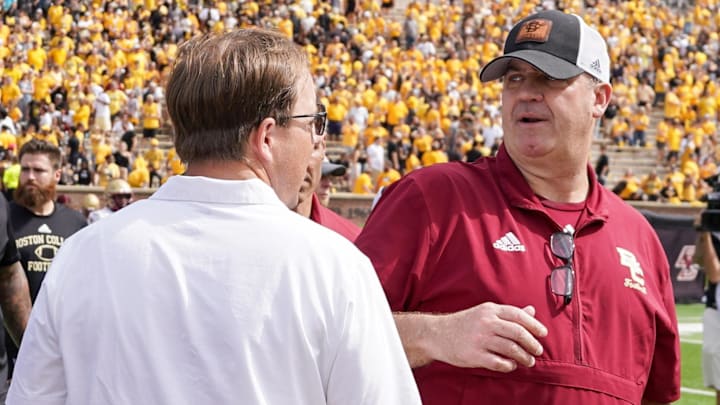
Now that a few months have passed since the initial settlement was finalized, BC head coach Bill O’Brien has taken some time to reflect on the new decisions which will dictate the next era of college athletics.
After Tuesday’s fall training camp practice, O’Brien shared his thoughts on what he has learned about revenue sharing and the individuals who have helped him get a better grasp of the recent settlement.
I also asked if there was anything O'Brien has learned about revenue sharing now that there has been more time to explore the intricacies of what it means. He had some very insightful, informational things to say.
— Graham Dietz (@graham_dietz) August 19, 2025
Read this thread for more on O'Brien's thoughts: pic.twitter.com/VNFiEAuF7a
As it pertains to Boston College, which has struggled to compete with its Atlantic Coast Conference foes in NIL (name, image, and likeness), O’Brien pointed to revenue sharing as an opportunity to level the playing field in terms of recruiting, first and foremost.
“You know, we have guys that are making some money, but we also have an incredible academic institution here,” O’Brien said.
Ever since O’Brien came to the Heights in the 2024 offseason, he has stood on a recruiting pitch which prioritizes the benefits of an institution like BC. His focus is character development, academics, giving back to the greater Boston community, all while still owning a position in a Power Conference, the ACC.
However, BC’s NIL collective, Friends of the Heights, simply does not have the financial resources to compete with schools like Clemson, Florida State, Georgia Tech, and North Carolina—just to name a few of the programs that BC competes with on a yearly basis. After-all, money is mainly what prospective student-athletes are after, at least to some degree.
But with revenue sharing involved—where each school is allocated the same sum of funding—O’Brien’s pitch has far more backing to it.
“If you have a chance to maybe get compensated a little bit, plus have all those things for you, that's a hard thing to turn down as we move into the future,” O’Brien said. “So I'm happy with where we are.”
There are still hoards of minuscule details that revolve around revenue sharing which are unclear to the general public, and O’Brien was first to note that when he addressed the topic after Tuesday’s practice.
“What I've also learned is that a lot of people on the outside don't really understand it,” O’Brien said. “It is hard to understand.”
But if revenue sharing does, in fact, play out with every component of what has been promised of the settlement’s new guidelines—with each school receiving $20.5 million to divvy up for its athletics programs on an individual basis—it gives institutions like BC a major boost in recruiting for a sport like football, where it could not compete before, especially with NIL.
NIL as an addendum to revenue sharing will still be a concern for an athletics program like BC’s. The total amount of NIL dollars invested in college football “blue bloods,” like Alabama, Michigan, Ohio State, and LSU, among others, is vastly disproportionate to what BC has to offer.
"We're not going to be three yards in a cloud. We're going to run the football, but we got to be an exciting team to watch. If people want to come to watch us, we got to continue to market the program. The athletic department is working hard to market the program." https://t.co/1VtJX9OlVE
— Graham Dietz (@graham_dietz) August 19, 2025
But revenue sharing is a step in the right direction—or even a step back, in some sense, to the landscape prior to NIL.
Before NIL, when student-athletes could not compensate for their name, image, or likeness, the success and pedigree of a college football program was the only factor that played into how it could recruit.
That includes the types of coaches within the program’s ranks, and BC now checks that box with a former National Football League head coach, and one that has over 30 years of experience coaching in the pros and at the collegiate level combined, at the helm.
Revenue sharing does not fix the entire disparity between programs with massive NIL collectives and those with relatively smaller pools of donors. But it should have the power—through the equal resources provided to each school—to fix some of the problems that BC has faced with its lack of NIL funds compared to the aforementioned “blue bloods.”
The dollars, to an extent, are not shielded from the public entirely anymore, and NIL collectives are not the sole source from which student-athletes can compensate. Additional factors related to the school’s pedigree, such as academic, social, and location, might now come into play in recruiting more so than people might think.
Using the model of making BC Boston's "fifth" sports team is also something O'Brien intends to do, and any former or current professional athlete can attest to the excitement and pressure of building a winning culture with Boston's fanbase rallied behind them.
 Add us as a preferred source on Google
Graham Dietz is a 2025 graduate of Boston College and subsequently joined Boston College On SI. He previously served as an editor for The Heights, the independent student newspaper, from fall 2021, including as Sports Editor from 2022-23. Graham works for The Boston Globe as a sports correspondent, covering high school football, girls' basketball, and baseball. He was also a beat writer for the Chatham Anglers of the Cape Cod Baseball League in the summer of 2023.
Follow graham_dietz