
Pittsburgh Aftermath: Boston College Football's Worst Loss Signals Bigger Issues
In this story:
If anybody is still trying to wrap their head around the latest chapter of Boston College football miseries, I’m right there with you. The latest episode didn’t just upset. It stunk. Period.
It makes you wonder what is really happening behind the scenes—how a team with a former NFL head coach, who was a coordinator under Bill Belichick, a quarterback who was recruited to play for Nick Saban originally, and a roster which, relatively speaking, didn’t substantially lose depth after posting a 7-5 record and reaching the seven-win mark in the regular season for the first time since 2018, has catapulted backward into the very bottom of the Atlantic Coast Conference.
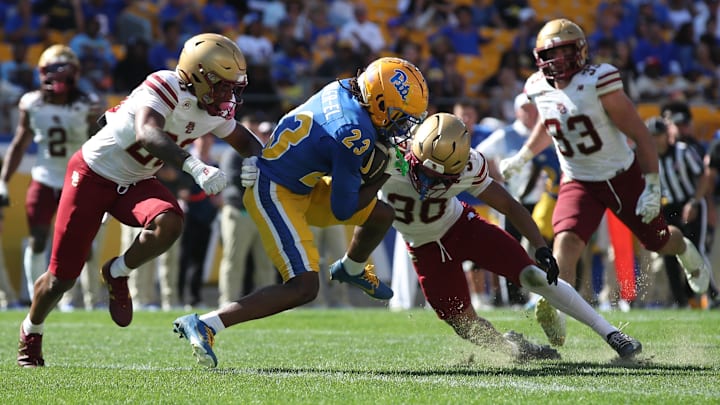
On Saturday, BC fell to 1-4 on the season with an 0-3 conference record after getting blown out at Pittsburgh against true freshman quarterback Mason Heintschel in his first-ever collegiate start. Heintschel looked like he should have been the Panthers’ starter since the beginning of the season, registering 323 passing yards (30-for-41), four touchdown passes, and 42 rushing yards on 10 carries.
He was named the ACC Rookie of the Week on Monday for his superb performance.
The Eagles didn’t stand a chance in the game after the second quarter, down 31 to zip and kicking the ball away to start the second half.
If it weren’t for a nine-play, 80-yard scoring drive in garbage time courtesy of third-string quarterback Shaker Reisig and freshman tight end Kaelan Chudzinski, BC would have suffered its first shutout loss since it fell to Notre Dame, 44-0, on Nov. 19, 2022—when the Eagles went 3-9 under former BC head coach Jeff Hafley.
Reverting again to Saturday, though, even through the blinding glare of the TV mounted up to my living-room wall, I witnessed a team which gave up on each other during the game.
Upon Further Review: Pitt 48, Boston College 7
That wasn’t the case when BC fell on the road to Michigan State, 42-40, in double overtime just a month ago, or even in its losses to Stanford and California. Quite the contrary, if you ask me.
Back then, faith still hovered in the Chestnut Hill, Mass., air like a soft mist, unrelenting to outside pressure. That mist dissipated on Saturday, vanished like ashes floating into the night sky from a bonfire.
It is one thing to keep the faith of your fanbase intact, but that began to falter after the Eagles’ last home loss to Cal, when they blew a three-point lead with 1:30 remaining in the game and ensuingly turned the ball over inside of the Golden Bears’ endzone on what could have been a game-winning passing score.
But when the players lose faith in each other—or, frankly, the coaching staff—that is when the tumble starts to cement in an irreversible manner. From a performance and energy standpoint, Saturday’s loss saw BC take a closer step toward stumbling down that kind of path.
Beyond the X’s and O’s, there are the very basic fundamentals of playing any sport, and that starts with the team. Even a high school football coach will say that football is the ultimate team sport.
In football, arguably more so than any other sport, it takes all 11 players on the field, on offense, defense, or special teams, and the 50 or so guys on the sideline in a full, collective effort to beat the opposition. It can’t be one, two, three, or even 10 guys that are invested in that operation. It has to be full go, from every player on the field, at all times. Not for two or three quarters, but for all four.
BC head coach Bill O’Brien has this proverb about winning and losing that applies to when BC does not come out on top in close games—those 10-or-less-point losses in which one or two plays ultimately makes or breaks BC.
“We need to learn how not to lose before we can learn to win,” O’Brien has said on multiple occasions.
But after this blowout, there is another proverb that might apply even better: BC must learn how to lose as a team before it can start to win again, because it did not show any sign of being a team on Saturday in Pittsburgh, Pa., even during a loss.
Just last season, the Eagles looked nearer to being an eight-win-or-more program than one that would not be able to qualify for a bowl game. Nobody could have expected a downfall as adverse as this current slide, and with a difficult remaining strength of schedule—not that any game this season has been a cupcake, per se, besides Fordham—O’Brien will have to regroup his troops on the fly.
First and foremost, BC needs to get healthy. O’Brien can talk all he wants about players exuding a next-man-up mentality, but in a conference as competitive as the ACC, consistently playing second- and third-stringers won’t equate to success in any sort of measure.
It is costing the underclassmen—who are being thrust into high-intensity situations rather than focusing on their development—to a major degree, and that makes an impression on BC’s future recruiting classes as well.
I am aware that O’Brien can’t just wave a magic wand and get all of his starters who have been sidelined for several games back—notably starting cornerbacks Syair Torrence and Amari Jackson, linebacker Daveon “Bam” Crouch, defensive end Quintayvious Hutchins, defensive lineman Kwan Williams, and wide receiver Jaedn Skeete—but Eagles’ fans can’t be truly upset with the product when the tools for production have been utterly decimated.
That is just a bad stroke of luck, at the end of the day, but health is arguably hurting BC more than any other factor.
Everything BC Head Coach Bill O'Brien Said After Pitt Loss
Secondly, the Eagles have to play more to their strengths every game—use the positives of one game and carry it on to the next, which builds momentum in the areas that the offense and defense can rely on.
Running the football with Turbo Richard through the B and C gaps, or on outside-zone schemes and pitches, was effective against Cal and resulted in the longest touchdown run of the season amid a 171-yard, two-touchdown performance for the second-year back.
Why did O’Brien give Richard the ball just six times on Saturday against Pitt, especially considering starting left tackle Jude Bowry returned from injury after missing the game versus Cal in which Richard didn’t even need Bowry to explode individually?
Just look back at the tape and see how the Eagles were successful in the run game against the Golden Bears. It doesn’t take a genius to see that if Richard gets in open space with the ball, he is arguably the most dangerous player on the offense. Utilize him—every game, every series. Don’t think twice.
Pitt’s defensive front wreaked havoc against BC because it forced the Eagles into long third downs early and often—on the first two drives alone, BC faced a 3rd-and-12, a 3rd-and-10, and a 3rd-and-6 and converted just once. Running the ball through the guards and center has been less effective for the Eagles, so why even try it when running through the tackles has sufficed just fine?
I, for one, don’t enjoy preaching pessimism. I like to cover a team that at least puts up a fight, rather than one that gets down on itself over and over again as a result of painful, consecutive losses.
But it was quite obvious for anybody watching the game on Saturday that there was a disconnect growing like a weed amongst the players and coaches. Addressing those problems head-on by putting them out in the open—rather than suppressing them by reverberating the same “one-play-at-a-time” message like a broken record—is a better start toward solving this recurring nightmare for the BC football program.
 Add us as a preferred source on Google
Graham Dietz is a 2025 graduate of Boston College and subsequently joined Boston College On SI. He previously served as an editor for The Heights, the independent student newspaper, from fall 2021, including as Sports Editor from 2022-23. Graham works for The Boston Globe as a sports correspondent, covering high school football, girls' basketball, and baseball. He was also a beat writer for the Chatham Anglers of the Cape Cod Baseball League in the summer of 2023.
Follow graham_dietz