
The Reason Behind Bill O’Brien’s Shotgun-Heavy Offense at Boston College
In this story:
Something very simple that happens on every single play of a football game is a transaction of the ball from the center, or the snapper in some cases, to the player hiking the ball — in most instances, the quarterback.
With that being said, there isn’t one particular way for this transaction to occur, which is where terms like “shotgun” and “under center” come into play.
The shotgun formation is an offensive setup where the quarterback lines up approximately five to seven yards behind the center instead of directly underneath, receiving the snap through the air.
The extra distance gives the signal caller a deeper view of the defensive alignment and a bit more time to locate an open receiver down the field before the pass rush starts to make its way through to the pocket.
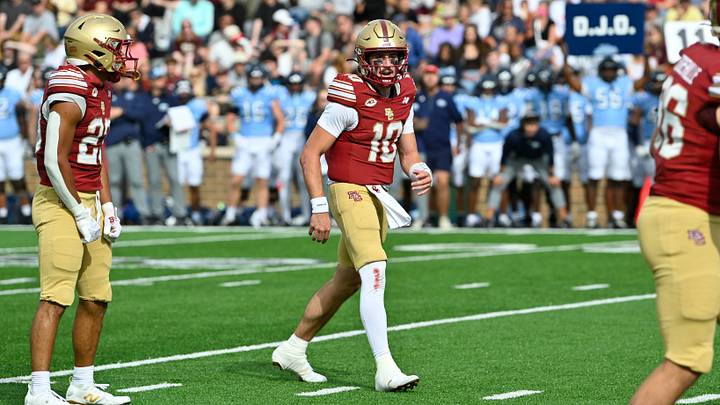
This is the type of offense that Boston College football runs, as opposed to one where the quarterback lines up directly behind the center and places their hands underneath the center’s hands to receive the snap more directly, almost like a handoff. That would be under center.
There are positives and negatives to both pre-snap setups, but O’Brien said the reason that BC uses the shotgun primarily is mostly due to the fact that coming out of high school, quarterbacks have often never played under center and are less accustomed to dropping back in the pocket from that spot.
Under center, the quarterback must essentially run in the opposite direction of where the offense wants to go in order to actually find a pocket of space to throw the ball, whereas that pocket is already established, essentially, before the snap has even happened in the shotgun position.
“So a lot of that has to do with several things, but [mostly] how these guys were trained in high school,” O’Brien explained after Thursday’s practice. “Most of these guys that come to us from high school, they've really never been under center. It doesn't mean that they can't do it. It just means that to spend time teaching them that relative to what we have to do is just, in some ways, it's not a waste of time, it's just there's other things we need to concentrate on, and they're really good at being in the shotgun.”
“Most of the guys that come to us out of high school have never really been under center”
— Mike Sidhly (@Sidhly01) September 24, 2026
Bill O’Brien on why quarterbacks come in preferring shotgun formations as opposed to being under center@BCEagleInsider pic.twitter.com/rZiSCtNkg2
For a quarterback like Mason McKenzie, who is slightly over six feet, having that additional room to see the field seems actually quite helpful.
On the other hand, being in the shotgun can sometimes expose the direction of a play, especially in the run game when the back is lined up to one side of the quarterback.
“But there are things under center that are very good [with under center], right?” O’Brien said. “The back and the dot, meaning right behind the quarterback. Defense doesn't know, you know, based on back alignment where the back’s going to go, is it run or pass? So there's a lot to be said that's positive about being under center, but we're a shotgun offense. I think that's what Mason [McKenzie] does very well. But I think over time, depending on who the quarterback [is in the] future or whenever, you know, we could incorporate more under-center things. But right now we're primarily a shotgun offense.”
Another thing that O’Brien must be cognizant of with a shotgun offense is finding centers who have comfortability with snapping the ball from the shotgun setup.
“That's a huge thing in your shotgun offense,” O’Brien said. “On the positive side, you know in the running game, the back is closer to the handoff, so the back can get the ball a little bit earlier, and he can see the cut and he can see the blocking relative to under center. You know, [under center] he starts seven and a half yards deep. The quarterback turns his back and things like that, and the ball gets into the running back's hands a little bit later.”
In the Eagles’ win over Maine this past weekend, there were a pair of 4th-and-1 situations which BC did not convert, the first of which happened less than two minutes into the game after a Black Bears’ turnover on the opening kickoff.
It was a 4th-and-1 from Maine’s 15-yard line, and the Eagles, naturally, lined up in the shotgun with Evan Dickens as the back to the right of McKenzie.
BC had two blocking tight ends lined up on the offensive line as well, with Bryce Lewis on the right edge and Zeke Moore just a yard back of the line on the left edge, which made it pretty obvious it would try to run.
Instead of running it out to the left, however, Moore pulled to the other side of the line for a counter design, but Dickens was stuffed short of the first-down marker, forcing a turnover on downs.
STOPPED ON FOURTH DOWN 💪#BlackBearNation | ⬆️ pic.twitter.com/NLa6YnyEjo
— Maine Football (@BlackBearsFB) September 19, 2026
In cases like these, it does seem like it could be more useful for the offense to utilize the under-center setup, which takes out the extra yardage added onto the play when the quarterback is standing so far back from the center.
It also eliminates the risk of a botched snap, which occurred a few times in the Eagles’ season-opening loss to Cincinnati.
But this is how O’Brien has run the offense ever since he took over play-calling duties for this season, and that doesn't look like it will change anytime soon — even in those late-down situations with just a yard or two to go.
Follow us on Twitter/X, Facebook, YouTube, Instagram, and Tiktok for the latest Boston College news.
 Add us as a preferred source on Google
Graham Dietz is a 2025 graduate of Boston College and subsequently joined Boston College On SI. He previously served as an editor for The Heights, the independent student newspaper, from fall 2021, including as Sports Editor from 2022-23. Graham works for The Boston Globe as a sports correspondent, covering high school football, girls' basketball, and baseball. He was also a beat writer for the Chatham Anglers of the Cape Cod Baseball League in the summer of 2023.
Follow graham_dietz