
An in-depth preview of K-State's matchup against Washington State plus predictions
In this story:
Kansas State couldn't have asked for a better start to the Collin Klein era, rolling to a dominant 71-3 victory against an outmatched Nicholls squad. The 71 points tied for the fourth-most points in a game in school history and the most ever in a K-State season opener.
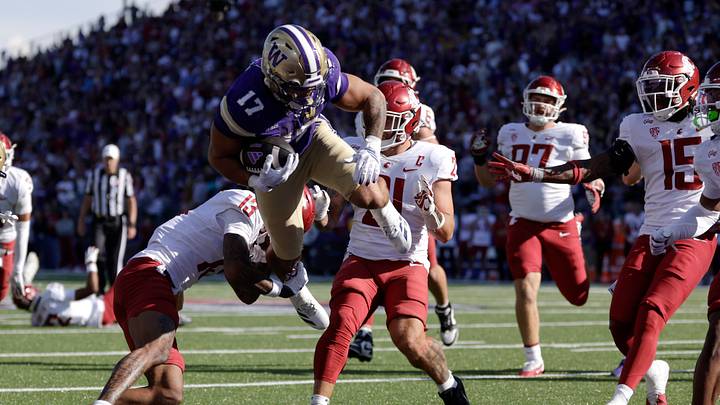
Now the Wildcats look to carry over that momentum this Saturday as the competition across the field ramps up against Washington State, which lost to in-state rival and 17th-ranked Washington 24-10 on the road Sunday.
The Cougars—similar to K-State—hired a first-time head coach who was previously an offensive coordinator in Kirby Moore. Moore, who replaces Jimmy Rogers, was the offensive coordinator at Missouri the previous three seasons. He coordinated an offense that averaged 2.81 points per drive in his first year in 2023, a mark that ranked 18th nationally. However, the effectiveness of the Tigers’ offense decreased in his final two seasons, ranking 46th at 2.41 points per drive in 2024, and falling to 63rd nationally with 2.28 points per drive last season.
Washington State has proven itself as a program teams cannot overlook. The Cougars have won seven or more games in four of the past five seasons. They held Ole Miss to 24 points last season, tying for its fewest points scored in a game in 2025, ultimately falling 24-21 to the fourth-ranked Rebels. They led at Virginia by 10 in the fourth quarter before falling 22-20 to the eventual 11-win Cavaliers. Lastly, they blew a fourth-quarter lead to James Madison, another team that advanced to the College Football Playoff.
However, almost everyone from that Washington State team is gone. The Cougars return just 42% of their overall production from 2025, according to Bill Connelly of ESPN. That ranks 109th nationally among all FBS teams and is last in the new Pac 12.
The Cougars return just 36% of their defensive production from last season’s team, which ranked 19th nationally with 1.66 points per drive allowed, including holding seven of 12 regular-season opponents to 13 points or less. All 17 players who played 200 or more snaps on defense last season are gone.
Washington State’s offense vs. K-State’s defense
My belief going into the season was Washington State’s offense would pose the biggest challenge to K-State in this matchup. The Cougars brought in transfer quarterback Caden Pinnick from FCS program UC Davis. The 6-foot-0 sophomore was the Big Sky Freshman of the Year last season, throwing for over 3,200 yards while completing nearly 70% of his passes. His 172.4 passer rating ranked third nationally in the FCS, while he also rushed for over 400 yards on a team that went 9-4 and made the FCS playoffs.
However, the Cougars struggled offensively in the season opener, averaging just 4.3 yards per play, a mark that ranks 118th out of 138 FBS teams through week one. Pinnick was 16-of-25 passing for just 142 yards, throwing for zero touchdowns while registering two interceptions.
Now, before we go any further I want to emphasize and acknowledge Washington State played a top-25 opponent, while the majority of teams in the sport, including K-State, played overmatched FCS schools or Group of Six programs to open the 2026 season.
Washington State struggled to run the football in 2025, ranking 91st nationally with 4 yards per rush, and those struggles carried over to the season opener in Seattle on Sunday. Washington State’s three running backs combined to rush for 38 yards on 16 carries (under 2.4 yards per carry) against the Huskies.
Washington State allowed a 31% stuff rate (percentage of plays stopped at or behind the line of scrimmage), which is a poor number, while averaging just 2.3 line yards per rush (the average yards per rush attributed to the offensive line). Washington State allowed a havoc rate of 29%, including an over 17% havoc rate from Washington’s front seven. Those are all bad numbers, reflecting poorly on the Cougars’ offensive line.
The Cougars went 0-9 on third down, and lost the turnover battle 3-0.
If there was one positive, it was Pinnick’s ability to run the ball. He carried it14 times for 61 yards. K-State will have to keep eyes on him and ensure they keep contain when bringing pressure. And I suspect they will get pressure on him with what I continue to believe will be a very good pass rush. Pinnick took 31 sacks last season at UC Davis, a mark that ranked 102nd nationally, and he was sacked three times by Washington on Sunday.
All of this makes me wonder if Moore has the personnel he needs to run the offense he wants. At Missouri, the Tigers utilized star running back Ahmad Hardy last season. Missouri averaged 5.3 yards per carry in 2025, ranking 14th nationally, and ran the ball on over 59% of their total plays, the 19th-highest mark in the country. The Cougars faced a really good defense Sunday—a unit that ranked No. 9 nationally in Bill Connelly’s SP+ last season and returned 61% of its production, according to Connelly.
Washington State had just two plays that went over 20 yards against Washington, and they’ll be missing a big piece in Manhattan on Saturday. Leading returning receiver Tony Freeman is not expected to play after suffering a knee injury 10 snaps into the game at Washington. Freeman had 590 yards receiving on 54 receptions in 2025.
Special teams matchup
Freeman’s absence hurts the Cougars in multiple ways. The 5-foot-8 senior recorded five punt returns of 40-plus yards last season, third-most in the country. His 17.3 yards per punt return set a single-season school record and ranked sixth-best nationally in 2025. With him out of the game, Washington State muffed a punt they were able to recover, and also struggled to handle a kickoff that resulted in a 2-yard loss.
Washington State allowed a punt return of 27 yards, and while turnovers play a big part in this, it’s notable that field position really hurt the Cougars. Washington’s average drive started on its own 37-yard line, while Washington State’s drives started on its own 24-yard line on average.
Washington State also missed field goals from 32 yards and 52 yards out.
Look for special teams to be a major advantage for K-State on Saturday.
K-State’s offense against Washington State’s defense
I expected Washington State’s defense to take a step back in 2026 with all of the departures from last season’s group. But that wasn’t the case Sunday against a high-powered Washington offense and Demond Williams, one of the best dual-threat quarterbacks in the country.
The Cougars and new defensive coordinator Trent Bray held Washington to under 2.2 points per drive, including bottling up the Huskies’ offense to just 10 points going into the fourth quarter. Washington State’s defensive line was stout, limiting the Huskies’ running backs to 76 yards on 21 carries (3.6 yards per rush), including an impressive goal-line stand on the final play of the first half.
Washington State did only record two tackles for loss, and produced a havoc rate of under 8% overall, including a 4.7% havoc rate from the front six of its 4-2-5 defense. That’s not a good number, but the Cougars did have a strong 25% stuff rate against a Washington offensive line that returned four starters.
Washington State starts two quality defensive ends in Linus Zunk, a 6-foot-6, 264-pound senior transfer from Vanderbilt, as well as Matyus McLain, who had 13.5 tackles for loss at Idaho last season before transferring to spend his final season with the Cougars.
The Cougars are big at defensive tackle, including 6-foot-3, 349-pound junior Jirah Leaupepetele, and Damarjhe Lewis, a 6-foot-3, 332-pound senior as his backup. At the other defensive tackle spot is Kaden Beatty, a captain who is 6-foot-2, 287 pounds.
This is a good test for K-State’s inexperienced offensive line, which paved the way for over 300 yards rushing against Nicholls. Holding up well against this Cougars defensive front would be a good sign for the Wildcats, and will help them as they gear up for conference play. And Zunk and Matyus specifically will provide a good barometer for K-State’s young offensive tackles in Gus Hawkins and Ryan Howard.
Other notes and prediction:
Something many will rightfully wonder is the impact of Washington State traveling to Manhattan on short rest given it played on Sunday. Also, what is the mentality of the Cougars following the emotions of a hard-fought game against their rival? There’s a tendency for some teams to let down the week following a rivalry game.
Lastly, this game is at 9 a.m. PT, so it’s a body-clock game. Washington State has won the ensuing week after playing Washington each of the prior two seasons, though it came against Colorado State and San Jose State, not a Big 12 opponent. Additionally, the Cougars handled time zone changes well last year. They played Ole Miss at 11:45 a.m. CT and lost 24-21, had Virginia on the ropes on its home field as well as James Madison—two schools on the East coast.
The SP+ on ESPN projects K-State by 18.9 points and predicts a 35-16 final, while Brian Fremeau’s FEI rankings projects K-State to win 28-18.
While Washington State will provide a much stronger test than Nicholls, I’m still predicting another dominant effort.
K-State wins 38-13.
 Add us as a preferred source on Google
K-State grad serving as the co-host of 3MAW, a K-State podcast on KC Sports Network. Previously covered K-State as the beat writer for the Manhattan Mercury. KC Sports Network is the premier destination for Kansas City sports fans with podcasts, YouTube and social media content. Stay connected with the latest news and analysis by following KCSN on all social media platforms.
Follow kstate_kcsn