
LSU Report Card: Who Delivered and Who Disappointed Against Alabama
In this story:
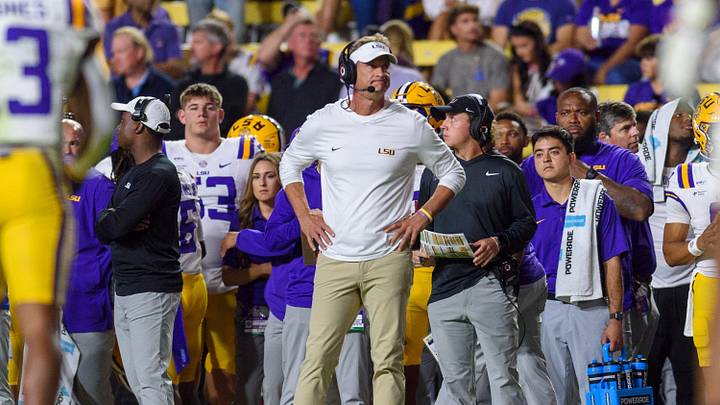
LSU fell 31-13 to No. 5 Alabama on Saturday despite out gaining the Crimson Tide 457-285. The Tigers controlled stretches of the game but struggled to capitalize on scoring opportunities, allowing Alabama to pull away with 21 unanswered points.
Here is how each LSU position group performed against the Crimson Tide.
LSU Report Card vs. Alabama
Quarterback: C+

Sam Leavitt completed 35 of 47 passes for 380 yards but failed to throw a touchdown and recorded one interception. Leavitt consistently moved the offense downfield, but his inability to finish drives proved costly. Despite facing pressure throughout the contest, he gave LSU opportunities to score but couldn't make it count.
Running Backs: B-

Dilin Jones led LSU's rushing attack with 56 yards and a touchdown on 17 carries. While Jones showed flashes of productivity, the Tigers struggled to establish a consistent ground game. Much of the group's limited production can be attributed to insufficient blocking up front.
Wide Receivers: A-

LSU's receiving corps was arguably its strongest offensive unit. Jackson Harris led the way with 11 receptions for 166 yards, consistently creating opportunities in the passing game. The receivers helped LSU accumulate 380 passing yards and repeatedly moved the chains despite the offense's inability to finish drives.
Tight Ends: C+

The tight ends played a relatively limited role in LSU's offensive production. While the passing attack generated significant yardage, the group failed to establish itself as a consistent receiving threat. Its contributions in the blocking game also weren't enough to help LSU establish a reliable rushing attack.
Offensive Line: D+

The offensive line struggled against Alabama's defensive front, surrendering four sacks and failing to generate consistent rushing lanes. LSU managed just 77 net rushing yards on 33 attempts, averaging 2.3 yards per carry. The group's inability to consistently control the line of scrimmage contributed to LSU's offensive struggles in critical situations.
Defensive Line: B



LSU's defensive front delivered one of the team's stronger performances, limiting Alabama to 79 rushing yards and 2.7 yards per carry. The Tigers also recorded two sacks and frequently disrupted the Crimson Tide's rushing attack. Despite the final score, the defensive line helped keep Alabama's offense in check for much of the contest.
Linebackers: C+

The linebackers contributed to LSU's success against the run but struggled with consistency in pass coverage and containment. Alabama quarterback Keelon Russell found opportunities to extend plays and exploit defensive openings. Although the group helped prevent Alabama from establishing a dominant rushing attack, its performance declined during critical stretches.
Cornerbacks: C-

Despite limiting Alabama to 206 passing yards, LSU's secondary surrendered three passing touchdowns. The cornerbacks struggled to prevent timely completions, particularly as Alabama pulled away in the second half. The group's inability to consistently disrupt the passing attack contributed to the Crimson Tide's offensive efficiency.
Safeties: C-

LSU's safeties struggled to prevent Alabama from capitalizing on scoring opportunities. The Crimson Tide's passing attack became increasingly effective as the game progressed, exposing weaknesses in the Tigers' secondary. Although LSU limited Alabama's total offensive production, breakdowns in the defensive backfield proved costly.
Special Teams: C

Kicker Scott Starzyk converted field goals from 23 and 41 yards but missed a 56-yard attempt. LSU also surrendered a 32-yard punt return while generating just six yards on three punt returns of its own. Although the kicking unit contributed six points, special teams failed to provide a meaningful advantage.
Coaching: D
LSU's coaching staff struggled to translate offensive production into points. The Tigers finished 0-for-4 on fourth-down attempts and converted just two of four red-zone opportunities into points. Defensively, the Tigers let men go free all night, leading to several wide open touchdowns for Alabama. Despite holding advantages in total yardage and time of possession, LSU failed to execute when it mattered most.

Overall Grade: C-
LSU's performance was defined by missed opportunities rather than an inability to compete. The Tigers moved the football effectively and limited Alabama's overall offensive production, but costly mistakes and poor situational execution ultimately determined the outcome.
The receiving corps and defensive line provided encouraging performances, while offensive-line struggles and defensive breakdowns exposed areas requiring improvement. LSU demonstrated the ability to compete with a top-five opponent but lacked the consistency necessary to finish the job.
Sign up to our free newsletter and follow us on Facebook and X for the latest news.
 Add us as a preferred source on Google

Brett Kemper is a senior at Louisiana State University, double majoring in Business Marketing and Management. Kemper got his start in sports reporting at LSU’s student newspaper, The Reveille, where he covered LSU baseball during its 2025 National Championship season. Born and raised in Texas, Kemper now calls Louisiana home and continues to pursue his passion for sports, storytelling and journalism.
Follow kemper_brett