
What Tennessee Did to Sam Leavitt Should Alarm Everyone at LSU
In this story:
Eight sacks. Thirteen tackles for loss. One fourth-quarter fumble that helped put the game out of reach.
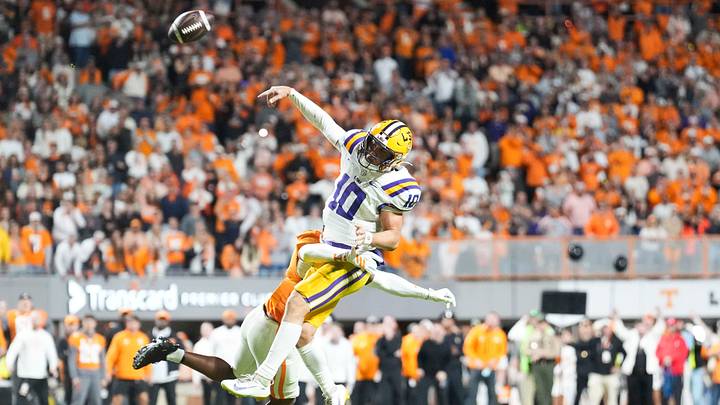
Tennessee didn't need an explosive passing attack to beat LSU on Saturday. The Volunteers instead spent much of their 27-13 victory making life miserable for quarterback Sam Leavitt and an offense that struggled to protect him when it mattered most.
The eight sacks were Tennessee's most in a game during Josh Heupel's tenure. Seven were credited against Leavitt, while the other came when running back Dilin Jones lost 15 yards on a third-down play in the opening quarter. The Vols would also overtake LSU as the nation's sack leader, now with 47 to LSU's 42.
Deep Rooted Issues

LSU's problems went beyond one quarterback repeatedly getting dragged to the turf. Tennessee disrupted the Tigers in multiple situations, including critical third downs, the red zone and a fourth-quarter possession that offered LSU an opportunity to tie the game.
The first warning came in the opening quarter. After LSU reached the Tennessee 2-yard line, a false-start penalty pushed the Tigers backward. On third-and-7, Arion Carter sacked Leavitt for a one-yard loss. Instead of potentially extending its six-point advantage with a touchdown, LSU settled for its second field goal of the afternoon.
The pressure continued into the second quarter. Xavier Gilliam brought Leavitt down for a two-yard loss, while Nathan Robinson and Jordan Norman later combined for another sack.
Neither play was particularly damaging in terms of yardage. Together, however, they illustrated a larger problem: LSU was repeatedly losing opportunities to stay ahead of the chains.
By the second half, Tennessee's pressure had become more consequential.
Amare Campbell recorded a six-yard sack on third-and-8 late in the third quarter, forcing a punt. The Volunteers subsequently muffed that punt, giving LSU possession at Tennessee's 9-yard line and setting up Leavitt's only touchdown of the day to Trey'Dez Green.



LSU had tied the game, but its offensive problems weren't resolved.
Campbell struck again early in the fourth quarter, recording another six-yard sack as Tennessee continued disrupting LSU's possessions.
Then came the game's defining defensive play.
Trailing 20-13 with fewer than five minutes remaining, LSU had advanced into Tennessee territory. The Tigers still had an opportunity to tie the game.
Instead, linebacker Edwin Spillman reached Leavitt from the blindside and forced a fumble. Dejuan Lane recovered, ending the possession and giving Tennessee the ball.
Three plays later, Faizon Brandon broke loose for a 55-yard touchdown run, extending Tennessee's lead to 27-13.
A potential game-tying drive had become a two-touchdown deficit.
The biggest concern for LSU isn't simply that its quarterback was sacked seven times. It's that Tennessee repeatedly found cracks in LSU's protection.
The Tigers had no meaningful answer to anything the Tennessee defense had to offer.
What is already clear is the result. Tennessee found enough ways to disrupt LSU's offense that the Tigers couldn't sustain drives when the game was still within reach.
For an organization that fired its last head coach for having an underperforming offense, this seasons underperforming offense does not offer much reassurance for what the future may hold.
Sign up to our free newsletter and follow us on Facebook and X for the latest news.
 Add us as a preferred source on Google

Brett Kemper is a senior at Louisiana State University, double majoring in Business Marketing and Management. Kemper got his start in sports reporting at LSU’s student newspaper, The Reveille, where he covered LSU baseball during its 2025 National Championship season. Born and raised in Texas, Kemper now calls Louisiana home and continues to pursue his passion for sports, storytelling and journalism.
Follow kemper_brett