
Everything Pass Rush Specialist Brandon Jordan said at his spring practice availability
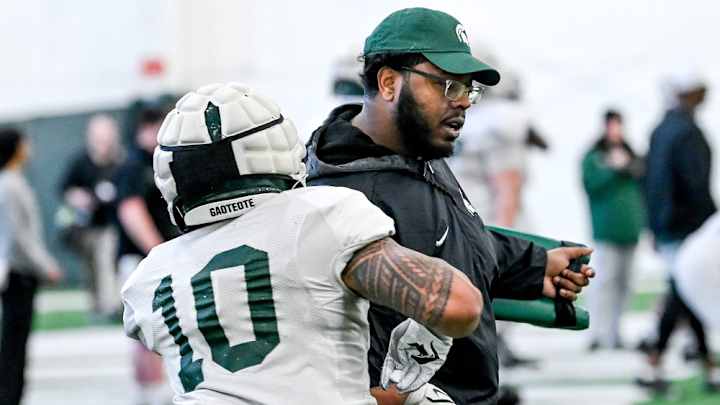
Michigan State head coach Mel Tucker made an unexpected yet inspired move on his coaching staff by bringing in pass rush specialist Brandon Jordan to add to the Spartans' coaching staff.
Having personally trained several NFL players, and with a major social media presence, the addition of Jordan to MSU's staff is expected to pay big dividends on the recruiting trail for the Spartans.
Speaking to the media this week as Michigan State continues spring practice, Jordan discussed a variety of topics including how his career got started, his goals for Michigan State players and his experiences in recruiting so far.
On what brought him to Michigan State:
“It’s been my dream to get back into coaching. I was kind of forced out a little bit, couldn’t get a job when we got let go at Austin Peay, and once I got this call, I ran to it – especially at a program like this for a head coach like that, Coach Tucker. Talking to him and coming here, interviewing with him and just seeing his vision, this was the place to be.”
On what makes a ‘Pass Rush Specialist’:
“Just the small details. So how I got into D-line – I was a D-line coach at Austin Peay, went back and started training back in New Orleans. Doing that, it really made me a better coach, because I had to really start studying the game. I didn’t have anything, I didn’t have to worry about scheme and things like that, so I started studying the game. And, being an O-lineman, I knew what would beat me as an offensive lineman. So, I went back, watched a lot of film…started working with the young guys, working with the high school guys out there and finding a way to make those guys better.”
“With high school guys, they’re more progressional learning, there are small details with it, so it made me a better coach. Because, if I can coach a high school guy, I can break it down for a high school guy so they can be the best at what they could be, it was easy for me when I started working with the NFL guys.”
“I think I’m a little different in what I do. Just how I teach the rush – I break it down, I’m a real progressive guy. Me, growing up, I was a progressive learner. So, I teach by detail. I do small detail, small detail and then I put it all together. So, when you put it all together, now they know the small details, so if they mess up at that small detail, now they can correct themselves. I’m trying to make it where it’s muscle-memory, and it’s self-corrective. So, they know if I didn’t turn my shoulder much this time, I didn’t step through this time, it’s really self-corrective because we work those small details so much, now they know how it feels.”
On how his career has progressed:
“I feel like every year I got better. As I started doing it, I started finding the smaller details that helped the guys. It made me look at the things that just made them better, and find their weaknesses. So, when I find a weakness, I find a way to make their weakness strong. So, I’ll isolate the movement – if it’s an upper body violence, I’ll find a way to make their upper body violent. If it’s their footwork, I’ll find a way to get their footwork better.”
“When I started working with the NFL guys, I started picking their brain. So, dealing with Von Miller, dealing with guys like Cameron Heyward, they made me better just for picking their brain as I made them better. So, it was kind of like an ‘iron sharpening iron’ with that, so that made me what I am.”
“When I was in college, I sustained an injury, I tore my hamstring. While I was hurt, my coaches in college kind of seen coaching in me. I was an offensive lineman, so [my coach] seen it in me – I was at a Division II school – he had me work with the tackles and he worked with the guard. So, as I was playing in college, they were already transitioning me into coaching.”
On desire to return to a coaching staff:
“I just wanted to get back in the grass. I was volunteering at a high school. So, while I couldn’t get work at a college, I was volunteering at a high school, helping guys there. I always wanted to get into coaching. I think a lot of coaches didn’t know I wanted to, because of my success with training, so when the opportunity came I ran with it.”
On goals for MSU players:
“My personal goal is for them to be the best pass-rushing group in college football. But, we’re going to work like that every day to be that. I want those guys to be the best player they can be, that’s my goal. If I feel like those guys are their best player, I’m fine with it.”
“Watching the film, I seen that we could work our line – just small details of it – work the line a little bit better. Getting the D-tackles from staying down the middle [to] working half a man, keeping their hands active. Converting, once it’s run or pass, converting, seeing it. Just focusing on the man, not the ball, not the quarterback – you focus on the man in front of you. You beat the man in front of you, and once you convert it, now you can see where the quarterback’s at. But, beat the man in front of you. The man in front of you will tell you where the ball is going.”
On NFL guys coming to train in East Lansing:
“It’s been great. It’s been top-notch here. The program has really been taking care of those guys. These guys really feel like home while they’ve been here. It’s been top-notch.”
On MSU guys watching NFL guys train:
“I think they benefit from it. They’re able to watch the film, we record some of it, so we’ll watch the film of guys working and things like that.”
On juggling responsibilities to MSU with responsibilities to pros he works with:
“It’s been good. I’ve been working hard, man. Long hours, but it’s been great.”
“It hasn’t been bad, because I kind of got trained for it when I had my internship with the [Arizona] Cardinals this summer. They helped me out a lot. Coach [Brentson] Buckner, Coach Vance Joseph – they helped me with the day-to-day, how to approach the day, how to break down film, how to get that balance. So, it was great. They helped me, they prepared me.”
On what makes a good pass rusher:
“It’s athleticism – guys can be freaky athletes, but don’t have body control, don’t know how to comprehend. It’s a lot of eye discipline too. It’s your eyes, it’s your hands, it’s your feet. If you have feet, and you don’t have hands and eyes, you can’t coordinate it. Because you’ve got to know, if an O-lineman is throwing hands, I’m going to work a finesse move. If I’m working speed, and the guy don’t shoot hands, and I throw my hands, I’m not going to beat the guy – so, I’ve got to come with power. So, it’s bringing eye discipline to the rush too.”
On Michigan State’s defensive tackles:
“We’re keeping their hands active. I watch a lot of film. Whenever we could, I put up some NFL tape for them so they could see it – see how they work at the next level, see what moves work, what counters they do for the O-lineman, studying the O-lineman, seeing different things like that. Trying to bring it to the next level. It’s a great group of guys.”
On Michigan State’s defensive ends:
“Those guys, I think it’s a room full of great guys. It’s Brandon Wright, it’s Jeff Pietrowski, Khris Bogle, Michael Fletcher – it’s a group of real good guys, it’s workers. All I can ask for are workers. If a guy will work, I feel like I can get you better. As long as you give effort, you work hard every play, you run to the ball, you finish – because you will win sacks with just effort. If you give effort, you get sacks.”
On Michigan State’s linebackers:
“I worked with the linebackers today [Tuesday] with their blitzes, the blitz tech, hands and stuff. I usually get with those guys once a week, with the middle guys. And then I’ll try to get some extra stuff with the guys that’s converting from…working a little bit in a pass rush situation on the line.”
On seeing progress through two weeks of spring practice:
“I’m seeing it right now. Guys using their hands, keeping it active – I see it every day. Every day they get better. We find a good detail – and that’s the good thing about me coming back and coaching in college, is that I can get the guy better every day. We can watch the mistakes, go to the mistakes, go to the film, see what they need to work on, and then we’ll go craft on that. So, I think they guys have been getting better every day, taking steps, one percent.”
On recruiting, advantage of training NFL guys:
“It’s been great. I kind of have relationships with guys already, because I’ve trained a lot of these guys already, and with my social media presence, most of these guys know me. So, it’s really just building a relationship with these kids. I’m really just trying to help them out, just help them get better at their craft too.”
“It helps me out a lot [having trained NFL guys], just because of the guys I work with. Most of those kids, when they call me they’re just asking questions on how [it’s like] it work with him, what moves does he use and things like that. So, it’s a big advantage because I was working with a lot of these guys’ idols. It’s big.”
 Add us as a preferred source on Google