%22%3E%0A%3Cpath%20d%3D%22M0%206.78369H6.40251L10.3403%2013.2334L14.2782%206.78369H20.6807V25.1413H14.5709V16.0381L10.3498%2022.5728H10.2459L6.02478%2016.0381V25.1413H0.0188864V6.78369H0Z%22%20fill%3D%22white%22%2F%3E%0A%3Cpath%20d%3D%22M22.6729%206H28.8393V9.80562H22.6729V6ZM22.7767%2010.8255H28.7354V25.1509H22.7767V10.8255Z%22%20fill%3D%22white%22%2F%3E%0A%3Cpath%20d%3D%22M29.6514%2023.4133L31.6722%2020.0326C33.4003%2021.1091%2035.3456%2021.6285%2036.9699%2021.6285C37.5459%2021.6285%2037.8386%2021.4963%2037.8386%2021.1564V21.0997C37.8386%2020.8164%2037.5742%2020.6275%2036.1389%2020.2593C32.5221%2019.3716%2030.2935%2018.3989%2030.2935%2015.4338V15.3866C30.2935%2012.242%2032.8148%2010.4761%2036.5355%2010.4761C38.8963%2010.4761%2041.2288%2011.0804%2042.9663%2012.1286L41.0777%2015.6698C39.5573%2014.8294%2037.7159%2014.3289%2036.5166%2014.3289C35.9406%2014.3289%2035.6761%2014.4894%2035.6761%2014.7727V14.8294C35.6761%2015.1221%2035.9878%2015.3016%2037.4326%2015.6698C41.0493%2016.5575%2043.2307%2017.5585%2043.2307%2020.4953V20.552C43.2307%2023.6683%2040.8982%2025.4814%2037.0171%2025.4814C34.2408%2025.4814%2031.7194%2024.7731%2029.6703%2023.4133H29.6514Z%22%20fill%3D%22white%22%2F%3E%0A%3Cpath%20d%3D%22M43.2598%2023.4133L45.2806%2020.0326C47.0087%2021.1091%2048.954%2021.6285%2050.5783%2021.6285C51.1543%2021.6285%2051.447%2021.4963%2051.447%2021.1564V21.0997C51.447%2020.8164%2051.1826%2020.6275%2049.7473%2020.2593C46.1305%2019.3716%2043.9019%2018.3989%2043.9019%2015.4338V15.3866C43.9019%2012.242%2046.4232%2010.4761%2050.1439%2010.4761C52.5047%2010.4761%2054.8372%2011.0804%2056.5747%2012.1286L54.6861%2015.6698C53.1657%2014.8294%2051.3243%2014.3289%2050.125%2014.3289C49.5489%2014.3289%2049.2845%2014.4894%2049.2845%2014.7727V14.8294C49.2845%2015.1221%2049.5962%2015.3016%2051.041%2015.6698C54.6577%2016.5575%2056.8391%2017.5585%2056.8391%2020.4953V20.552C56.8391%2023.6683%2054.5066%2025.4814%2050.6255%2025.4814C47.8492%2025.4814%2045.3278%2024.7731%2043.2786%2023.4133H43.2598Z%22%20fill%3D%22white%22%2F%3E%0A%3Cpath%20d%3D%22M57.7168%2018.0402V17.9835C57.7168%2013.9418%2061.0786%2010.4856%2065.8002%2010.4856C70.5218%2010.4856%2073.8269%2013.8946%2073.8269%2017.9363V17.993C73.8269%2022.0347%2070.4651%2025.4909%2065.7435%2025.4909C61.0219%2025.4909%2057.7168%2022.0819%2057.7168%2018.0402ZM68.1043%2018.0402V17.9835C68.1043%2016.567%2067.0561%2015.4338%2065.7435%2015.4338C64.4309%2015.4338%2063.4394%2016.567%2063.4394%2017.9269V17.9835C63.4394%2019.4%2064.4876%2020.5237%2065.8002%2020.5237C67.1128%2020.5237%2068.1043%2019.4%2068.1043%2018.0307V18.0402Z%22%20fill%3D%22white%22%2F%3E%0A%3Cpath%20d%3D%22M75.1582%2020.2687V10.8254H81.1169V18.3517C81.1169%2019.5888%2081.8534%2020.297%2082.7411%2020.297C83.6288%2020.297%2084.4503%2019.5888%2084.4503%2018.3517V10.8254H90.3996V25.1508H84.4503V23.2338C83.5343%2024.4142%2082.0895%2025.4908%2080.0687%2025.4908C77.0563%2025.4908%2075.1676%2023.4982%2075.1676%2020.2687H75.1582Z%22%20fill%3D%22white%22%2F%3E%0A%3Cpath%20d%3D%22M92.2891%2010.8256H98.2383V13.7152C99.0504%2011.7699%20100.363%2010.5139%20102.724%2010.6178V16.9448H102.091C99.5698%2016.9448%2098.2383%2018.3329%2098.2383%2021.5058V25.1509H92.2891V10.8256Z%22%20fill%3D%22white%22%2F%3E%0A%3Cpath%20d%3D%22M103.81%206H109.976V9.80562H103.81V6ZM103.913%2010.8255H109.872V25.1509H103.913V10.8255Z%22%20fill%3D%22white%22%2F%3E%0A%3Cpath%20d%3D%22M123.423%2011.9775H118.021V6.78369H134.963V11.9775H129.561V25.1413H123.423V11.9775Z%22%20fill%3D%22white%22%2F%3E%0A%3Cpath%20d%3D%22M136.256%206H142.422V9.80562H136.256V6ZM136.36%2010.8255H142.318V25.1509H136.36V10.8255Z%22%20fill%3D%22white%22%2F%3E%0A%3Cpath%20d%3D%22M143.943%2027.6154L145.775%2024.0176C147.371%2024.858%20148.977%2025.3774%20150.941%2025.3774C153.169%2025.3774%20154.35%2024.2253%20154.35%2022.2328V21.8079C153.538%2022.7239%20152.197%2023.7721%20150.204%2023.7721C146.503%2023.7721%20143.83%2021.1468%20143.83%2017.1901V17.1335C143.83%2013.1201%20146.559%2010.4666%20149.864%2010.4666C151.961%2010.4666%20153.198%2011.2503%20154.246%2012.3269V10.8065H160.205V21.5057C160.205%2024.1592%20159.657%2025.9629%20158.344%2027.2755C157.06%2028.5598%20155.096%2029.3719%20151.895%2029.3719C148.693%2029.3719%20146.257%2028.7392%20143.943%2027.5871V27.6154ZM154.378%2017.1712V17.1146C154.378%2015.8775%20153.434%2014.886%20151.989%2014.886C150.544%2014.886%20149.6%2015.9059%20149.6%2017.1712V17.2279C149.6%2018.465%20150.544%2019.4282%20151.989%2019.4282C153.434%2019.4282%20154.378%2018.4366%20154.378%2017.1712Z%22%20fill%3D%22white%22%2F%3E%0A%3Cpath%20d%3D%22M161.649%2018.0685V18.0118C161.649%2013.7341%20164.718%2010.4856%20169.015%2010.4856C174.105%2010.4856%20176.466%2014.0268%20176.466%2018.3801C176.466%2018.6918%20176.466%2019.06%20176.437%2019.3717H167.23C167.646%2020.6276%20168.647%2021.2886%20169.931%2021.2886C171.007%2021.2886%20171.895%2020.7882%20172.839%2019.8155L176.041%2022.3652C174.624%2024.1972%20172.603%2025.4814%20169.506%2025.4814C164.813%2025.4814%20161.64%2022.5163%20161.64%2018.0591L161.649%2018.0685ZM171.036%2016.7559C170.903%2015.3961%20170.091%2014.6028%20169.043%2014.6028C167.995%2014.6028%20167.334%2015.4433%20167.155%2016.7559H171.036Z%22%20fill%3D%22white%22%2F%3E%0A%3Cpath%20d%3D%22M177.882%2010.8256H183.831V13.7152C184.643%2011.7699%20185.956%2010.5139%20188.317%2010.6178V16.9448H187.684C185.163%2016.9448%20183.831%2018.3329%20183.831%2021.5058V25.1509H177.882V10.8256Z%22%20fill%3D%22white%22%2F%3E%0A%3Cpath%20d%3D%22M188.431%2023.4133L190.452%2020.0326C192.18%2021.1091%20194.125%2021.6285%20195.749%2021.6285C196.325%2021.6285%20196.618%2021.4963%20196.618%2021.1564V21.0997C196.618%2020.8164%20196.354%2020.6275%20194.909%2020.2593C191.292%2019.3716%20189.063%2018.3989%20189.063%2015.4338V15.3866C189.063%2012.242%20191.585%2010.4761%20195.305%2010.4761C197.666%2010.4761%20199.999%2011.0804%20201.736%2012.1286L199.848%2015.6698C198.327%2014.8294%20196.486%2014.3289%20195.286%2014.3289C194.71%2014.3289%20194.446%2014.4894%20194.446%2014.7727V14.8294C194.446%2015.1221%20194.758%2015.3016%20196.202%2015.6698C199.819%2016.5575%20202.001%2017.5585%20202.001%2020.4953V20.552C202.001%2023.6683%20199.668%2025.4814%20195.787%2025.4814C193.011%2025.4814%20190.489%2024.7731%20188.44%2023.4133H188.431Z%22%20fill%3D%22white%22%2F%3E%0A%3Cpath%20fill-rule%3D%22evenodd%22%20clip-rule%3D%22evenodd%22%20d%3D%22M211.368%204.36764C217.191%20-1.45588%20226.632%20-1.45588%20232.456%204.36764C238.279%2010.1912%20238.279%2019.6324%20232.456%2025.4559L221.912%2036L211.368%2025.4559C205.544%2019.6324%20205.544%2010.1912%20211.368%204.36764ZM214.009%207.55761C213.948%207.86849%20213.916%208.39718%20213.916%209.14566V10.4189C213.916%2011.1832%20213.948%2011.7198%20214.013%2012.0267C214.078%2012.3317%20214.278%2012.6168%20214.617%2012.8762C214.956%2013.1376%20215.403%2013.3316%20215.958%2013.4623C216.512%2013.593%20217.1%2013.6584%20217.837%2013.6584C218.573%2013.6584%20219.217%2013.591%20219.769%2013.4524C220.322%2013.3158%20220.761%2013.1178%20221.086%2012.8604C221.411%2012.6029%20221.605%2012.3178%20221.666%2012.0069C221.728%2011.6961%20221.759%2011.1674%20221.759%2010.4189V9.14566C221.759%208.38134%20221.728%207.84473%20221.662%207.53781C221.597%207.23287%20221.397%206.94971%20221.058%206.68834C220.72%206.42696%20220.272%206.23291%20219.718%206.10223C219.163%205.97154%20218.536%205.90619%20217.839%205.90619C217.102%205.90619%20216.459%205.97352%20215.906%206.11213C215.352%206.24875%20214.914%206.44677%20214.589%206.70418C214.265%206.9616%20214.071%207.24673%20214.009%207.55761ZM219.276%2024.8638C222.876%2024.8638%20224.557%2024.2064%20224.557%2021.862V21.858V21.3155C224.557%2019.6581%20223.516%2018.971%20220.252%2018.3136C219.278%2018.1136%20218.908%2017.9136%20218.908%2017.3136V16.9414C218.908%2016.6543%20219.177%2016.5117%20219.413%2016.5117C219.749%2016.5117%20219.918%2016.7137%20219.918%2016.9414V18.1136H224.391V17.3988C224.391%2015.4563%20223.347%2014.4266%20219.177%2014.4266C216.15%2014.4266%20213.896%2015.3414%20213.896%2017.3711V17.7433C213.896%2019.5155%20214.805%2020.3155%20218.201%2021.0303C218.28%2021.0472%20218.355%2021.063%20218.427%2021.0781C219.329%2021.2674%20219.647%2021.3341%20219.647%2021.9174V22.2897C219.647%2022.6619%20219.546%2022.8045%20219.142%2022.8045C218.67%2022.8045%20218.637%2022.5471%20218.637%2022.262V21.2897H213.894V21.7471C213.894%2024.149%20215.476%2024.8638%20219.276%2024.8638ZM225.424%2024.5569H229.925V14.7355H225.424V24.5569ZM226.955%2013.5019H229.925V6.06064H227.092V9.411L225.193%206.06064H222.359V13.5019H225.193V10.1199L226.955%2013.5019ZM218.269%2012.152C218.204%2012.2688%20218.055%2012.3262%20217.825%2012.3262L217.827%2012.3282C217.604%2012.3282%20217.459%2012.2767%20217.398%2012.1758C217.336%2012.0748%20217.305%2011.8074%20217.305%2011.3758V7.90068C217.305%207.51852%20217.352%207.28684%20217.445%207.20962C217.538%207.13239%20217.675%207.09279%20217.851%207.09279C218.059%207.09279%20218.198%207.14031%20218.265%207.23734C218.332%207.33239%20218.366%207.55416%20218.366%207.90068V11.3203C218.366%2011.7579%20218.334%2012.0352%20218.269%2012.152Z%22%20fill%3D%22white%22%2F%3E%0A%3Cpath%20fill-rule%3D%22evenodd%22%20clip-rule%3D%22evenodd%22%20d%3D%22M211.368%204.36764C217.191%20-1.45588%20226.632%20-1.45588%20232.456%204.36764C238.279%2010.1912%20238.279%2019.6324%20232.456%2025.4559L221.912%2036L211.368%2025.4559C205.544%2019.6324%20205.544%2010.1912%20211.368%204.36764ZM214.009%207.55761C213.948%207.86849%20213.916%208.39718%20213.916%209.14566V10.4189C213.916%2011.1832%20213.948%2011.7198%20214.013%2012.0267C214.078%2012.3317%20214.278%2012.6168%20214.617%2012.8762C214.956%2013.1376%20215.403%2013.3316%20215.958%2013.4623C216.512%2013.593%20217.1%2013.6584%20217.837%2013.6584C218.573%2013.6584%20219.217%2013.591%20219.769%2013.4524C220.322%2013.3158%20220.761%2013.1178%20221.086%2012.8604C221.411%2012.6029%20221.605%2012.3178%20221.666%2012.0069C221.728%2011.6961%20221.759%2011.1674%20221.759%2010.4189V9.14566C221.759%208.38134%20221.728%207.84473%20221.662%207.53781C221.597%207.23287%20221.397%206.94971%20221.058%206.68834C220.72%206.42696%20220.272%206.23291%20219.718%206.10223C219.163%205.97154%20218.536%205.90619%20217.839%205.90619C217.102%205.90619%20216.459%205.97352%20215.906%206.11213C215.352%206.24875%20214.914%206.44677%20214.589%206.70418C214.265%206.9616%20214.071%207.24673%20214.009%207.55761ZM219.276%2024.8638C222.876%2024.8638%20224.557%2024.2064%20224.557%2021.862V21.858V21.3155C224.557%2019.6581%20223.516%2018.971%20220.252%2018.3136C219.278%2018.1136%20218.908%2017.9136%20218.908%2017.3136V16.9414C218.908%2016.6543%20219.177%2016.5117%20219.413%2016.5117C219.749%2016.5117%20219.918%2016.7137%20219.918%2016.9414V18.1136H224.391V17.3988C224.391%2015.4563%20223.347%2014.4266%20219.177%2014.4266C216.15%2014.4266%20213.896%2015.3414%20213.896%2017.3711V17.7433C213.896%2019.5155%20214.805%2020.3155%20218.201%2021.0303C218.28%2021.0472%20218.355%2021.063%20218.427%2021.0781C219.329%2021.2674%20219.647%2021.3341%20219.647%2021.9174V22.2897C219.647%2022.6619%20219.546%2022.8045%20219.142%2022.8045C218.67%2022.8045%20218.637%2022.5471%20218.637%2022.262V21.2897H213.894V21.7471C213.894%2024.149%20215.476%2024.8638%20219.276%2024.8638ZM225.424%2024.5569H229.925V14.7355H225.424V24.5569ZM226.955%2013.5019H229.925V6.06064H227.092V9.411L225.193%206.06064H222.359V13.5019H225.193V10.1199L226.955%2013.5019ZM218.269%2012.152C218.204%2012.2688%20218.055%2012.3262%20217.825%2012.3262L217.827%2012.3282C217.604%2012.3282%20217.459%2012.2767%20217.398%2012.1758C217.336%2012.0748%20217.305%2011.8074%20217.305%2011.3758V7.90068C217.305%207.51852%20217.352%207.28684%20217.445%207.20962C217.538%207.13239%20217.675%207.09279%20217.851%207.09279C218.059%207.09279%20218.198%207.14031%20218.265%207.23734C218.332%207.33239%20218.366%207.55416%20218.366%207.90068V11.3203C218.366%2011.7579%20218.334%2012.0352%20218.269%2012.152Z%22%20fill%3D%22white%22%2F%3E%0A%3C%2Fg%3E%0A%3Cdefs%3E%0A%3CclipPath%20id%3D%22clip0_15202_214811%22%3E%0A%3Crect%20width%3D%22237%22%20height%3D%2236%22%20fill%3D%22white%22%2F%3E%0A%3C%2FclipPath%3E%0A%3C%2Fdefs%3E%0A%3C%2Fsvg%3E%0A)
Everything Mizzou AD Laird Veatch Said in Reaction to House Settlement
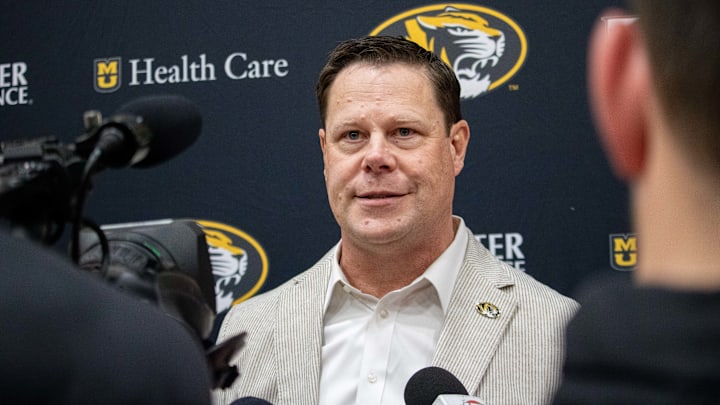
Though the administration is familiarized with the new structure for college athletics created by the passing of the NCAA v. House settlement, not even Missouri director of athletics Laird Veatch can be exactly certain of the impacts it will have over the next few years.
Veatch spoke to the media Thursday to provide updates and clarification on how the athletic administration plans to move forward in the new era.
Here's a look at everything Veatch had to say.
On which sports will receive revenue sharing funds, the breakdown of distribution:
“I would just say that the bulk of our revenue share funds will go to football and men's basketball, similar to the conversation you're seeing across the country. In large part, in line with how monies are generated, but also the brand value that those student athletes bring to Mizzou. There will be other sports that will receive revenue share. Not all sports will, but there'll be opportunities for student athletes across our sports to receive those funds also.
“They can change year to year. And I'm sure there will be a lot that we learn through this process, just like everyone else does, as we enter into this for the first time. I don't feel like we're in a position to share specific sports or specific details and amounts. The reason for that, candidly, is because until we're at a point where this process allows for that kind of transparency across the board with all sports, I just candidly don't see a competitive value or reason, a strategic incentive, for us to disclose those specifics. I do think that will likely happen in time across the board, but until that time, I still think it's in the best interest.”
On why Missouri isn’t sharing distribution details, while other schools are:
“It's just a strategic decision that we've made at this point, and likely as that comes out in the future, across the board we may change that position. But, at this point, we feel like providing the insight with that is far.”
On getting college athletics to a more stable point:
“Well, from a stable standpoint, I think what I mean by that is we are finally getting back to where we have real structure and real oversight. We are getting the point where, as with revenue share, with those dollars going to be reported to a cap system, a national system, and have read about, we're going to get to a point where NIL deals do go through this NIL Go clearinghouse, and there'll be standards that have to be met. From that standpoint, I think it's good and healthy for everyone to get to a type of environment where we're all playing by the same rules and have some consistency there. I do think it gives us an opportunity to begin to stabilize college athletics. But it's a step. It is not going to be perfect. I think we all have to recognize that there are going to be challenges as we work through this together and learn it together. There’s also going to be continued challenges to the system and process that we're going to have to work through. But it is a really important step.”
On what the NIL Go clearinghouse is, algorithm for deals:
“First of all, we don't know the specifics of the algorithm or how that will play out yet. I think it's just the thought that what we have seen to this point, and what has been developed behind the scenes by Deloitte and that we'll have real oversight from the CSC. It gives us a chance to have that kind of consistency. What it exactly looks like, we're going to all have to learn together.
We don't know again, because we haven't gone through the process. So I think we'll have to learn as we go over the coming months, and as those third-party NIL deals are entered by student athletes and they receive information and feedback, then we'll learn with them. But until we go through that process, we really just, we can't speculate, really any more than you can at this point."
On creating scholarships within the $20.5 cap limit, if Missouri will follow a $2.5 million investment for new scholarships:
“That’s consistent from a Mizzou standpoint, correct, and our understanding of what other schools are doing as well. It was a mutual commitment of the schools involved. The $2.5 million is inclusive of (the $3 million in new scholarships).”
On continuing to invest in women’s sports:
“We have show that we're committed to our Olympic sports, inclusive of our female sports in that as well. We're having some real success in some of those sports, as you've seen with volleyball, gymnastics and others. So, it was just an important part of that discussion. There was a lot of things that went into our decisions. Over the last years, we've been preparing for that, and investing in our Olympic sports, investing in our female sports was a big part of that. I am proud of that. I'm thankful that we were in a position to do that, I think that had a lot to do with this sort of collective decision we've made as a school and as a conference, and we've had other ways we were investing in some of those sports, as well. As you may or may not be aware, in recent or coming months, we'll be investing significantly in baseball, the new field, track and soccer. We've done some things with our tennis indoors here recently. So we're continuing to invest in those areas, even in the face of some of these financial pressures.”
On the decision-making process for deciding what sports receive revenue-sharing:
“It was a lot of conversation … among a sort of a leadership team within our athletic department on the administrative side. Of course, we would come back to providing information to our leadership on campus, President, board, etc. But a lot of factors, a lot of data and input went into that. It would be difficult to extrapolate all that out and share the specific details, but it took a lot of discussion and a lot of thought on a lot of levels, both in terms of the brand value that those student athletes provide to the institution, our competitive positions, etc. There's a lot that went into that.”
On his biggest concern of the evolving college athletics landscape:
“I'd say the concern is really just more of the operational and financial pressures that go into it. I mean, they're significant for us as they are for everyone. I do genuinely look at this as an opportunity for Mizzou. I think we are uniquely positioned to take advantage of this and continue to elevate, so we're taking that stance. It is a lot to manage, and there's decisions that have to be made that can be difficult at times, and those decisions sometimes include taking a step back in areas that we've spent. We're trying to be much more efficient with our dollars and look at ways where we might be able to pull back in some areas so that we can invest those dollars now into rev share, or other other types of areas that are going to really help us be successful.”
Where the money for the $20.5 million comes from, increased ticket prices:
“We looked at it at an in-depth level on the expense side, not just the revenue generation side. Certainly we're asking more of our people, the ticket prices, how we're adjusting some of our fundraising, etc., but we looked at areas like travel and dining and equipment, specific elements to what we do. Stepping back, from a staffing standpoint, how do we approach certain areas? Where do we need to apply our resources? I would say it was across the board and inclusive. Really, everybody's touched, whether that's the administrative side or sports, we're going to have to adjust and really kind of make room for this opportunity to provide more of those resources directly to student athletes.”
On the potential impact on revenue from the new College Football Playoff contract, Memorial Stadium renovation:
“Any athletic director worth their soul is going to say they're not pleased yet with the revenue where we're at. I do feel like we've made significant improvements there, and I feel really good about the decisions we've made, how that's been embraced in the response we've received from fans. Our ticket sales continue to go really well. Renewals are up to 85 percent, which where we're at is tracking really well as compared to last year. That's just from a season-ticket standpoint. It's football as an example. But the response to our new fundraising efforts, how that's been received by our donors, has been really good, so I feel like we're tracking really well. We are making significant progress. So we have an opportunity to take another significant step next year, but we're going to have to continue to push the envelope there, just like everyone will.
“As we're looking at as much as just this next fiscal year, where our focus is currently in managing this. So, that's right in front of us. In future years, there is some significant upside from a CFP television standpoint, SEC, etc., that will certainly be helpful. I think the expenses are going to continue to go up as well, as including what we are compensating directly to student athletes through revenue share. The North End Zone is going to have a significant impact on our capacity to generate revenues, but in order for that to happen, we're going to have to continue to receive the kind of response that we need on the philanthropic side. So essentially, for us to utilize that North End as an opportunity to truly increase our revenues and help our bottom line, we need more and more of that. Those dollars provided up front by our key contributors to help unlock that margin, if you will. So, we're not just paying for the facility. We're pushing it, but it has a real opportunity, and we're tracking really well in that area, but that doesn't hit for a few years either, right? That's something else that has to take time to play out. So it's managing through these, these, these immediate fiscal years that we see in front of us, and then continue to be successful and continue to be competitive and win, so that we can realize more and more of those benefits down the road.”
On conversations with teams and coaches ahead of July 1, when direct payments to athletes will start to be made:
"We have had multiple conversations, particularly with head coaches and our staff across the board and at different times, preparing for the likely outcome of the house settlement and the ways we need to adjust. We've really tried to be very transparent and upfront with our staff, but particularly engaged with head coaches as we're going through it, so they can start to prepare and think about it. Obviously, it looks different depending on the sport and the coach in different ways. But across the board, we've been communicating multiple times as a group and individually with our sport administrator, myself, etc.”
On if there will be more transparency on what student athletes make in the future:
I think we are tracking more and more towards that atmosphere where we have those types of that type of transparency. I don't think we're there yet, and in large part because we are still dealing with student athletes and they are young people with protections, legal protections. Some of those areas that have to be worked through, and we have to get advice on before we can provide those kinds of specifics. So I could see that happening down the road, and maybe that's in our future, but I think that's one of the many, many questions that has to be answered on the legal front first.
On if he believes that there is truly a final solution on the legal front:
"I don't think that's an either/or answer. I do think we have an opportunity to take a significant step, and we do have some structure and a foundation here to work from. We do need to be committed to it and give it an opportunity to work and be successful. This is only to be successful as the members decide to make it right, and if we are committed to it and give it a chance, then that's a starting place. Will there be lawsuits, whether it be continued outside pressures? Absolutely, right? That’s why it is a step, but it's not the last or final step, no. It's also why we need congressional support, right? Why we need to have, at some level, some federal action that gives us a level of protection so we can continue to move forward with the collegiate model and in a new way, in a new day. We've taken an important step to move that forward, but it is only a step.”
On rumors that the Big Ten and SEC are looking to separate from the rest of the NCAA:
“Well, I think that there's always going to be talk and speculation in our world about conferences and how they compete together and restructuring and all those things. So that is a common media topic. I will tell you that in our rooms and the conversations that I have with other athletic directors, I just left Orlando, where we were with all the FBS ADs, and there's a real commitment to seeing this through for the betterment of college athletics as a whole. We all are competitive, and we all need to keep pushing for our opportunities to be successful in that environment. But beyond that,I wouldn't speculate any further on those topics.”
On the SCORE Act: (The SCORE Act, currently undergoing hearings in the House of Representatives, would set national standards for NIL and prohibit student athletes from being considered employees:
“I wouldn't speak to the specifics, just because I'm not up to speed enough to truly do that. I am encouraged that we are continuing to have real dialogue, and we're making real progress in that area, and I am convinced that we're going to need that type of action and support for us to really get to a truly stable environment and be able sort of protect the future of college athletics, particularly our Olympic sports, as we move move this process forward.”
On how revenue sharing can be used to create a competitive advantage:
“I think we all have to make a commitment, and particularly as leaders and as athletic directors, presidents, and I think that's what you're seeing, and we'll continue to see. And even when you talk to coaches, particularly behind the scenes. They're tired of operating in the environment that we have been. So I do think coaches in particular, just by their nature, they like to know what the rules are. They want to know what the rules of the game are. And they're going to continue to push and try to get a competitive advantage. But we have to get to a point where we're at least, operating from the same set of rules. And I believe we're all embracing that piece of it. We're all going to continue to push, we're all going to be aggressive, and Mizzou will be too. We're going to do what it takes to continue to win and be aggressive, but we also have to be committed to being a part of a larger role.
What his simple explanation would be to fans for how the House settlement has changed the compensation system for student athletes:
“I think to understand the new environment, you have to sort of step back and kind of set aside what NIL has been and think about how the structure of the settlement allows NIL to be moving forward.
“So I’ll take a step back, kind of give you my 101 speech. First of all, moving forward, there's going to be three ways for student athletes to receive some type of compensation from through through athletic through college athletics, obviously, you continue to have scholarships right now. The good thing with scholarships is the limits have gone away. So we've set roster limits, but us and many others are providing a lot more and scholarship support. But that's a piece of it. The second piece is this revenue share, which I think you could think of as more internal in il there's, there's a lot of terms that are being thrown around, but that's the NIL type support that we are providing directly as an institution to student athletes. Now, with that now is that we have contracts with student athletes, though that has the cap as you as that is going through a system that's going to have oversight. So that's a new, better structured environment. And it's, it's pretty historical, if you step back and think about it, then on a national level, for the first time ever, we could provide those types of resources directly to student athletes. And then on top of that, you're going to have this third party, and if so, that that is separate from you could think of that as more external nil. I think of it as authentic NIL, what it was originally intended to be. And it's going to have to meet certain standards. It's going to go through this Clearinghouse now, so it student athletes are going to need to have approval of that, and it's going to have to meet those standards. So who the payer is, those specific elements meeting within that range of compensation that we're all waiting to learn more and more about. So we're going to need our businesses, our sponsors, to really embrace that as part of the new era. And it's going to be on us as athletic departments, Learfield, as our partner, to continue to integrate those types of opportunities in meaningful ways for sponsors, but we're going to need to really embrace that, and I see that as sort of the next element of our area of innovation, and where we can really help to try to give our sports and our programs another
If revenue-sharing agreements are more simplified, beneficial than NIL-agreements have been in the past:
“I don't know if I would say simplification, they are going through adjustments. And obviously we are working with Every True Tiger Brands, with our attorneys and our staff to really think through all those things and those contracts, and they're evolving and adjusting to reflect the latest standards within the house settlement.”
On the possibility of teams creating multi-year agreements with players:
“That’s an option.”
“I think that's going to be a case-by-case basis, based on the school and how they want to approach it, as well as the student athletes. It's going to be one of the many things that's negotiated, typically through agents these days. So I do think that that's going to be an important element, and can provide some balance and commitment consistency on both sides, which I think is healthy and good, but it's going to be different depending on the school, the sport, the student athlete.”
On the benefit of the men’s basketball program hiring a general manager:
There’s no question that we all have to continue to really invest in this area, with people that are focused on maximizing the opportunities that it provides, and have experiences, relationships, knowledge of how to navigate that space. So, so whether it's that position in particular, I think you'll see different schools do it different ways. One of our big advantages, in my mind, is, is how advanced and just professional, thoughtful, our Every True Tiger bands group, and particularly Brad Larrondo, and effectively our GM for our department, and how that works, it's not a department employee, it's part of that. And our own marketing firm, but he does a wonderful job. Our staff there does a great job. It's a really good, advanced system, and that kind of operational excellence is an advantage of ours that we're able to continue to lean into we're we're not necessarily having to create some of the infrastructure that others are creating, because that's such a good, good organization. So we all have to really assess our individual departments, how we operate, and be willing to evolve those, those types of investments and staff
On if the athletics administration knows how many rostered players across the University’s teams will be ‘grandfathered’ in:
“Not yet. No, it's too early in that process. We are definitely learning as we go there as well and trying to work with our coaches and student athletes to navigate it, but we'll know more here in the coming weeks. We have a deadline of July 6, so we have some time.
On if grandfathering in roster spots will be up to coaches, or need to be approved by athletics administration:
“It's something that we work with our coaches on. They still have the authority and ability to determine their rosters from a competitive standpoint, and they need to be able to do that, and then the specifics of how the designated student athlete piece applies to that. That's something we work with them together on, but we empower coaches to make decisions, and then we support them to help understand the nuances of the settlement and the application.
On how revenue-sharing agreements with student athletes will be structured;
Most of them are structured as monthly payments. I think you'll see that maybe be a different thing at different places as well. We all, as institutions and how we choose to operate that can do it differently, but essentially they go out as monthly payments for the most part.”
On how the role of an athletics director has changed, will continue to:
“It is certainly evolving and changing. There's no question. And we have to lean in more and more to the business side, the strategic side. I do feel like we're more and more change managers than we have been in the past but I think that's an important opportunity. And in a lot of ways, while it's challenging, it's also a real opportunity. It's a real opportunity to positively impact your place, if you're willing to really dig in, think differently, be strategic and smart, be aggressive, and how we think things through. So I actually enjoy a lot of that process and working with a really smart team behind the scenes to manage through all of it.
But there is no question, it's taken a significant amount of time, and one of the things I struggle with on a personal basis is it doesn't allow me the time to maybe lean into some more relational or time elements with programs, teams, student athletes that I would like. There's things like that that you have had to kind of take a step back as we really put time and resource and thought into this. So I am looking forward to, hopefully, there can be a day where we can do some of the things that we maybe were able to do more as as kind of traditional athletic directors, but we also have to accept the fact that it's evolving and embrace that, because that's what's best for for Mizzou.
On the hiring of Tim Fuller, the power structure hiring a general manager creates:
“I think I found it interesting. One of the interesting elements of this is the interpretation or definition of GM at different places is different.
And with Coach Gates, that was important to him. He wanted to have that kind of role on staff and have somebody that can really help him interact directly with agents and manage some of those kinds of elements. So it is going to be different depending on the coach and the sport. And I think that's important is that we meet coaches where their needs are. Some coaches are positioned differently to manage this than others, so we need to support them in whatever they need. But it also has to then fit within our overall structure and have an accountability to how we manage and make sure we're going through the process that we are establishing to meet the specifics of the House settlement. So there's a lot to it, but ultimately, we need to continue to empower our coaches to lead.”
Read more Missouri Tigers news:
 Add us as a preferred source on Google
Chase Gemes is a journalism student at the University of Missouri, and has served as sports editor for its student newspaper, The Maneater. He's covered Missouri football, men's basketball and baseball, along with the Oklahoma City Thunder for FanNation. He's contributed to MizzouCentral since 2023.
Follow chasegemes
Joey Van Zummeren is the lead writer for Missouri Tigers on SI, covering the Tigers since 2023. He also has experience reporting on the Green Bay Packers and high school sports. A Belleville, Ill., native, he joined Missouri Tigers On SI as an intern in 2023.
Follow JoeyVZ_